

 English
 русский
 España
 Portugal
 عربي
Chen Xiao | Customer Service & After-Sales Coordinator
Home / Author / Chen Xiao | Customer Service & After-Sales Coordinator / A Complete Guide to the HMT Series Home Aquarium
Content
The HMT Series Home Aquarium is designed for people who want the visual appeal of a professionally arranged aquarium together with the convenience, safety, and organization of an integrated home system. Rather than treating the aquarium, lighting, filtration, control panel, and storage cabinet as separate purchases, the HMT Series brings these elements together in one coordinated design.
Available in multiple widths, depths, capacities, cabinet configurations, and finishes, the series can accommodate different living spaces and display preferences. Its product range includes narrow models for compact rooms, deeper models for larger aquatic layouts, and several cabinet door arrangements for practical storage access. The available finishes—Milk White, Nano Grey, and Congo Teak—allow the aquarium to coordinate with modern, minimalist, or more traditional interior styles.
The product combines ultra-white glass, professional LED lighting, an integrated sink filtration system, a visualized waste precipitator, a controllable digital display, a circulating water pump, and a load-bearing base cabinet. These features are intended to improve both the aquarium experience and everyday maintenance. The result is a complete home aquarium platform that emphasizes clear viewing, efficient operation, quiet performance, and long-term usability.
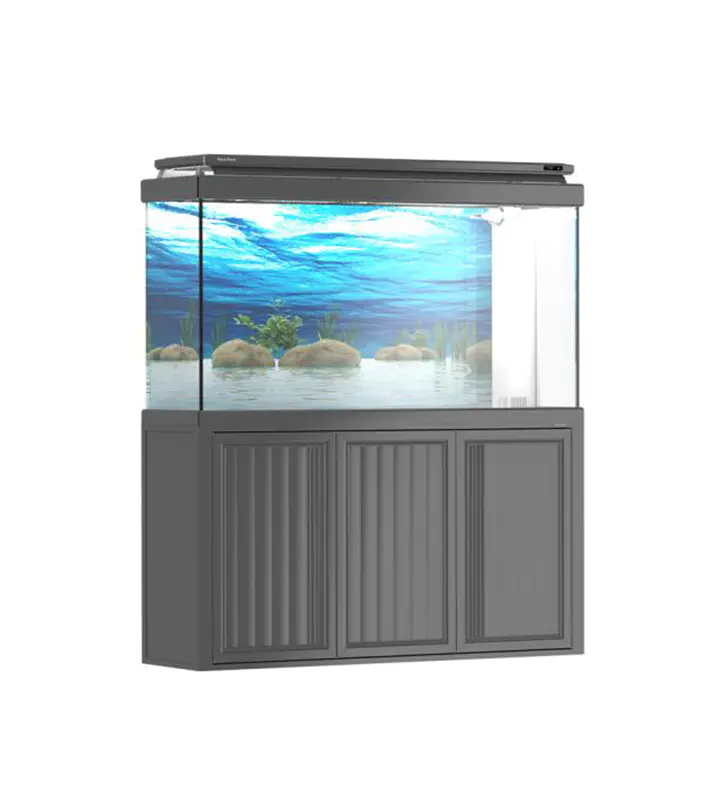
HMT Series Home Aquarium
The HMT Series belongs to the big fish tank category, but its design is more refined than that of a basic large aquarium. Conventional aquariums often require owners to select a cabinet, light, pump, filter, heater-control arrangement, and cable-management solution separately. This can lead to mismatched dimensions, visible equipment, complicated installation, and an appearance that is less suitable for carefully designed interiors.
The HMT Series addresses these issues through an integrated product architecture. The aquarium body, lower cabinet, lighting system, filtration arrangement, control equipment, and water circulation components are designed to work together. This integrated approach gives the product a more unified appearance and reduces the planning burden for the buyer.
The design language is elegant and streamlined. It avoids unnecessary decoration while using carefully selected proportions, neutral colors, and a frameless viewing concept. The aquarium is intended to function as both an aquatic habitat and a piece of home furniture. Its visual presence can complement living rooms, offices, reception areas, hospitality spaces, and other environments where the aquarium must look polished from multiple viewing angles.
Continuous quality improvement is a central aspect of the product concept. The series is offered in several configurations rather than as a single fixed model, allowing the same design platform to serve different volume requirements. Buyers can choose between ED and ID versions, different lengths, and different water capacities without abandoning the overall product style.
One of the most important advantages of a display aquarium is the quality of the viewing experience. The HMT Series uses ultra-white glass with a higher light-transmission rate than ordinary glass. This helps viewers see fish, plants, substrate, decorations, and water movement with greater clarity and more natural color reproduction.
Glass quality affects more than appearance. Standard glass can introduce a noticeable green tint, particularly when viewed through thicker panels or under bright lighting. That color shift may reduce the visual accuracy of fish coloration and aquatic plants. Ultra-white glass is selected to provide a cleaner and brighter presentation, making the aquarium more suitable for users who value display quality.
The large viewing area is supported by a bezel-less design. By reducing visual interruption around the front viewing surfaces, the aquarium creates a broad, panoramic perspective. The product material describes this as a large infinity view and a “4K” visual experience. In practical terms, the design is intended to make the aquarium appear more open, immersive, and visually continuous.
The frameless visual concept also gives aquascaping greater importance. A carefully arranged layout can be seen with fewer distractions from the structure of the tank. Fish movement, plant textures, rock formations, and lighting gradients can therefore become the primary focus. This is especially beneficial for aquarists who treat the aquarium as a living display rather than simply as a container for fish.
Compared with a conventional aquarium that uses a visually heavy frame, the HMT Series offers a cleaner presentation for contemporary interiors. It can also make a room feel more spacious because the open viewing surface allows the water environment to appear less enclosed. The result is a stronger connection between the aquatic display and the surrounding room.
The HMT Series is available in three principal colors: Milk White, Nano Grey, and Congo Teak. These choices are not merely cosmetic. The cabinet is a prominent part of the product, so its finish influences how the aquarium integrates with furniture, flooring, wall colors, and lighting in the room.
Milk White provides a bright and clean appearance. It is appropriate for interiors that emphasize openness, soft colors, contemporary furniture, or a light visual atmosphere. The finish can help the aquarium appear less visually heavy while highlighting the contrast between the cabinet and the water environment.
Nano Grey offers a more restrained and modern expression. Its neutral character can work well with darker flooring, metal details, concrete-inspired interiors, or minimalist spaces. The streamlined shape and subdued tone create an aquarium that is noticeable without dominating the room.
Congo Teak presents a warmer and more grounded appearance. Its wood-inspired character can complement natural materials, traditional furniture, warm lighting, and home environments that favor a more relaxed atmosphere. The design is deliberately simple, allowing the finish to express character without relying on excessive decorative elements.
This range gives the product an advantage over aquarium systems available in only one cabinet color. Buyers can select a finish that matches their existing design scheme instead of treating the aquarium as an isolated object. The same technical platform can therefore be used in very different interior settings.
Filtration is essential for maintaining water clarity and supporting a stable aquatic environment. The HMT Series uses a sink filtration arrangement that is integrated into the aquarium structure. This approach helps keep filtration equipment organized and reduces the need for external components that could disrupt the appearance of the display.
A sink filtration system is especially useful in a home aquarium because it can support a more orderly maintenance routine. Water is directed through the filtration area, where mechanical and biological treatment can take place as part of the circulation process. The integrated layout makes the system easier to understand than a collection of unrelated accessories connected around the tank.
The design also helps separate technical equipment from the main viewing area. Pumps, pipes, and filtration-related components can remain in the lower or rear service zones, allowing the front display to maintain a cleaner appearance. This separation benefits users who want strong filtration performance without exposing a large amount of equipment to view.
The HMT Series is supplied with model-specific water pumps. Depending on the configuration, the pump specification is either CQB-2000 at 35 watts or CQB-2500 at 45 watts. These pumps are selected according to the size and layout of the aquarium models. Matching the pump to the system reduces the need for buyers to calculate compatibility independently.
Compared with purchasing a tank and filtration system separately, an integrated filtration design can simplify installation and reduce the risk of choosing an undersized or incompatible pump. It also allows the manufacturer to account for the relationship between water volume, pipe routing, filtration space, and cabinet construction during product development.
Routine removal of solid waste is an important part of aquarium maintenance. The HMT Series includes a visualized waste precipitator designed to separate large particles of impurities from the circulating water. This component gives users a clearer view of collected waste and makes the maintenance process more direct.
The precipitator is intended to separate large-particle waste before it becomes dispersed throughout the filtration system. This can help reduce the burden placed on later filtration stages and make cleaning more convenient. By concentrating visible waste in a designated area, the user can identify when maintenance is required rather than relying only on changes in water clarity.
Its one-key discharge function is designed for fast and simple emptying. A convenient discharge method is valuable because maintenance systems are more likely to be used consistently when they do not require a complicated sequence of steps. Regular removal of collected waste can support cleaner operating conditions and reduce unnecessary accumulation in the filtration area.
The visualized design is also useful for new aquarium owners. Instead of hiding all waste inside an opaque filter box, it provides a more understandable indication of what the filtration system is removing. This can help users develop better maintenance habits and recognize the relationship between feeding, fish activity, waste production, and filtration demand.
In comparison with a basic aquarium that relies entirely on concealed filter media, the waste precipitator offers a more transparent maintenance process. It does not eliminate the need for water changes or routine filter care, but it makes one of the most visible maintenance tasks easier to observe and perform.
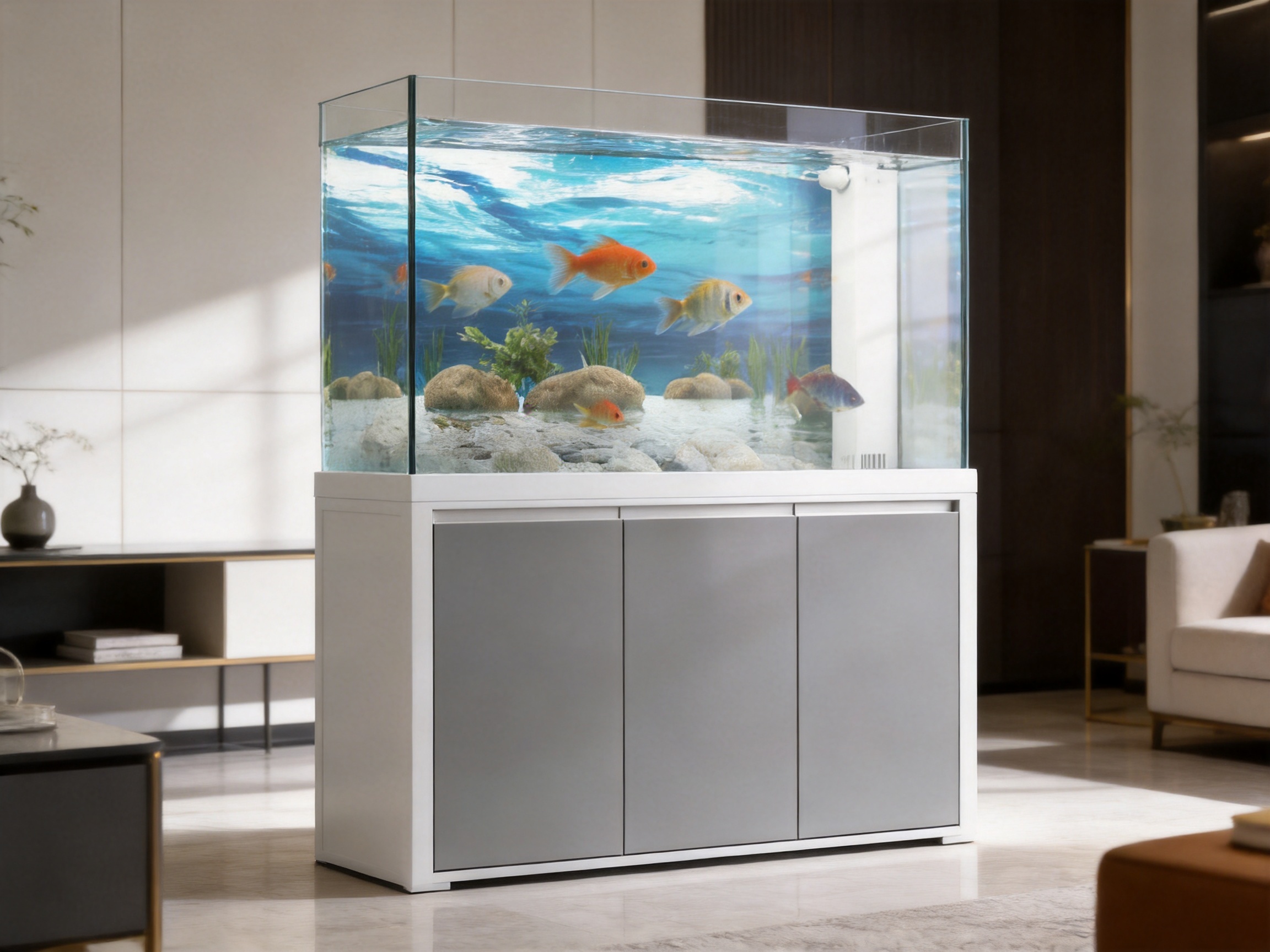
The HMT Series includes an AQ-192H touch-screen controller together with an AQ-130 cylinder component. The touch interface is intended to make daily operation more accessible by placing relevant functions and information in a centralized control environment.
The digital display supports real-time monitoring and touch-screen operation. This is a significant convenience improvement over aquarium systems that depend entirely on separate switches, hidden controls, or manually adjusted equipment. A centralized interface can make the status of the system easier to check, particularly when the aquarium is installed in a living area where convenience and appearance are both important.
The product information also highlights water-temperature protection. Temperature is a critical consideration in aquarium care because fish and aquatic organisms can be sensitive to sudden or unsuitable changes. While the aquarium still requires appropriate setup and monitoring for the specific species being kept, a temperature-protection function can provide an additional layer of operational reassurance.
A digital controller also supports a more modern user experience. Owners can interact with the system through a clear control surface rather than repeatedly opening the cabinet or searching for individual equipment switches. This is useful when managing lighting, reviewing system status, or checking whether the equipment is operating normally.
Compared with a conventional aquarium equipped with independent switches, the HMT Series offers better integration between operation and display. The control system is part of the product design rather than an afterthought. This contributes to a cleaner installation and can make the overall aquarium easier to manage.
Lighting influences the appearance of fish, aquatic plants, decorations, and water movement. The HMT Series uses high-bright LED lighting to illuminate the aquarium and enhance its visual impact. The product information emphasizes both brightness and energy-saving performance.
Different aquarium sizes use different LED configurations. The 600ED model uses one 6-watt LED unit, while the 800ED, 1000ED, 1200ED, and 1500ED models use one 9-watt, 13-watt, 20-watt, or 22-watt unit respectively. The ID models use two LED units, with wattage corresponding to the aquarium size. This model-specific arrangement provides a more appropriate relationship between light output and display dimensions.
High-bright LED technology helps create a vivid display while consuming less power than many older lighting technologies. Lower energy consumption can be valuable for an aquarium that operates for several hours each day. It may also reduce heat generation and contribute to more controlled operating conditions, although the aquarium should always be installed and operated according to the supplied instructions.
The lighting system is designed to show the aquarium beautifully at night. A warm, illuminated aquarium can become a distinctive interior feature after the surrounding room becomes darker. Fish movement and plant forms can remain visible while the tank provides a calm visual focus.
Professional aquarium lighting also offers a practical advantage over generic household lighting. Aquarium lights are selected for the special conditions of a water-filled display, including the need to illuminate the tank evenly and present aquatic colors attractively. A coordinated factory-supplied light reduces uncertainty about size, mounting, appearance, and compatibility.
The base cabinet performs several functions at the same time. It supports the aquarium, provides space for equipment and accessories, conceals technical components, and contributes to the overall appearance of the installation. The HMT Series uses a load-bearing base cabinet designed around the dimensions and weight requirements of the corresponding aquarium body.
A large aquarium contains a substantial volume of water, and water is heavy. The cabinet therefore needs to provide a stable support structure rather than merely serving as decorative furniture. The product information highlights a stable pivot-point load-bearing design intended to make the aquarium more secure.
The cabinet is also described as offering good heat insulation, waterproof performance, rust resistance, and corrosion resistance. These characteristics are important in an environment where water, humidity, condensation, and occasional splashing may occur. A cabinet designed for aquarium use should be better suited to these conditions than ordinary domestic furniture.
The enclosed base improves visual organization. Filtration equipment, pump connections, maintenance tools, and other accessories can be kept out of sight, leaving the upper display area uncluttered. This is a clear advantage over open stands or improvised furniture that exposes pipes and electrical components.
The number of cabinet doors depends on the model. The range includes single vertical doors, double vertical doors, and three vertical doors. This arrangement gives users different access patterns according to the width of the aquarium. Wider cabinets can provide more storage access without requiring one oversized door.
A properly matched cabinet also helps simplify installation. When the aquarium and base are developed as one system, their dimensions, proportions, and load-bearing relationship are planned together. Buyers do not need to search for a third-party stand that may have uncertain compatibility or insufficient support.
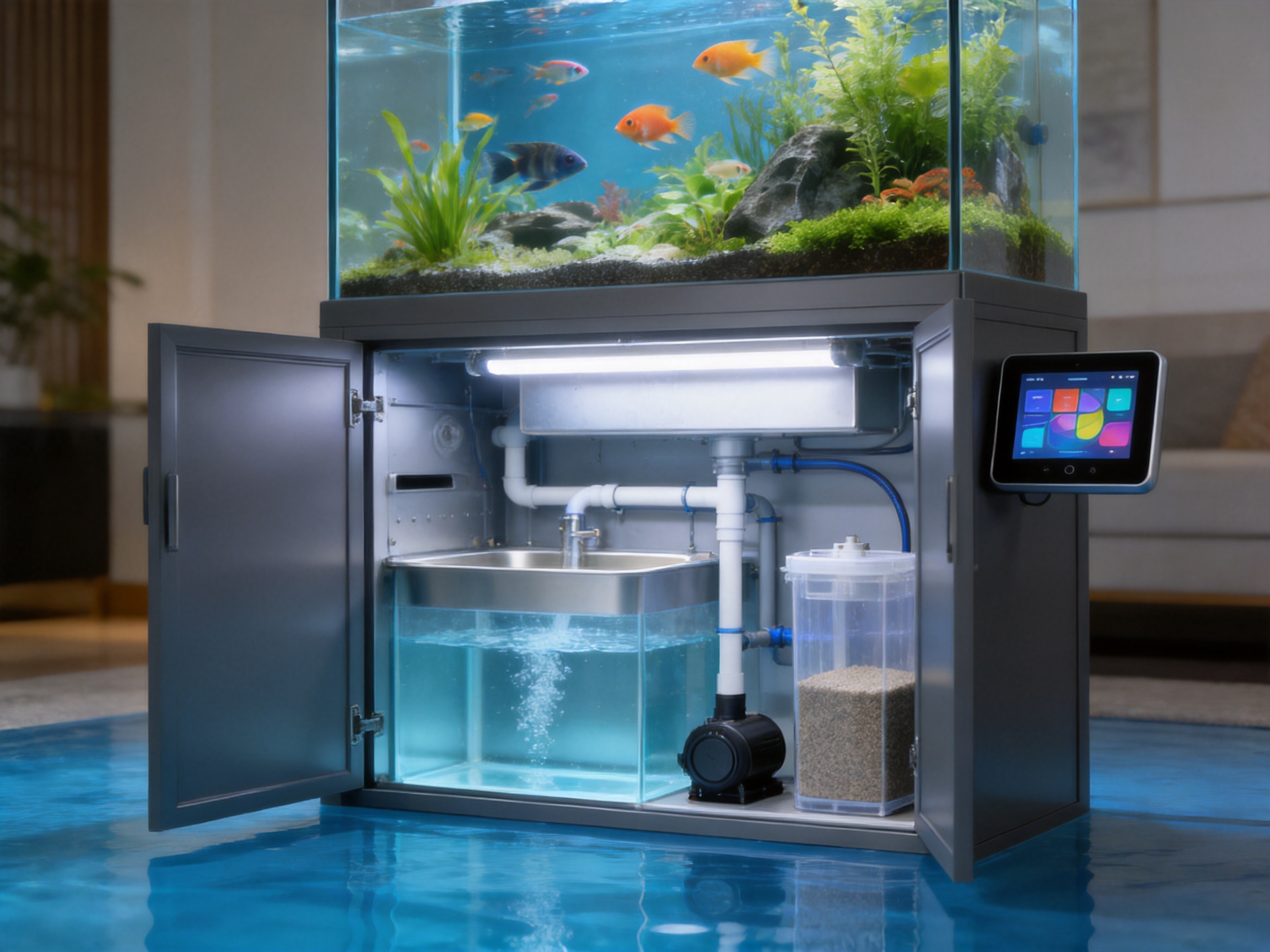
The HMT Series includes ED and ID configurations. The ED models have a narrower depth, while the ID models provide greater depth and therefore greater capacity in comparable lengths. This distinction allows buyers to select a tank based not only on length but also on the available floor area and desired aquascaping depth.
| Model | Cylinder Size | Base Cabinet Height | Capacity | Lamp Configuration | Water Pump |
| 600ED | 590 x 345 x 718 mm | 680 mm | 98 L | LED, 1 x 6 W | CQB-2000, 35 W |
| 800ED | 796 x 345 x 758 mm | 740 mm | 144 L | LED, 1 x 9 W | CQB-2000, 35 W |
| 1000ED | 995 x 345 x 758 mm | 800 mm | 181 L | LED, 1 x 13 W | CQB-2000, 35 W |
| 1200ED | 1190 x 345 x 758 mm | 800 mm | 220 L | LED, 1 x 20 W | CQB-2500, 45 W |
| 1500ED | 1508 x 345 x 758 mm | 800 mm | 281 L | LED, 1 x 22 W | CQB-2500, 45 W |
| 800ID | 796 x 415 x 758 mm | 740 mm | 177 L | LED, 2 x 9 W | CQB-2000, 35 W |
| 1000ID | 990 x 415 x 758 mm | 800 mm | 223 L | LED, 2 x 13 W | CQB-2500, 45 W |
| 1200ID | 1190 x 415 x 758 mm | 800 mm | 270 L | LED, 2 x 20 W | CQB-2500, 45 W |
| 1500ID | 1508 x 415 x 758 mm | 800 mm | 346 L | LED, 2 x 22 W | CQB-2500, 45 W |
The 600ED is the most compact model in the range, with a listed capacity of 98 liters. It may be suitable for users who want an integrated aquarium while working within tighter floor-space limitations. The longer ED models increase display length while maintaining a relatively narrow depth.
The ID models provide greater depth at similar lengths. For example, the 800ID has a listed capacity of 177 liters compared with 144 liters for the 800ED. The increased depth can give aquascapers more room for layered layouts, larger decorations, planted compositions, or more substantial swimming space.
The largest listed model is the 1500ID, with a capacity of 346 liters. This configuration is intended for users who want a more substantial display and have sufficient room for installation. Larger models also require more careful planning regarding floor strength, access, water management, and maintenance space.
The HMT Series is produced by Sensen Group Co., Ltd., a manufacturer with a long history in aquarium products, aquaculture machinery, industrial equipment, and related industries. The company was established in November 1985 and has developed its business through continuous product innovation and broad manufacturing activity.
A major strength of an established manufacturer is the ability to combine knowledge from several product categories. Aquarium systems require more than glass fabrication. They also involve pumps, lighting, controllers, cabinets, filtration structures, electrical components, water circulation, materials engineering, and quality control. Experience across these areas can support more coordinated product development.
The company operates functional departments that include a research institute, business school, quality control department, personnel and administrative information department, and financial department. The presence of a dedicated research function indicates an organized approach to product development rather than reliance only on basic assembly. A quality control department is also important for checking consistency across materials, components, and finished products.
The company has established wholly owned subsidiary corporations and maintains a wide organizational structure. This broader network can provide manufacturing and operational resources for product development, production, distribution, and service. It also reflects the scale required to support a diverse catalog that includes aquarium pets, aquaculture machinery, industrial equipment, water pumps, air pumps, aquarium accessories, and garden equipment.
For a product such as the HMT Series, manufacturing capability is important because many components must operate together. The glass must align with the support cabinet. The cabinet must accommodate filtration and electrical equipment. The pump must suit the water volume and circulation design. The lighting must fit the display dimensions. The controller must function as part of the overall system. A manufacturer with experience across these product areas is better positioned to coordinate these relationships.
The company’s stated development direction includes industrial technicalization, marketing globalization, and brand internationalization. These goals suggest an effort to combine technical product development with broader market support. For buyers and distributors, this can be valuable because a sophisticated aquarium is easier to purchase and operate when documentation, product configuration, distribution, and after-sales communication are also organized.
A home aquarium must be evaluated as a system rather than as a single decorative object. Important quality considerations include glass clarity, structural alignment, cabinet stability, sealing, water circulation, electrical safety, lighting consistency, controller performance, and resistance to the humid aquarium environment.
The HMT Series product architecture supports a coordinated quality-control approach. The aquarium, cabinet, lighting, controller, pump, and filtration components are specified together. This gives the manufacturer a defined set of relationships to inspect during production and assembly.
The load-bearing cabinet is particularly important because the water volume creates considerable weight. A stable support point and correctly aligned cabinet help distribute the load. Users should still install the aquarium on a level, adequately supported surface and follow all assembly and placement instructions.
Water resistance and corrosion resistance are also significant for long-term usability. The cabinet may be exposed to moisture during filling, maintenance, or accidental splashing. Materials and surface treatments that are intended for this environment can provide a practical advantage over ordinary home furniture.
Silent operation is listed as one of the product features. Quiet performance matters because the aquarium may be installed in a living room, bedroom, office, or relaxation area. Pump noise and vibration can become distracting when an aquarium operates continuously. A quieter system improves comfort and makes the aquarium more suitable for spaces where people rest or work.
As with any aquarium, silent operation depends on correct installation, water level, pump condition, pipe positioning, and routine maintenance. Even a well-designed product should be checked periodically for vibration, blockages, air intake, and component wear.
The HMT Series has several practical advantages when compared with a basic aquarium sold without integrated furniture or equipment. The first is reduced selection complexity. Buyers do not need to separately identify an appropriate stand, light, pump, controller, and filtration arrangement.
The second advantage is visual unity. A separate aquarium and aftermarket cabinet may have different widths, finishes, or proportions. Independent accessories can create visible cables, exposed pipes, or equipment that does not fit the intended interior. The HMT Series is designed as one coordinated installation.
The third advantage is maintenance accessibility. The visualized waste precipitator, touch-screen controller, and integrated filtration area are intended to make key tasks easier to understand. These elements do not remove the need for regular maintenance, but they can make the routine more organized.
The fourth advantage is configuration choice. The series includes compact, medium, and large options, as well as narrow and deeper versions. A single basic aquarium platform may not offer this range. With the HMT Series, the buyer can select a model according to room dimensions, capacity, and aquascaping goals.
The fifth advantage is a higher-quality display presentation. Ultra-white glass, bezel-less viewing, and professional LED lighting work together to improve clarity and visual impact. This is particularly valuable for buyers who regard the aquarium as a central interior feature.
The sixth advantage is product support from an experienced manufacturer. A company with decades of industry experience and dedicated research and quality-control functions can offer a stronger foundation for product development than an occasional furniture supplier or an unrelated household-goods manufacturer.
These advantages should not be understood as a guarantee that every aquarium environment will produce the same result. Species selection, biological filtration, water chemistry, stocking levels, maintenance frequency, installation quality, and user practices all affect performance. However, the HMT Series provides a more complete technical and visual foundation than a simple tank-only solution.
Before installation, buyers should confirm that the selected model fits the intended location. The length, depth, cabinet height, access space, electrical outlet position, and maintenance clearance should all be considered. Larger models require particular attention to floor strength and delivery access.
The aquarium should be placed on a stable and level surface. The base cabinet must be assembled and positioned correctly before the tank is filled. Because water weight is substantial, the aquarium should never be placed on improvised furniture or a support structure that has not been designed for aquarium use.
Electrical connections should be kept dry and arranged in a way that prevents water from traveling along cables toward outlets or control equipment. Users should follow the product instructions for pump operation, lighting, controller use, and maintenance. The cabinet should not be overloaded with unrelated items that could interfere with ventilation, pipe routing, or access to equipment.
Once installed, the aquarium can be operated as a complete display system. The LED lighting can emphasize fish and aquascaping features, the pump can circulate water through the filtration system, and the digital controller can provide access to operating information. The cabinet keeps many components organized and out of direct sight.
Routine maintenance should include checking water level, inspecting the pump, removing collected waste, cleaning appropriate filter components, observing fish behavior, and performing water changes according to the needs of the aquarium inhabitants. The one-key discharge function of the waste precipitator can make visible waste removal faster, but it is not a replacement for full aquarium maintenance.
Owners should also inspect the cabinet for moisture, confirm that doors remain aligned, and check for unusual vibration or sound. Early attention to small issues can help preserve the appearance and operating condition of the system.
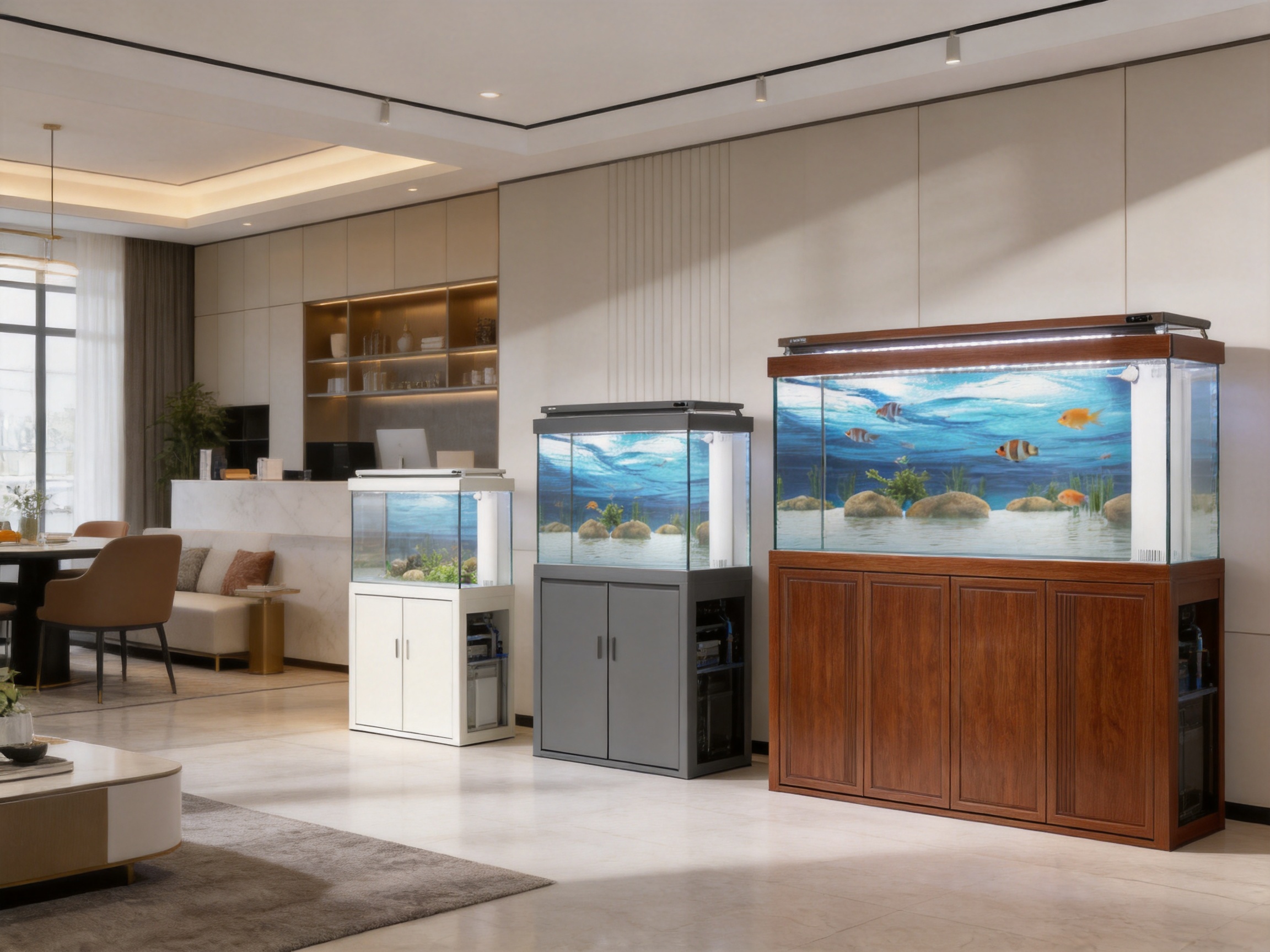
The HMT Series is primarily suited to home use, but its integrated appearance can also work in offices, hotel reception areas, restaurants, retail stores, educational spaces, and professional waiting areas. The aquarium can serve as a visual focal point while contributing to a more welcoming environment.
In a living room, the aquarium can function as a furniture feature positioned against a wall or used as part of a larger interior arrangement. The Milk White finish may suit bright contemporary rooms, Nano Grey may coordinate with modern commercial interiors, and Congo Teak may complement warm residential décor.
In an office or reception area, the bezel-less viewing design can provide a polished first impression. The integrated cabinet prevents the equipment from appearing unfinished, while the digital controller and organized filtration design support more professional operation.
In hospitality spaces, the aquarium can add movement and color without requiring extensive architectural modification. However, commercial users should establish a clear maintenance schedule because public-facing aquariums typically experience longer operating hours and higher expectations for visual cleanliness.
The product’s model range makes it possible to select a size appropriate to the space. Smaller models can fit more limited rooms, while 1200 mm and 1500 mm versions can create a stronger visual presence in larger areas. The ID versions may be particularly useful when a deeper aquascape is desired.
Buyers should begin with available floor space. Measure the proposed installation area, including clearance for cabinet doors, cleaning access, electrical connections, and movement around the aquarium. A model should not be selected solely by its tank length.
Next, consider capacity. The 600ED provides a listed capacity of 98 liters, while the largest 1500ID provides 346 liters. Greater capacity can offer more flexibility for fish and aquascaping, but it also increases water weight, maintenance requirements, and initial setup demands.
Depth is another important factor. ED models have a listed depth of 345 mm, while ID models have a listed depth of 415 mm. The deeper ID format can provide more room for plant placement, rock structure, and layered visual composition. The narrower ED format may be easier to accommodate in corridors, apartments, or rooms with limited floor depth.
Lighting requirements should also be considered. The product range uses different LED configurations according to model size. ID models use two LED units, while ED models use one unit. Buyers interested in heavily planted displays should confirm that their selected configuration is appropriate for the intended plants and consult professional aquarium guidance if necessary.
Finally, select the cabinet finish that best matches the room. Because the cabinet is a large visible surface, the color can have as much influence on the interior as the aquarium itself.
The HMT Series Home Aquarium is an integrated aquarium system that combines an ultra-white glass tank, LED lighting, sink filtration, water circulation, a digital controller, a waste precipitator, and a load-bearing base cabinet. It is designed for home display and organized aquarium management.
The listed configurations include 600ED, 800ED, 1000ED, 1200ED, 1500ED, 800ID, 1000ID, 1200ID, and 1500ID. Capacities range from 98 liters to 346 liters.
The main listed difference is depth. ED models have a cylinder depth of 345 mm, while ID models have a depth of 415 mm. The deeper ID models provide higher capacities at comparable lengths and may offer more aquascaping space.
The available colors are Milk White, Nano Grey, and Congo Teak. Each finish is intended to suit a different interior style, from bright contemporary rooms to neutral modern spaces and warmer wood-oriented décor.
Yes. The HMT Series includes high-bright LED lighting. The wattage and number of LED units vary according to the selected model.
Yes. The listed pump options are CQB-2000 at 35 watts and CQB-2500 at 45 watts. The pump configuration depends on the aquarium model.
The visualized waste precipitator separates large particles of impurities from the water circulation system. It includes a one-key discharge function intended to make waste removal faster and easier.
Yes. The product includes an AQ-192H touch-screen controller with an AQ-130 cylinder component. The controller is intended to support real-time monitoring and touch-screen operation.
The ultra-white glass and professional LED lighting can support an attractive planted display. However, plant selection and growth depend on lighting intensity, photoperiod, nutrients, carbon availability, water parameters, and maintenance. Users should select plants and settings appropriate to their specific aquarium plan.
Yes. The base cabinet is designed as part of the aquarium system. It is described as load-bearing and is intended to provide heat insulation, waterproof performance, rust resistance, and corrosion resistance.
The HMT Series provides a more complete solution. It includes coordinated support furniture, filtration, lighting, pumping, control, and waste management rather than requiring the buyer to source each component separately.
Yes. The integrated features simplify selected maintenance tasks but do not eliminate the need for water changes, filter care, pump inspection, water-quality monitoring, and responsible stocking.
The product is manufactured by Sensen Group Co., Ltd., an established company involved in aquarium products, aquaculture machinery, industrial equipment, pumps, and related industries.
The HMT Series Home Aquarium is a complete display and management platform for buyers who want more than a basic glass tank. Its strongest advantages come from integration: ultra-white glass improves the viewing experience, the bezel-less design creates a panoramic appearance, professional LED lighting adds color and nighttime atmosphere, and the sink filtration system keeps technical functions organized.
The visualized waste precipitator supports simpler waste removal, while the touch-screen controller provides a modern operating interface. The load-bearing cabinet is designed to support the aquarium safely while providing storage and concealing equipment. Multiple lengths, capacities, depths, cabinet heights, door arrangements, and finishes allow the series to serve a broad range of rooms and aquarium plans.
The product is also supported by the manufacturing background of Sensen Group Co., Ltd., a company with decades of activity in aquarium products, aquaculture machinery, industrial equipment, and related fields. Its research, quality-control, manufacturing, subsidiary, and distribution resources provide a foundation for developing coordinated aquarium systems rather than isolated components.
For users seeking a refined home aquarium with an organized technical structure and furniture-like appearance, the HMT Series offers a practical and visually strong option. Its success in operation will still depend on correct installation, suitable livestock, responsible stocking, and regular maintenance, but the integrated design gives owners a more convenient starting point and a cleaner long-term aquarium environment.
1. HMT Series Home Aquarium product specification and feature materials supplied for this article.
2. HMT Series product parameter table, including model dimensions, capacities, lighting configurations, pump specifications, cabinet heights, and door arrangements.
3. Sensen Group Co., Ltd. company profile and corporate information supplied for this article.
4. General aquarium maintenance principles concerning filtration, water circulation, lighting, cabinet support, and routine waste removal.
5. General product-design considerations for integrated aquarium systems, including glass clarity, equipment coordination, moisture resistance, and user accessibility.


 No. 61-79, Baima Street, Maao Town, Dinghai District, Zhoushan City, Zhejiang Province, China.
 0086 580 8082088 / 8081168
 0086 580 8080978
 songhua@sunsun-china.com