

 English
 русский
 España
 Portugal
 عربي
Chen Xiao | Customer Service & After-Sales Coordinator
Home / Author / Chen Xiao | Customer Service & After-Sales Coordinator / A More Thoughtful Habitat for Aquatic Turtles: Design, Materials, Space, and Manufacturing Strengths
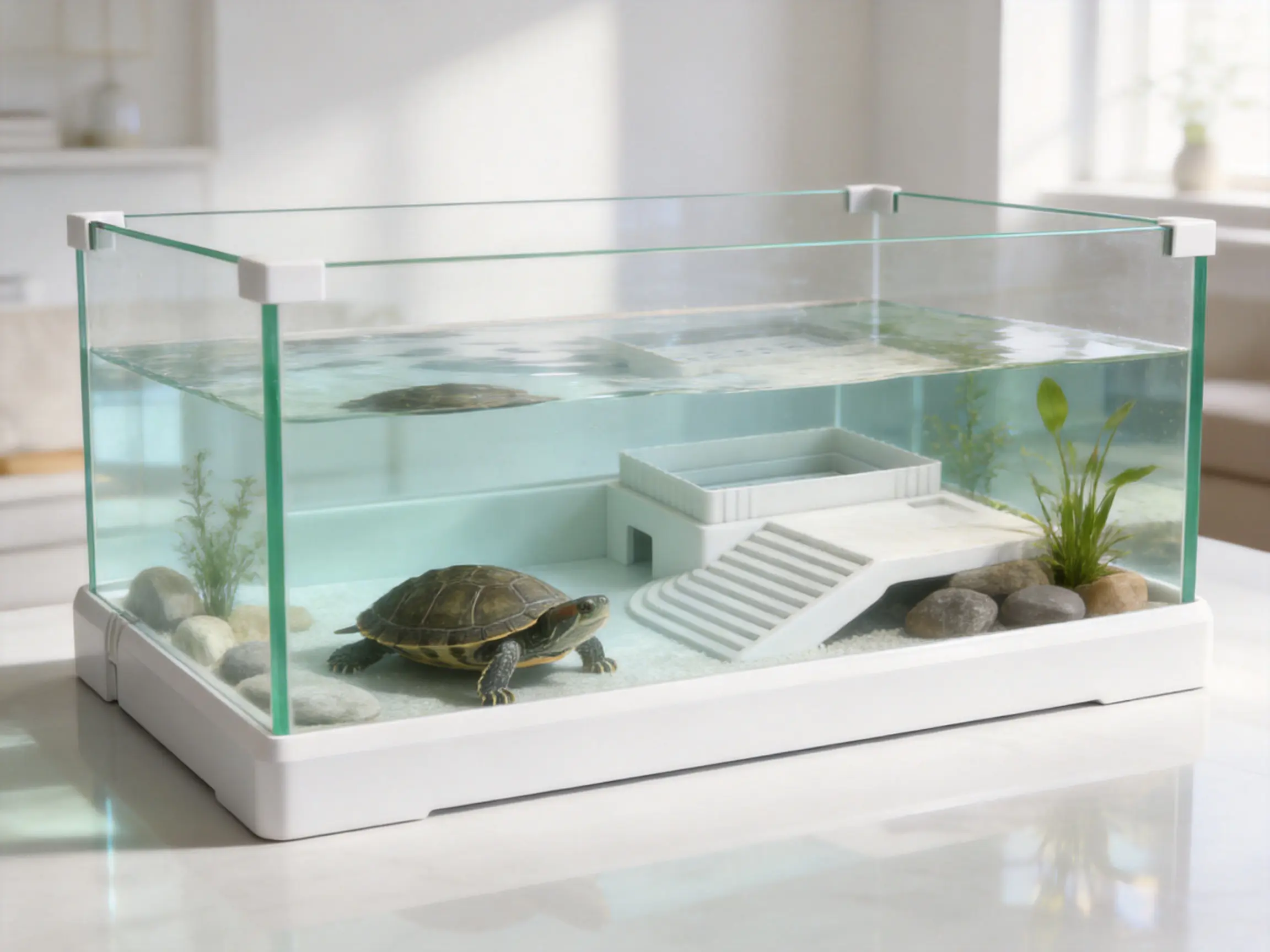
Keeping aquatic turtles successfully requires more than placing an animal in a container filled with water. A suitable habitat must balance swimming space, dry areas, visibility, maintenance, structural stability, and the everyday needs of both the animal and its keeper. The XGG Ecological Turtle Tank has been developed around this broader understanding of turtle care. It is designed to provide a more organized, spacious, and visually clear environment than a basic temporary tub or an ordinary glass aquarium used without modification.
The product belongs to the Xiaoli Sunsun range and is identified as the Eco Turtle Tank. Its main material is ultra-white glass, a choice that gives the enclosure a cleaner visual appearance and supports a clearer view of the turtle and its habitat. The available models are listed as XGG-400/500 and XGG-450/XGG-500, with stated dimensions of 390 × 270 × 170 mm and 490 × 310 × 195 mm. These size options allow keepers to select a compact or larger format according to the turtle’s size, the available placement area, and the intended layout.
Although turtle tanks are sometimes treated as simple products, their design involves several practical considerations. Turtles are active animals that need room to move, climb, rest, and interact with their surroundings. Their habitat also becomes wet, dirty, and frequently handled. A well-planned enclosure therefore needs to be easy to observe, reasonably convenient to maintain, and strong enough for regular household use. The XGG Ecological Turtle Tank addresses these expectations through a combination of ultra-white glass, a multifunctional concept, increased internal space, and an optimized structural approach.
Content
A conventional aquarium is primarily designed to hold water and display fish. A turtle enclosure has a different purpose. Depending on the species and life stage, a turtle may need both aquatic and resting areas. It may also climb, push against surfaces, search for food, and create more visible waste than many ornamental fish. These behaviors make layout and access important parts of the ownership experience.
A basic container can be inexpensive and useful for temporary care, but it often provides limited visibility and little opportunity for an organized habitat. A standard aquarium may offer a larger water volume, yet it may not be convenient for creating a turtle-oriented arrangement. Equipment, platforms, decorations, and maintenance tools can take up valuable room. If the structure is not planned carefully, the turtle may have less usable space than the external dimensions suggest.
The XGG Ecological Turtle Tank is intended to move beyond the idea that raising turtles means simply providing a box of water. Its product description emphasizes multifunctional design, broad use, increased space, and structural optimization. These principles are important because the useful capacity of a habitat depends not only on its outer dimensions but also on how effectively the interior is organized.
For the keeper, good design can make routine observation easier. Clear panels allow the turtle’s activity, feeding behavior, movement, and general condition to be seen without unnecessary disturbance. For the animal, a more thoughtfully planned enclosure can provide a greater range of movement and a more comfortable division between aquatic and resting functions. For the home, an attractive, clean-looking tank can be integrated into a living space more easily than an improvised container.
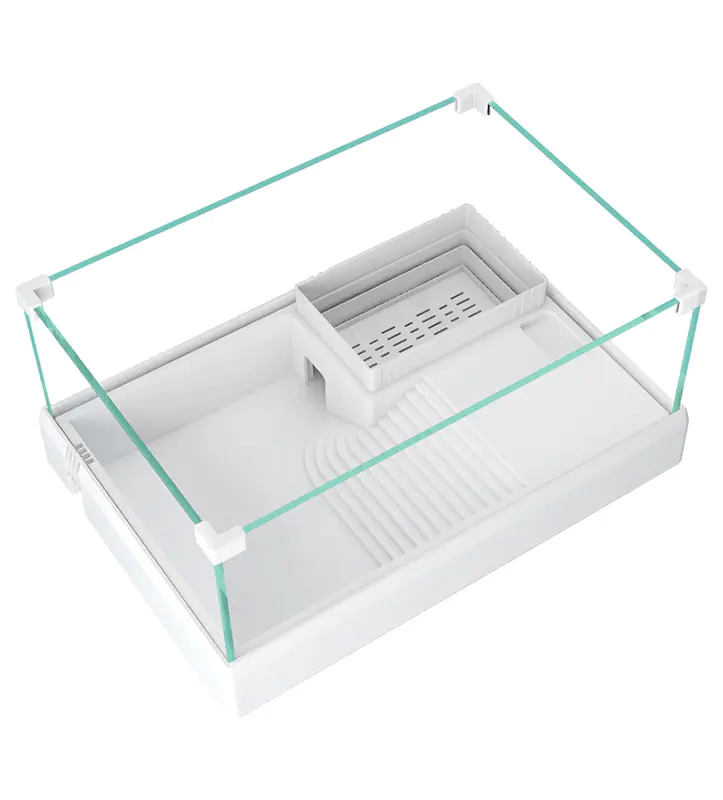
XGG ecological turtle tank
One of the most important stated features of the XGG Ecological Turtle Tank is its ultra-white glass construction. The term refers to glass with a particularly clear visual quality and reduced color distortion compared with ordinary glass. In an aquarium or turtle enclosure, this material choice changes the way the entire habitat is perceived.
Ordinary glass can introduce a noticeable green tint, particularly when viewed through thicker sections or across the edges of a larger panel. That tint may alter the appearance of water, substrate, plants, decorations, and the turtle itself. Ultra-white glass provides a more neutral viewing experience. Colors appear cleaner, details are easier to distinguish, and the enclosure can feel brighter and more open.
Clear viewing is not only an aesthetic benefit. It can support everyday care by making it easier to observe the animal. A keeper can monitor whether the turtle is active, identify changes in shell appearance, check the cleanliness of the habitat, and notice whether objects have shifted. A clear enclosure can also make children and visitors more interested in responsible animal care because the habitat is easier to understand visually.
Compared with an opaque storage box or a low-clarity plastic container, ultra-white glass offers a more display-oriented experience. It allows the turtle and its environment to become part of the room rather than hiding the animal from view. Compared with an ordinary aquarium, the clearer material can create a more refined presentation and reduce the visual distraction caused by glass coloration.
Glass also has a smooth, non-porous surface that is suitable for regular cleaning when handled correctly. Water marks, sediment, and residue can be seen more easily on a clear surface, allowing maintenance to be performed before the enclosure becomes heavily soiled. The keeper should still use appropriate aquarium-safe cleaning methods and avoid abrasive tools that could scratch the panels.
The product’s ultra-white glass is therefore not merely a decorative specification. It contributes to visibility, presentation, care awareness, and the overall impression of quality. These advantages are especially relevant for people who want a habitat that functions as both an animal enclosure and a visible feature in the home.
The product description presents the XGG Ecological Turtle Tank as multifunctional and suitable for broad use. This language reflects an important difference between a simple tank and a habitat designed around the practical realities of turtle keeping. A multifunctional tank is expected to support more than one activity or arrangement. It should be suitable for holding water, presenting a resting environment, accommodating basic habitat accessories, and making routine observation more convenient.
Multifunctionality does not mean that every possible accessory is automatically included. The supplied product information identifies the tank itself, its material, model information, dimensions, and an installation video. It does not specify a complete filtration system, lighting set, heater, platform, decoration package, or other accessories. Buyers should therefore confirm the exact package contents and compatibility requirements before ordering.
What the design concept does provide is a foundation for a more flexible setup. The owner can plan the interior according to the turtle’s size and needs, while using suitable accessories where necessary. The tank can be arranged as a simple aquatic habitat, a more developed turtle display, or a growing setup that changes as the animal becomes larger. This flexibility gives the product a wider practical life than a highly specialized enclosure that cannot be adapted.
A multifunctional turtle tank can also be useful for different household users. A new keeper may begin with a relatively simple arrangement and add appropriate components as experience increases. A more experienced hobbyist may use the available space to create a carefully separated aquatic and resting area. Families may value the clear display and accessible format, while dedicated keepers may appreciate the opportunity to organize the habitat around particular species requirements.
At the same time, responsible ownership remains essential. The tank does not replace research into the turtle species, water quality, temperature, nutrition, lighting, hygiene, or adult size. Its role is to provide a well-considered physical environment in which those care practices can be carried out more effectively.
The product information highlights increased space and structural optimization as central design ideas. These features are closely connected. More external volume is valuable only when the internal layout makes that volume usable. A tank that wastes space through awkward partitions, limited access, or unsuitable proportions may not serve the animal as well as its measurements suggest.
The stated dimensions are 390 × 270 × 170 mm and 490 × 310 × 195 mm. These measurements indicate two general size formats: a smaller version for limited spaces or smaller turtles, and a larger version for users who need additional room. Because turtle species and growth rates vary significantly, the correct model should be selected according to the animal’s present size and expected development, rather than by appearance alone.
More usable space can benefit turtle movement. A turtle should have enough room to change direction, explore, reach food, and move between different parts of the habitat without constant obstruction. Space also gives the keeper greater freedom to place suitable features without making the environment overcrowded. When every accessory is compressed into a small footprint, water circulation, cleaning, and observation may become more difficult.
Structural optimization can also improve the visual balance of the enclosure. A well-proportioned tank appears less cluttered and makes the animal easier to see. The keeper can arrange habitat elements in a more deliberate way, leaving open areas for movement rather than filling the entire tank with unnecessary decoration. This is particularly valuable for turtles because open swimming or movement zones are often more useful than an excessive number of decorative objects.
Compared with an improvised container of similar size, an optimized tank offers a more intentional user experience. The design is made for display and animal keeping rather than for general storage. Compared with an ordinary aquarium that may require extensive modification, a turtle-focused product can reduce the need to improvise the basic enclosure format. These are meaningful advantages for new owners who want a clear starting point.
The XGG Ecological Turtle Tank should be considered in relation to the alternatives available to turtle keepers. Each alternative has a place, but the product’s advantages become clearer when the differences are examined by material, purpose, appearance, and adaptability.
| Comparison factor | Basic plastic container | Ordinary aquarium | XGG Ecological Turtle Tank |
| Primary design purpose | General storage or temporary holding | Usually designed for fish and aquatic display | Designed around a turtle habitat concept |
| Viewing quality | May be limited by scratches, cloudiness, or opacity | Generally clear, but may show ordinary glass coloration | Uses ultra-white glass for a cleaner visual presentation |
| Interior planning | Often requires improvised arrangements | May need modification for resting and turtle-oriented functions | Supports a more deliberate, multifunctional setup |
| Space utilization | Depends heavily on the shape of the container | May prioritize fish display proportions | Promotes increased usable space and optimized structure |
| Display value | Usually practical rather than decorative | Often attractive but not necessarily turtle-specific | Combines habitat function with a refined display appearance |
| Adaptability | Simple but limited in presentation and organization | Can be adapted, often with additional effort | Provides a purpose-oriented base for different arrangements |
A plastic container may remain useful for quarantine, transport, temporary separation, or short-term care. It can also be economical. However, it is usually not intended to be a permanent display habitat. It may become scratched, difficult to view, or visually out of place in a living area. It may also require additional work to create a stable and attractive setup.
An ordinary aquarium offers clear advantages in availability and familiarity. Many aquarium products are strong, well-established, and available in numerous sizes. However, a fish tank is not automatically optimized for turtles. The keeper may need to add a platform, modify the interior, manage access, and ensure that the arrangement remains suitable for a turtle’s behavior. The XGG product differentiates itself by beginning with a turtle-oriented design objective rather than adapting a fish-oriented enclosure after purchase.
The strongest competitive advantage of the XGG Ecological Turtle Tank is therefore the combination of clarity, purpose, and design direction. It is not promoted merely as a glass box. It is presented as an ecological turtle tank that increases space, optimizes structure, and supports broader use. These qualities can reduce the gap between functional care and attractive presentation.
The supplied specifications mention the models XGG-400/500 and XGG-450/XGG-500. The product information also lists two dimensional formats: 390 × 270 × 170 mm and 490 × 310 × 195 mm. Because model naming in product materials can sometimes be presented in more than one format, buyers should verify the exact model code, dimensions, package contents, and available options with the supplier before placing an order.
The smaller size may be appropriate for a compact home, a juvenile turtle, or a carefully managed temporary stage, depending on the species and care requirements. The larger size offers more room for movement and habitat organization. However, neither size should be considered universally suitable for every turtle. A species that grows large may eventually require a substantially larger enclosure, and a small tank should not be treated as a permanent solution when the animal’s adult requirements exceed its capacity.
Placement is another important consideration. The support surface should be level, stable, and capable of carrying the weight of the tank, water, substrate, and accessories. Glass products should not be placed where they can be struck by doors, furniture, or falling objects. They should also be positioned away from excessive heat and direct sunlight unless the owner has carefully evaluated temperature control and algae management.
A visible location can improve observation, but high-traffic areas may create stress if the turtle is constantly disturbed. A balanced placement allows the keeper to inspect the habitat easily while giving the animal a degree of visual security. The tank should be kept within reach for maintenance without being placed where children or pets can overturn accessories or interfere with the animal.
When selecting between the available size formats, owners should consider the turtle’s current shell length, anticipated growth, water depth, resting needs, filtration requirements, available floor area, and maintenance routine. The best choice is not necessarily the largest product available, but the model that provides a responsible and manageable habitat for the specific animal.
The quality of a turtle tank depends not only on its visible design but also on the organization and experience of the company that produces it. The product is associated with Sensen Group Co., Ltd., a manufacturer with a long history in aquarium-related products, aquatic machinery, industrial equipment, and pet products. The company states that its group was established in November 1985 and has continued developing across multiple product fields for more than three decades.
This history is relevant because aquarium products require practical knowledge of water environments, equipment integration, materials, packaging, and distribution. A company active in the aquarium sector is more likely to understand the difference between a decorative container and a habitat product used in a wet, frequently maintained environment. Experience across aquarium pets and aquatic machinery can support more informed product development and quality-control procedures.
The company describes a broad organizational structure that includes a research institute, business school, quality control department, personnel and administrative information department, and financial department. It also identifies several wholly owned subsidiaries and an import and export company, along with holdings in multiple trading companies. These details indicate an enterprise with dedicated functional departments rather than a small operation focused only on assembly or resale.
A dedicated research function can contribute to product improvement by collecting market feedback, studying user requirements, and refining designs. For the XGG Ecological Turtle Tank, this type of organizational support is relevant to features such as material selection, panel presentation, structural proportions, packaging, and the practical needs of turtle keepers. A quality control department can provide an additional layer of process supervision, helping ensure that products are reviewed according to internal requirements before reaching customers.
The company also states that it has developed a substantial domestic sales network, including aquarium stores with unified decoration, and that it is integrating online and offline retail through the Sensen House application. A broad sales network can provide valuable feedback because products are used by many different customers in varied environments. This feedback may help identify common maintenance questions, preferred sizes, packaging concerns, and opportunities for future improvements.
Its import and export structure is also relevant to international buyers. Export-oriented companies must pay attention to product documentation, communication, packaging, shipping conditions, and the expectations of different markets. These capabilities can make the purchasing process more organized for distributors and professional buyers. Product specifications should still be confirmed in writing, but the company’s stated structure provides a foundation for international supply and service.
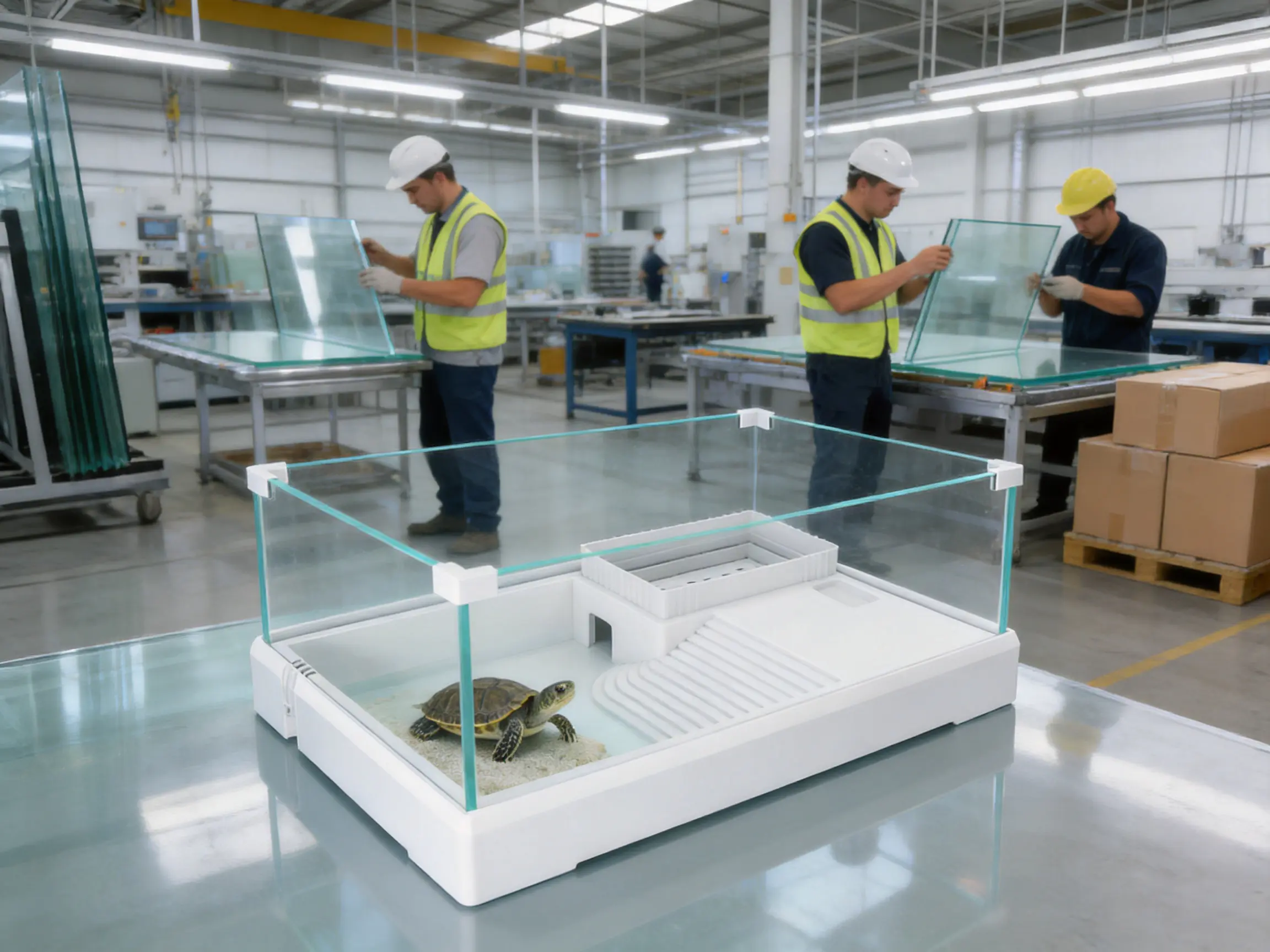
In the context of the XGG Ecological Turtle Tank, advanced manufacturing should be understood as the coordination of material selection, design development, quality control, production management, and distribution support. It is not limited to a single machine or production step. A high-quality enclosure requires a chain of decisions, beginning with the design concept and continuing through glass processing, assembly, inspection, packaging, and delivery.
Ultra-white glass must be selected and handled with attention to clarity, dimensions, surface condition, and edge quality. Panels need to be prepared accurately so that the finished tank has the intended proportions. Assembly must be managed carefully because the product will hold water and will be handled during cleaning and relocation. Inspection is important for identifying visible defects, uneven joints, damage, or packaging problems before shipment.
Structural optimization also depends on controlled production. If the dimensions vary excessively between units, accessories and packaging may not fit consistently. If the assembly process is not stable, the final appearance may differ from the intended design. A company with dedicated quality-control functions and experience in aquarium manufacturing is better positioned to establish repeatable procedures for these issues.
Manufacturing strength also includes the ability to connect research with production. A product concept becomes commercially useful only when it can be made consistently, packaged safely, and delivered efficiently. The company’s stated industrial, aquatic, and aquarium experience provides a broader technical base than a manufacturer that produces glass containers without understanding aquatic applications.
For distributors, consistency is especially important. Retailers need dependable product identification, stable dimensions, clear packaging, and reliable information for customers. For end users, the benefit appears as a product that is easier to install, easier to present, and more predictable in everyday use. While no product should be considered maintenance-free, good manufacturing discipline can reduce avoidable inconvenience.
The company’s long-term development philosophy also emphasizes industrial technicalization, marketing globalization, and brand internationalization. These goals suggest an intention to combine technical product development with wider market service. For the XGG Ecological Turtle Tank, that combination supports both the physical product and the information needed to sell, install, and maintain it in different markets.
The product information includes an installation video, which can be useful during preparation. Users should follow the official installation guidance and inspect the tank before adding water or animals. If the package includes components that are not described in the available material, the instructions supplied with those components should be followed separately.
Before installation, select a stable, level surface. Check that the support area is large enough for the complete base of the tank. Do not allow the tank to overhang the edge of a shelf or cabinet. Confirm that the surface is free of grit, screws, moisture, and other materials that could create uneven pressure beneath the glass.
After positioning the empty tank, inspect the panels and joints under good lighting. Look for visible chips, cracks, severe scratches, or signs of transport damage. Any concern should be documented and reported to the supplier before the tank is filled. A careful inspection at this stage is safer and easier than trying to correct a problem after water, substrate, and accessories have been added.
Rinse the interior with clean water and use only aquarium-appropriate cleaning methods. Household detergents, solvents, disinfectants, and fragranced products may leave residues that are harmful to aquatic animals. If a cleaning agent is ever required, it should be specifically identified as safe for the intended use and removed thoroughly according to its instructions.
Plan the habitat before filling the tank. Decide where the aquatic area, resting area, accessories, and equipment will be placed. Avoid creating sharp edges, unstable piles, narrow gaps, or climbing routes from which the turtle could fall. Any platform or decoration must be stable and suitable for the turtle’s size. It should not be able to tip over, trap the animal, or damage the glass.
Fill the tank gradually and observe whether the structure, accessories, and support surface remain stable. Check for leaks and confirm that the water level is appropriate for the turtle and the planned habitat arrangement. Do not introduce the turtle immediately if the water quality, temperature, or equipment settings have not been prepared.
A well-designed tank can make maintenance more organized, but it cannot eliminate the need for regular care. Turtle habitats often require attention to waste removal, water quality, surface cleaning, odor control, and equipment condition. A clear glass enclosure makes visible maintenance easier because dirt and residue are less likely to remain unnoticed.
Remove uneaten food and obvious waste promptly. Establish a water-changing routine based on the turtle’s species, water volume, filtration, feeding pattern, and test results. Water should not be judged by appearance alone. Clear water can still contain undesirable chemical conditions, while slightly cloudy water may have a temporary cause that requires investigation. Appropriate water testing is an important part of responsible aquatic care.
Clean the glass with suitable tools that will not scratch the ultra-white surface. Use separate equipment for the turtle habitat and household cleaning tasks. Algae scrapers, soft cloths, and dedicated buckets can help reduce contamination. Avoid pressing hard against the glass with rough particles trapped beneath a cleaning tool.
Inspect accessories regularly. A platform, rock, ornament, filter intake, or cable can shift over time. Turtles may push against objects more strongly than expected, so arrangements should be checked after feeding, cleaning, and water changes. Any component that becomes cracked, sharp, unstable, or difficult to clean should be removed or replaced.
The external area around the tank should also be kept dry. Water spills can damage furniture, create slipping hazards, or weaken unsuitable support surfaces. Check the base and surrounding area after maintenance. If the tank must be moved, empty it completely and use appropriate assistance. Never drag a filled glass tank across a surface.
The XGG Ecological Turtle Tank is a housing product, not a complete substitute for species-specific husbandry. Different turtles have different adult sizes, swimming abilities, temperature preferences, basking requirements, diets, and space needs. Owners should identify their species and consult reliable care information before selecting the tank and planning its interior.
Lighting and temperature may be important depending on the turtle species. The available product information does not state that lighting, heating, filtration, or other equipment is included. Users should therefore evaluate these requirements separately and select equipment that is suitable for the animal and compatible with the tank. Electrical equipment must be installed safely around water, with appropriate protection and cable management.
It is also important to avoid overcrowding. A visually attractive habitat can become unsuitable if too many decorations or animals are added. Open movement space, safe resting areas, and manageable water volume should take priority over decoration. The tank should be used in a way that protects the animal’s welfare rather than simply maximizing its display value.
For young turtles, the habitat may appear spacious at first but become restrictive as the animal grows. Owners should plan for future upgrades. The larger XGG format may provide additional time before an upgrade is needed, but it should still be evaluated against the expected adult requirements of the species.
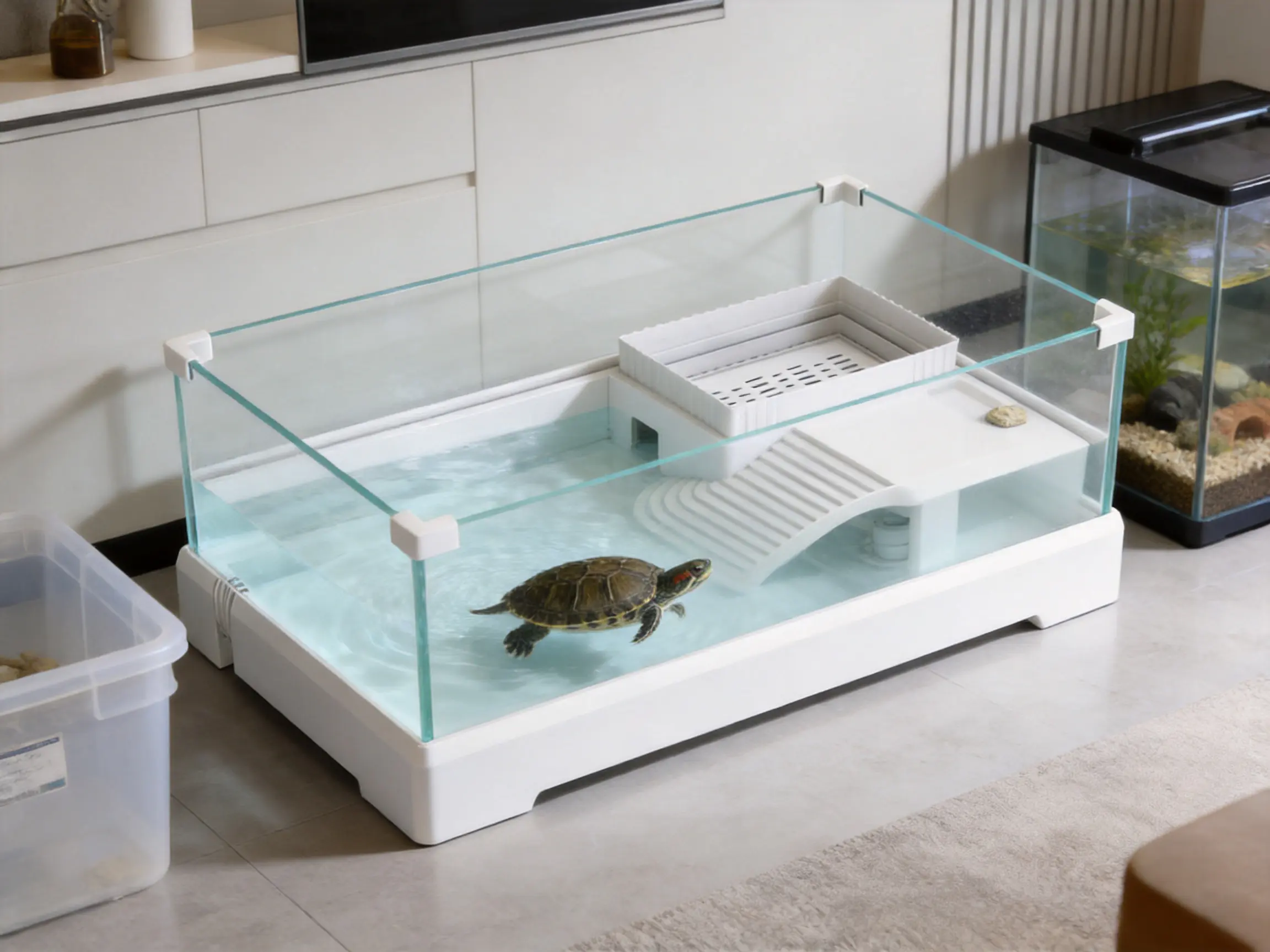
The XGG Ecological Turtle Tank also has potential value beyond individual household use. Aquarium stores, pet retailers, online sellers, and distributors often need products that are easy to explain and visually attractive. A turtle tank made with ultra-white glass offers a clear selling point that customers can understand immediately. The multifunctional and space-oriented design provides additional talking points for sales staff.
Retail presentation is supported by the product’s visible qualities. Clear glass makes the tank easy to demonstrate in a showroom. A well-arranged display can show the difference between a temporary container and a purpose-oriented habitat. The product can be presented as an option for customers who want both responsible animal housing and a clean home display.
For distributors, model clarity is important. The two stated size formats and the associated model names should be confirmed and standardized in catalogs, quotations, packaging, and online listings. Accurate product information helps reduce purchasing errors and supports customer confidence. Retailers should clearly identify dimensions, material, included components, installation requirements, and recommended use.
The manufacturer’s stated experience in domestic and international sales can support larger-scale distribution. Its group structure, import and export company, subsidiary network, and quality-control organization suggest an ability to work across multiple business channels. Commercial buyers should still request current specifications, packaging details, order quantities, production schedules, and after-sales policies before finalizing a contract.
Professional buyers may also benefit from the product’s relationship to a wider aquarium and pet-product portfolio. A store that already sells aquarium lighting, pumps, filters, accessories, and pet products can position the turtle tank as part of a complete habitat solution. This can make it easier to guide customers from the enclosure itself to the other products needed for safe and responsible care.
The competitive position of the XGG Ecological Turtle Tank is based on several features working together rather than on one isolated specification. Ultra-white glass improves visual clarity. Increased space supports more flexible habitat planning. Multifunctional design provides a broader range of setup possibilities. Structural optimization makes the enclosure more purposeful than a generic container. Manufacturing experience adds confidence in the company’s ability to develop, inspect, and distribute aquarium products.
Compared with low-cost temporary containers, the product offers stronger display value and a more deliberate habitat identity. Compared with an ordinary aquarium, it begins with turtle-oriented needs rather than requiring the owner to adapt a fish-focused design. Compared with highly specialized enclosures that may be difficult to modify, its broader multifunctional concept allows the keeper to organize the interior according to changing needs.
The product is also supported by the wider capabilities of Sensen Group Co., Ltd. The company reports a history beginning in 1985, a presence in aquarium pets and aquatic machinery, dedicated research and quality-control functions, multiple subsidiaries, an international sales structure, and a large domestic network. These strengths create a foundation for continuous product development and market support.
No tank can replace responsible husbandry, and no material alone guarantees a perfect habitat. The owner must still select the correct size, install the tank safely, manage water quality, provide suitable equipment, and upgrade the enclosure as the turtle grows. Within those limits, the XGG Ecological Turtle Tank offers a balanced combination of clear presentation, practical space, adaptable design, and manufacturing experience.
It is a turtle habitat product from the Xiaoli Sunsun range, identified as the Eco Turtle Tank. It is designed with ultra-white glass and emphasizes multifunctional use, increased space, and optimized structure for turtle keeping.
The supplied specifications identify ultra-white glass as the glass material. This type of glass is selected for its clear appearance and reduced color distortion compared with ordinary glass.
The product information lists XGG-400/500 and XGG-450/XGG-500 model references. The stated dimensions are 390 × 270 × 170 mm and 490 × 310 × 195 mm. Buyers should confirm the exact model and dimensions with the supplier because product listings may use different model formats.
The provided information does not confirm that these items are included. Customers should request a current package list and purchase compatible equipment separately when required by the turtle species and habitat plan.
No. Suitability depends on the turtle’s species, current size, expected adult size, swimming ability, resting requirements, and care conditions. The tank should be selected as part of a species-specific husbandry plan.
The tank offers a clearer, more refined, and more purpose-oriented habitat presentation. Ultra-white glass improves visibility, while the multifunctional and optimized structure supports a more organized permanent setup than many general-purpose containers.
An ordinary aquarium is commonly designed for fish, while this product is presented specifically as an ecological turtle tank. Its design direction focuses on turtle-oriented space, structure, and multifunctional use, reducing the need for extensive adaptation.
Place it on a stable, level, weight-bearing surface, inspect the glass and joints, follow the supplied installation guidance, and test the setup before introducing the turtle. The included installation video may assist with the preparation process.
Use clean water and aquarium-safe tools. Avoid abrasive materials, household detergents, solvents, and any product that may leave harmful residues. Clean gently to reduce the risk of scratching the glass.
Not necessarily. The larger format provides more room, but turtles grow at different rates and have different adult requirements. Owners should plan for a future enclosure if the turtle eventually outgrows the selected model.
The product is associated with Sensen Group Co., Ltd., also known through its Sunsun-related business and Xiaoli Sunsun product range. The company reports a history dating to November 1985 and activities in aquarium pets, aquatic machinery, industrial equipment, and related fields.
The company identifies a research institute, quality-control department, business school, multiple subsidiaries, an import and export company, and a broad sales network. These resources support product development, quality management, distribution, and customer service.
The XGG Ecological Turtle Tank presents a more considered alternative to improvised turtle housing and ordinary fish aquariums. Its ultra-white glass provides a clean and clear view, while its multifunctional concept, increased space, and optimized structure support a more practical habitat arrangement. These characteristics can improve both the keeper’s daily experience and the visual quality of the animal’s environment.
The product’s value is strengthened by the broader manufacturing background of Sensen Group Co., Ltd. With a history extending back to 1985, experience in aquarium and aquatic industries, dedicated research and quality-control functions, subsidiary companies, and international distribution capabilities, the company has the organizational foundation to develop and supply products for varied markets.
For consumers, the most important step is to match the tank to the turtle’s actual needs. For retailers and distributors, the product offers a clear combination of material quality, display value, and purpose-oriented design. When correctly sized, safely installed, and supported by appropriate water management and husbandry, the XGG Ecological Turtle Tank can serve as an attractive and adaptable foundation for responsible turtle keeping.
Sensen Group Co., Ltd. Company information and corporate history supplied in the product materials.
Xiaoli Sunsun. XGG Ecological Turtle Tank product specifications supplied in the product materials.
XGG Ecological Turtle Tank. Product feature description, model information, material details, and dimensional data supplied by the manufacturer.
Manufacturer-provided installation video reference for the XGG Ecological Turtle Tank.
General aquarium and aquatic turtle habitat planning principles concerning enclosure size, water quality, safe installation, cleaning, and species-specific care.


 No. 61-79, Baima Street, Maao Town, Dinghai District, Zhoushan City, Zhejiang Province, China.
 0086 580 8082088 / 8081168
 0086 580 8080978
 songhua@sunsun-china.com