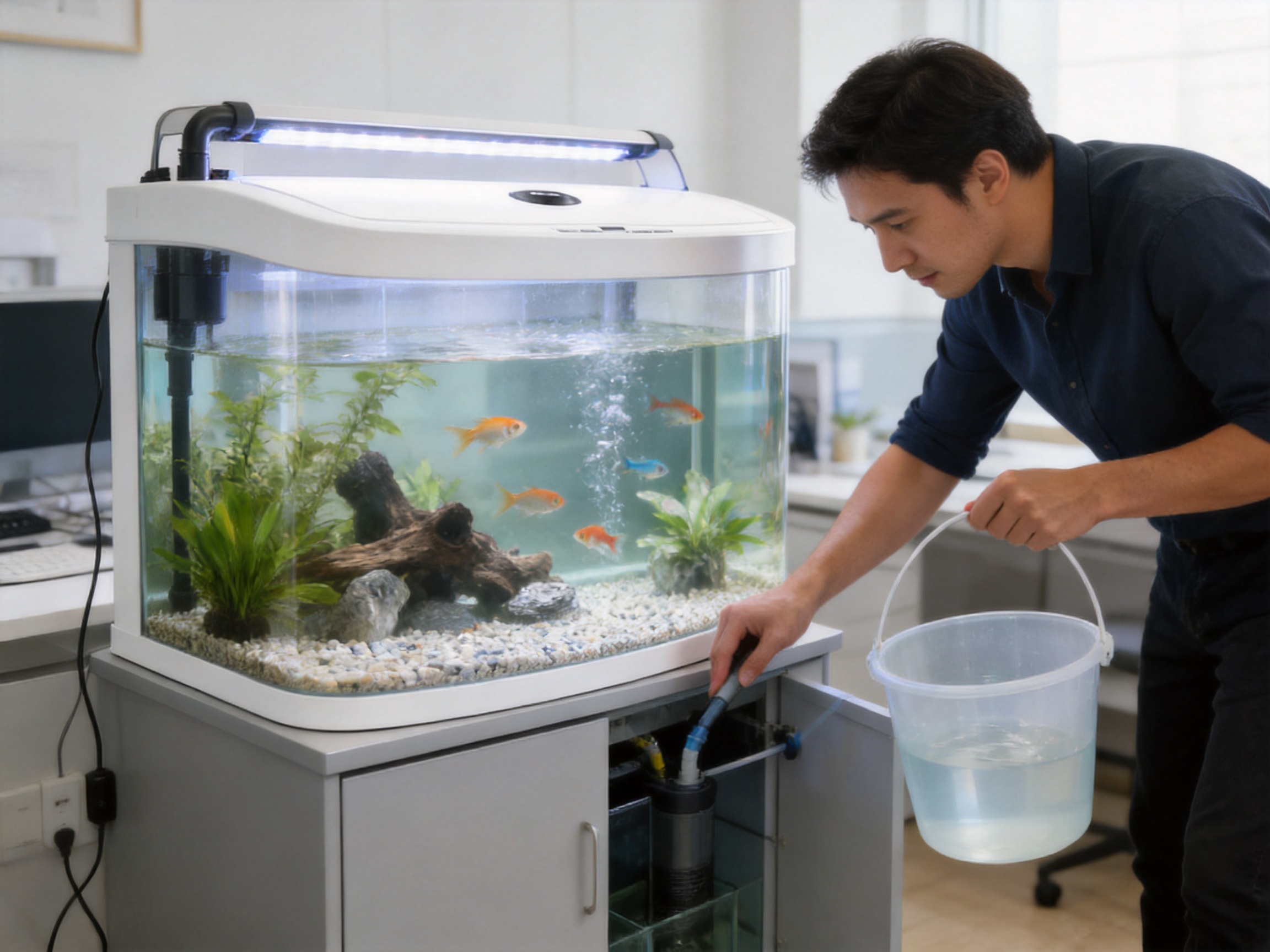
Introduction
A well-designed aquarium does more than hold water and fish. It becomes a living feature within a room, adding movement, color, light, and a quiet connection with nature. For homes, offices, reception areas, study rooms, bedrooms, and small commercial spaces, a tabletop aquarium must balance appearance, capacity, safety, filtration, lighting, and ease of maintenance. The HRG series tabletop fish tank is designed around this balance, offering several size options within one coordinated product family.
The series includes five models: HRG-300, HRG-380, HRG-500, HRG-600, and HRG-800. Their capacities range from 7 liters to 135 liters, allowing users to select a compact desktop aquarium or a larger tabletop display without changing to an unrelated design. Each model uses a rich white exterior color, a curved hot-bent glass structure, integrated top filtration, an LED lighting system, and a built-in water pump. Together, these features create a complete aquarium platform rather than a simple glass container.
The principal value of the HRG series lies in its integrated approach. The aquarium, upper filtration area, lighting, pump, cover frame, and base are developed as parts of one coordinated structure. This reduces the need to assemble a collection of unrelated accessories and helps maintain a cleaner appearance. Compared with basic tanks that require separate filters, lamps, brackets, and supports, the HRG series is intended to provide a more unified and accessible solution for everyday aquatic display.
Behind the product is Sensen Group Co., Ltd., a manufacturer with a long history in aquarium products, aquaculture machinery, industrial equipment, and related fields. The company’s broad production background, research functions, quality control organization, subsidiary network, and distribution experience support the development of aquarium products for both domestic and international markets.
This article examines the construction, specifications, advantages, manufacturing considerations, application possibilities, maintenance requirements, and selection criteria associated with the HRG series tabletop fish tank. It also explains how an integrated design can improve the user experience while identifying practical limitations that buyers should consider before selecting a model.

HRG series tabletop fish tank
1. Product Concept and Design Philosophy
1.1 A tabletop aquarium designed as a complete display system
Many small aquariums begin as a glass box to which the owner later adds a filter, light, lid, heater, support, and decorative accessories. Although this approach offers flexibility, it can also create visual clutter, compatibility problems, exposed cables, and uneven performance. The HRG series takes a different approach by treating the aquarium as a coordinated system.
The main tank body, top filtration structure, lighting, pump, upper cover frame, and base are intended to work together. This integrated design makes the product especially suitable for users who want a ready-to-use aquarium appearance without spending considerable time matching components from different suppliers. It also allows the outer proportions, functional spaces, and visual details to be considered during product development rather than added later.
The design is described as simple and beautiful, with a minimalist medium-tone aquarium body complemented by rich white structural elements. This neutral appearance can fit a variety of interior styles, including modern homes, offices, reception desks, educational settings, and retail displays. It does not depend on excessive decoration to attract attention. Instead, the water, plants, fish, and lighting become the visual focus.
1.2 Curved glass for a more refined visual effect
The HRG series uses hot bending technology to create a structure described as having a single straight face and double arc edges. This configuration combines a broad front viewing area with smoothly curved side transitions. The result is different from a conventional aquarium made from several flat panels joined by visible silicone seams at each front corner.
Curved edges can provide several practical and visual benefits. They soften the outline of the aquarium, reduce the visually heavy appearance of sharp corners, and create a smoother transition between the front and side viewing areas. They can also make the aquarium look more integrated into a living space, particularly when the tank is placed on a desk or cabinet where all sides may be visible.
High-strength glass is another important part of the design. Glass provides a clear viewing surface, resists ordinary scratching better than many transparent plastics, and maintains a bright, stable appearance when properly cleaned. The stated product features emphasize high-strength glass for improved viewing, while the hot-bending process contributes to the distinctive curved profile.
1.3 A style that supports long-term use
Aquarium products are often purchased for continuous display rather than short-term use. Therefore, design quality should not be judged only by the appearance of an empty tank. The product must continue to look orderly when the filter is operating, the light is installed, plants are growing, and water maintenance is taking place.
The HRG series addresses this requirement by placing key technical components within the upper structure. The top filtration arrangement helps keep equipment visually organized, while the upper cover frame and base establish a consistent external shape. The result is a cleaner appearance than a tank surrounded by loosely positioned accessories.
This approach can be particularly valuable in spaces where the aquarium is part of the room design. A living room, office counter, hotel reception area, or classroom benefits from equipment that appears intentional rather than improvised. A coordinated exterior also makes it easier for users to maintain a consistent appearance after cleaning or replacing filter media.
2. Model Range and Technical Specifications
The HRG family contains five models with different footprints, heights, capacities, light outputs, and pump powers. The range allows buyers to match the aquarium to available space, livestock requirements, visual preferences, and maintenance expectations.
| Model | Overall Size | Lighting Power | Pump Power | Nominal Capacity |
| HRG-300 | 29 × 20 × 32 cm | 3.5 W | 2.5 W | 7 L |
| HRG-380 | 38 × 26 × 40 cm | 5.5 W | 2.5 W | 19 L |
| HRG-500 | 50 × 30 × 45 cm | 7 W | 8 W | 29 L |
| HRG-600 | 60 × 30 × 54 cm | 7 W | 8 W | 72 L |
| HRG-800 | 80 × 30 × 64 cm | 14 W | 12 W | 135 L |
2.1 Compact option: HRG-300
The HRG-300 is the smallest model in the series, measuring 29 by 20 by 32 centimeters and offering a nominal capacity of 7 liters. Its compact dimensions make it appropriate for small desks, shelves designed to carry suitable loads, bedside areas, study rooms, and other locations where space is limited.
With 3.5 watts of lighting and a 2.5-watt pump, the HRG-300 is configured for a modest aquatic display. Its smaller water volume also means that changes in temperature, water chemistry, and cleanliness can occur more quickly than in a larger aquarium. As a result, users should pay close attention to feeding, water changes, stocking levels, and the condition of the filtration media.
The main advantage of this model is accessibility. It offers the visual experience of an integrated aquarium while requiring less physical space and generally less water for routine maintenance. It is a practical entry point for users who want a compact display and are prepared to follow careful small-aquarium care practices.
2.2 Balanced desktop option: HRG-380
The HRG-380 measures 38 by 26 by 40 centimeters and has a nominal capacity of 19 liters. This model provides more swimming and planting space than the HRG-300 while remaining suitable for many tabletop settings. Its 5.5-watt light and 2.5-watt pump are matched to the smaller-format design.
The additional volume can offer somewhat greater stability than the smallest model, although it should not be considered maintenance-free. A 19-liter aquarium still requires appropriate stocking and regular observation. It may suit a carefully planned freshwater display containing compatible small fish, shrimp, snails, or aquatic plants, depending on local care guidance and the needs of the selected species.
2.3 Medium display option: HRG-500
The HRG-500 provides a 50 by 30 by 45 centimeter footprint and a nominal capacity of 29 liters. Its 7-watt LED light and 8-watt pump represent an increase in equipment power compared with the two smallest models. This configuration supports a larger display area and a more substantial visual presence.
The HRG-500 may be suitable for users who want a centerpiece aquarium for a desk, sideboard, office cabinet, or reception area. The wider front viewing space allows greater flexibility in arranging hardscape, plants, and open swimming areas. Nevertheless, the support surface must be level, stable, and capable of carrying the aquarium’s filled weight.
2.4 Larger tabletop option: HRG-600
With dimensions of 60 by 30 by 54 centimeters, the HRG-600 has a stated capacity of 72 liters. Its 7-watt lighting system and 8-watt pump support the larger tank structure. This model provides a more prominent aquatic display while retaining the HRG series appearance.
A 72-liter aquarium requires more planning than a compact desktop tank. Users should consider the load on the furniture, access to electrical outlets, water-change procedures, and the space needed to work around the upper filtration area. The greater volume can contribute to more gradual changes in water conditions, but it also means that moving the aquarium after filling is not practical.
2.5 Large display option: HRG-800
The HRG-800 is the largest model, measuring 80 by 30 by 64 centimeters and offering a nominal capacity of 135 liters. Its 14-watt light and 12-watt pump are the highest listed outputs in the series. The long front profile is suitable for users seeking a stronger visual statement in a living area, office, showroom, hospitality space, or educational environment.
Because of its size and filled weight, the HRG-800 must be installed on a purpose-suitable aquarium cabinet or another professionally assessed support. The surface should be level, stable, water-resistant, and capable of carrying the combined weight of the aquarium, water, substrate, equipment, and decorations. The tank should be positioned before filling, with adequate access for maintenance.
3. Integrated Top Filtration and Water Quality Management
3.1 The role of filtration
Filtration is central to aquarium stability. Fish and other aquatic animals release waste, uneaten food decomposes, and organic material accumulates over time. A suitable filtration system helps remove suspended particles, supports beneficial microorganisms, and promotes water movement. The HRG series uses integrated top filtration to purify water quality as part of the aquarium’s main structure.
Top filtration offers a practical layout. Water can be drawn toward the upper filtration area, passed through suitable media, and returned to the aquarium. Because the filter is positioned above the tank, maintenance access can be convenient, and the equipment does not occupy as much visible space inside the display area as some internal filters.
The filtration system should be regarded as one part of responsible aquarium care rather than a replacement for maintenance. Even an effective filter cannot eliminate the need for partial water changes, surface cleaning, filter-media care, appropriate feeding, and observation of fish behavior.
3.2 Advantages over separate accessory arrangements
A basic aquarium often requires the user to select a filter independently. This creates several possible difficulties. The filter may be too weak for the tank, too large for the available space, visually unsuitable, noisy, difficult to mount, or incompatible with the tank’s cover. A separate filter can also introduce extra tubing and power cables.
By integrating the filtration area into the product structure, the HRG series provides a more coordinated starting point. The filtration component is considered together with the tank dimensions, upper cover frame, and water circulation arrangement. This does not mean that the system is suitable for every possible livestock combination, but it does reduce the uncertainty involved in building a basic aquarium from unrelated parts.
The integrated design is also useful for first-time users. Instead of researching multiple equipment categories before the aquarium can operate, users receive a product platform in which the primary lighting and pumping functions have already been incorporated. This can shorten setup time and make the finished installation look more professional.
3.3 Maintenance of the filtration area
Filter maintenance should be performed according to water flow, visible debris, manufacturer guidance, and aquarium conditions. Filter media should not be replaced unnecessarily, since established biological media may contain beneficial microorganisms. When cleaning is required, media is often rinsed with removed aquarium water rather than untreated tap water, although the correct procedure depends on the media type and local water conditions.
The pump intake should be checked regularly for debris. Reduced flow can affect filtration performance, oxygen exchange, and circulation. The upper filtration area should also be inspected for accumulated organic material, algae, and mineral deposits. Any maintenance involving electrical equipment should begin with the equipment disconnected from power.
4. LED Lighting and Visual Presentation
The HRG series includes high-brightness LED lighting described as low-consumption and durable. The listed lighting powers range from 3.5 watts on the HRG-300 to 14 watts on the HRG-800. LED technology is well suited to aquarium applications because it provides illumination in a compact format while generally consuming less power than many older lighting technologies with comparable visual output.
Lighting serves several purposes in an aquarium. It allows fish, plants, substrate, and decorative elements to be seen clearly. It establishes the aquarium’s visual character in the room. It can also support the growth of selected aquatic plants, although plant performance depends on more than wattage alone. Light spectrum, photoperiod, plant type, carbon availability, nutrients, water conditions, and algae management all influence results.
The integrated position of the light helps maintain a tidy appearance. A separate lamp may require brackets, clips, or a suspended frame, while an integrated lamp remains associated with the tank’s upper structure. This is especially valuable on a desk or cabinet where a clean silhouette is desirable.
Users should avoid leaving the aquarium light on continuously. A regular day-and-night schedule is generally more appropriate for fish and plants, and it can help limit algae growth. The precise schedule should be adjusted according to the aquarium’s livestock, plant density, ambient light, and observed algae levels.
4.1 Lighting power across the series
The lighting specification increases as the models become larger, although the relationship is not a simple linear calculation of tank volume. The HRG-300 uses 3.5 watts, the HRG-380 uses 5.5 watts, the HRG-500 and HRG-600 each use 7 watts, and the HRG-800 uses 14 watts. This indicates that each model has its own equipment configuration rather than being a single lamp simply scaled by tank length.
Buyers who plan to keep demanding aquatic plants should evaluate the actual light distribution and plant requirements rather than relying on wattage alone. The product’s built-in LED is well suited to general aquarium viewing and compatible planting plans, but specialized planted-tank goals may require additional technical assessment.

5. Glass Construction, Hot-Bending Technology, and Product Quality
5.1 Hot-bent glass as a manufacturing feature
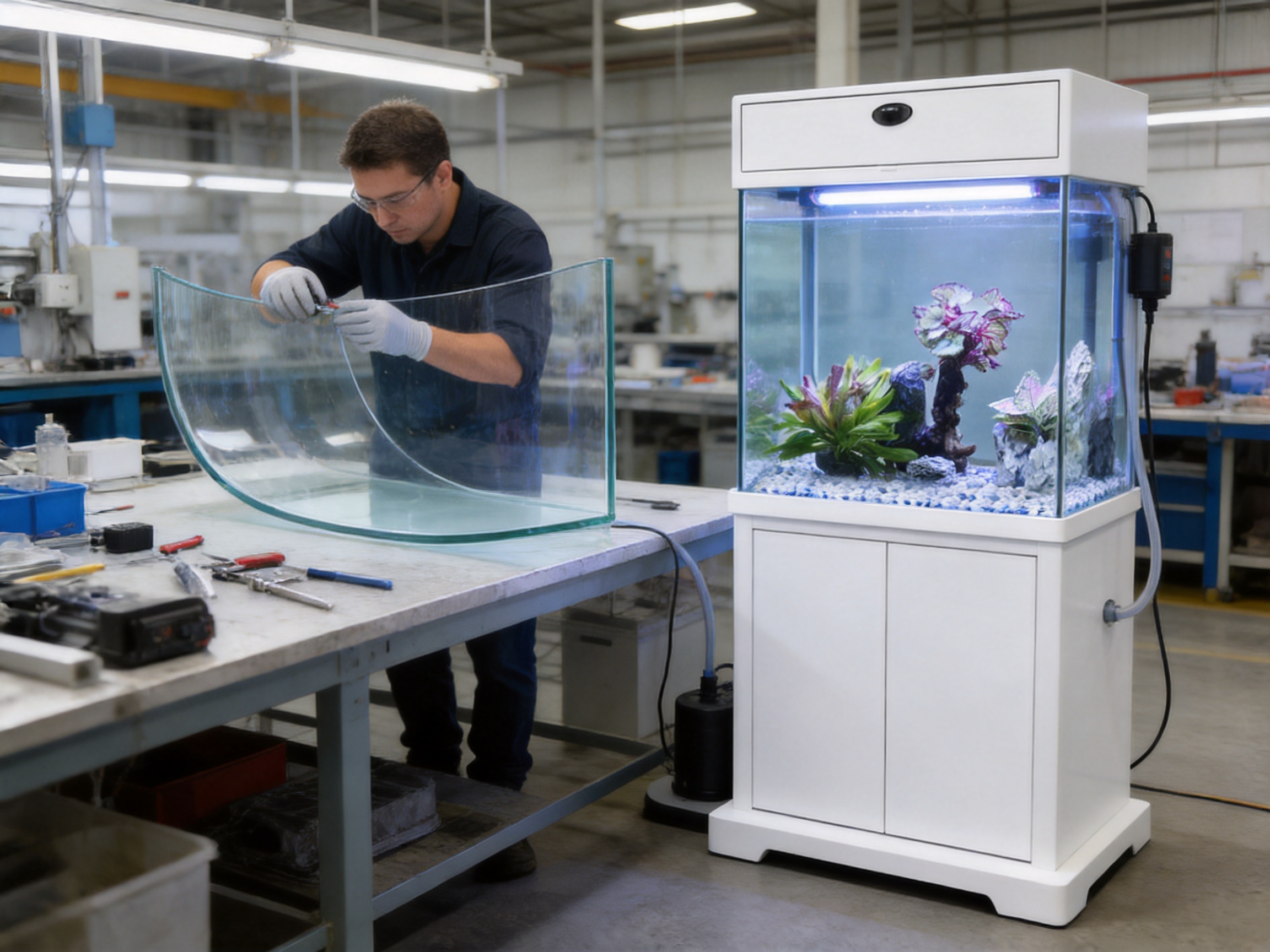
Hot bending is a process in which glass is heated until it becomes sufficiently pliable to form over or within a shaped tool. After forming, the glass is cooled under controlled conditions. The quality of the final component depends on factors such as material selection, mold accuracy, heating uniformity, cooling control, dimensional inspection, and careful handling.
For the HRG series, hot bending supports the single straight face and double arc-edge profile. This shape gives the aquarium a smoother visual transition than a conventional box with prominent front seams. It also demonstrates that the product is not merely a standard flat-panel tank with accessories attached; the glass profile itself is part of the design concept.
Curved glass manufacturing requires attention to shape consistency. If the curvature varies between units, the fit of the upper frame, cover, base, and filtration components may be affected. For this reason, controlled forming and inspection are important to maintaining a consistent product experience across a production run.
5.2 High-strength glass and viewing clarity
The product information identifies high-strength glass as a key feature. Strong, clear glass contributes to structural confidence and visual quality, while a smooth viewing surface helps users observe fish and plants without unnecessary distortion. The aquarium should still be handled carefully, since glass can be damaged by impact, improper support, or contact with hard particles during cleaning.
Cleaning tools should be selected to avoid scratching. Sand or gravel trapped between a scraper and the glass can cause damage, and heavy objects should not be placed on the aquarium’s upper frame unless specifically intended for that purpose. The aquarium should also be installed on a suitable level support so that uneven loading does not place unnecessary stress on the structure.
5.3 Inspection considerations
A professional aquarium manufacturing process should include checks for dimensions, glass appearance, edge condition, bonding quality where applicable, frame fit, pump operation, light operation, and water-tightness. The exact inspection procedures used by a manufacturer may vary by factory and model, but these areas are important indicators of product consistency.
Quality control is particularly significant for integrated aquariums because several components must work together. A tank may be visually attractive yet fail to provide a satisfactory user experience if the cover is difficult to remove, the pump is poorly fitted, the lighting connection is unreliable, or the filtration path is obstructed. Coordinated inspection helps identify such issues before products reach customers.
6. Manufacturing Strengths and Corporate Capabilities
The HRG series is associated with Sensen Group Co., Ltd., a company established in November 1985. According to the supplied company information, the group has developed across aquarium pets, aquaculture machinery, industrial equipment, and related sectors. This breadth is relevant because aquarium products often combine electrical, mechanical, glass, plastic, water-flow, and manufacturing considerations.
The company states that it has established functional departments including a research institute, business school, quality control department, personnel and administrative information department, and financial department. A dedicated research function can support product development, testing, and design improvement. A quality control department can help formalize inspection procedures and address consistency across production batches.
The company also reports a network of wholly owned subsidiary corporations and an import and export company. Such an organizational structure may provide access to broader production resources, specialized capabilities, supply-chain coordination, and international distribution experience. These advantages can be important for maintaining product availability and supporting customers in different markets.
6.1 From product concept to manufacturing
The manufacturing of a product such as the HRG series involves more than assembling purchased parts. The design must first be converted into controlled dimensions and production specifications. Glass components require forming or cutting plans, while the upper filtration structure, base, cover frame, pump placement, and lighting system need compatible interfaces.
During production, the glass must be formed accurately, inspected for visible defects, and handled in a way that minimizes damage. Structural components must be assembled with suitable precision. The filtration and pump arrangement must allow water to move through the intended path. The light must be securely positioned and electrically appropriate for the product. Packaging must protect the curved glass and external structure during storage and transportation.
A manufacturer with experience in aquarium equipment can draw on knowledge of water circulation, aquatic environments, electrical safety, product ergonomics, and consumer maintenance. Experience across related machinery categories can also support improvements in production organization, component management, and quality systems.
6.2 Scale and market experience
The company information describes a large production and marketing operation serving domestic and foreign markets. It also refers to a broad network of aquarium stores and an effort to integrate online and offline services. Market experience can provide valuable feedback about how products perform in actual homes, retail spaces, offices, and public environments.
Customer feedback may reveal common concerns such as installation clarity, filter access, lighting expectations, packaging protection, maintenance frequency, and model selection. When manufacturers are able to connect market feedback with research and quality-control processes, future products can be refined more effectively.
These corporate capabilities help distinguish the HRG series from an individually assembled aquarium solution. The advantage is not only the physical product but also the organizational environment behind design, production, inspection, logistics, and customer support.
7. Advantages Compared with Conventional Basic Aquariums
7.1 Coordinated appearance
The most visible advantage of the HRG series is its coordinated appearance. The rich white exterior, curved glass, upper cover frame, integrated top filtration, and built-in lighting create a unified visual language. A conventional basic aquarium may require several separately purchased products that do not match in color, proportion, or finish.
This difference matters when the aquarium is placed in a visible location. On a living-room cabinet or office reception desk, the tank may be viewed from multiple angles. A unified structure is more likely to appear intentional and refined than a collection of exposed accessories.
7.2 Reduced equipment-selection burden
New aquarium owners often find it difficult to determine the correct filter flow, lamp size, mounting method, and equipment compatibility. The HRG series reduces this initial burden by providing a built-in pump, filtration arrangement, and LED light for each model.
Users still need to understand stocking limits, water treatment, maintenance, and species requirements. However, they do not have to begin by designing an equipment system from the ground up. This makes the product approachable for beginners while retaining useful features for experienced hobbyists who prefer a clean integrated format.
7.3 Efficient use of tabletop space
A separate filter or lamp can extend beyond the footprint of a tank. Additional equipment may occupy surrounding desk space or require a wall, shelf, or hanging point. The HRG design places important functions within the aquarium’s overall structure, helping preserve the surrounding area for books, office materials, decorative objects, or other household uses.
The space-saving benefit varies by model. The HRG-300 and HRG-380 are particularly appropriate where the available surface is limited, while the HRG-600 and HRG-800 need substantial support because of their larger dimensions and filled weight.
7.4 Broad model choice
A single fixed-size aquarium cannot meet every room and stocking requirement. The HRG series provides five sizes, from 7 liters to 135 liters. This makes it possible for users to stay within the same design family while selecting a capacity that better matches their available space and intended display.
The model range is also useful for commercial buyers, interior designers, retailers, and project purchasers who may need several sizes for different locations. A consistent design language can help create a coordinated installation across multiple rooms or display zones.
8. Applications in Homes, Offices, Retail, and Education
8.1 Residential use
In a home, the HRG series can serve as a quiet focal point in a living room, study, dining area, bedroom, or hallway. The aquarium’s movement and lighting can add visual interest without occupying the space required by a large freestanding aquarium. Smaller models may fit on a carefully selected desk or cabinet, while larger models can become a primary decorative feature.
Home users should select the model according to the furniture’s load rating, available maintenance access, electrical outlet location, and the needs of the intended aquatic inhabitants. Water should be added only after confirming that the installation surface is appropriate and level.
8.2 Office and hospitality environments
An aquarium can make an office reception area, meeting room, hotel lobby, salon, clinic, or restaurant feel more welcoming. The integrated structure is valuable in professional environments because it presents a finished appearance and reduces visible cable and accessory clutter.
For business use, maintenance responsibilities should be assigned clearly. A staff member or service provider should monitor water level, filter flow, lighting operation, livestock condition, and cleaning requirements. The largest models can provide a strong visual effect, but they also require greater planning for water changes and safe access.
8.3 Retail and showroom displays
Retailers can use different HRG models to demonstrate fishkeeping possibilities at several scales. The consistent styling makes it easier to create a recognizable display environment, while the range of capacities allows products to be shown in different room settings.
When used in a store, the aquarium should be protected from accidental impact, excessive direct sunlight, and unauthorized handling. Clear information about maintenance and livestock care can help customers understand that the aquarium is a living system rather than a purely decorative object.
8.4 Educational settings
An aquarium can support lessons about ecosystems, animal behavior, water quality, plant growth, filtration, and responsible pet ownership. The visible filtration process can help students understand how mechanical and biological water treatment contribute to an aquatic environment.
Teachers and facility managers should establish a maintenance schedule and ensure that students interact with the aquarium under supervision. A smaller model may be easier for classroom observation, while larger models may provide more room for plants and habitat design.
9. Installation and Setup Guidance
9.1 Selecting the support surface
The support surface is one of the most important factors in aquarium safety. It should be level, stable, water-resistant, and strong enough for the filled aquarium. Water weighs approximately one kilogram per liter, before adding the weight of glass, substrate, rocks, wood, equipment, and the support structure. Consequently, a 135-liter aquarium can impose a substantial load.
The aquarium should be positioned away from unstable shelves, narrow ledges, direct heat sources, and locations where it may be struck. The surface should provide complete and appropriate support rather than allowing the tank to overhang in a way that creates stress.
9.2 Preparing the tank
Before adding water, users should inspect the aquarium for visible shipping damage, confirm that the upper structure is correctly positioned, and check that electrical components are dry and safely arranged. The tank should be rinsed according to suitable aquarium practices, without using household detergents or chemical cleaners that could harm aquatic life.
Substrate, rocks, wood, and decorative materials should be cleaned and arranged carefully. Heavy items should be placed so they cannot fall against the glass. Decorations should not obstruct the intake, return path, or access to the filter area.
9.3 Starting the filtration system
The pump should be operated only when the water level is sufficient for the intended circulation path. Users should follow the product instructions for priming and operation. After startup, observe the water movement, listen for unusual noise, and confirm that the filtration area is functioning correctly.
New aquariums generally require time for beneficial biological communities to establish. Adding too many fish immediately can overload the developing system. A gradual stocking approach, regular testing, and careful observation are recommended.
10. Maintenance and Responsible Use
10.1 Routine water care
Routine water changes help control dissolved waste and maintain a healthier environment. The precise amount and frequency depend on stocking density, feeding, plant growth, filtration, water chemistry, and test results. Water added to the aquarium should be prepared appropriately for the livestock being kept.
Users should avoid replacing all aquarium water without a specific reason, since large sudden changes can stress aquatic life. Partial changes are commonly used to refresh water while preserving some environmental continuity. Any maintenance plan should be adapted to the specific species and local water conditions.
10.2 Filter and pump care
The filter should be checked for blocked media, reduced flow, unusual noise, and accumulated debris. The pump intake and return path should remain unobstructed. Electrical components should be disconnected before hands or tools enter the water or filtration compartment.
Filter media should be cleaned or replaced carefully. Excessive cleaning with untreated tap water or frequent complete replacement can reduce beneficial biological activity. At the same time, neglected media can become clogged and reduce circulation. A balanced maintenance schedule is therefore essential.
10.3 Glass and exterior cleaning
Algae and mineral deposits should be removed using tools suitable for aquarium glass. Abrasive materials should be avoided, particularly when particles of sand or gravel may be trapped between the cleaning tool and the viewing surface.
The rich white exterior and upper frame can be wiped with a soft, slightly damp cloth. Household chemicals should not be allowed to enter the aquarium. Any water spilled around electrical connections should be cleaned promptly after disconnecting power safely.
10.4 Livestock selection
The nominal capacity of a tank does not determine the exact number or type of fish it can house. Species size, behavior, adult growth, swimming requirements, territorial needs, filtration capacity, temperature, oxygen demand, and compatibility must all be considered.
The HRG-300 and HRG-380 require especially conservative stocking because smaller water volumes can change quickly. Larger models provide more space, but they still require responsible stocking and regular maintenance. Buyers should obtain species-specific advice before purchasing livestock.
11. Choosing the Right HRG Model
Model selection should begin with the installation location rather than appearance alone. Measure the available width, depth, and height, including clearance for opening the upper cover and accessing the filter. Confirm that the support furniture can carry the filled weight and that there is a nearby safe power source.
| Primary Requirement | Recommended Consideration |
| Very limited desk space | Consider HRG-300, subject to suitable livestock planning |
| Compact display with more room than the smallest model | Consider HRG-380 |
| Medium centerpiece aquarium | Consider HRG-500 |
| Larger home or professional display | Consider HRG-600 |
| Long, high-impact display with substantial support | Consider HRG-800 |
The intended aquatic environment also matters. A planted display may need a lighting assessment, while a fish-focused display may place greater emphasis on swimming space, filtration, and oxygen exchange. Users who plan to keep multiple species should consider compatibility before choosing a tank simply because it has a larger capacity.
Maintenance access is another selection factor. Larger tanks require more water, larger tools, more storage space for supplies, and more planning during water changes. A model that fits the room beautifully may still be unsuitable if the user cannot conveniently reach the filter or safely transport prepared water.
12. Practical Limitations and Buying Considerations
No aquarium system eliminates the responsibilities of fishkeeping. The HRG series simplifies equipment integration, but it does not remove the need for cycling, water testing, cleaning, appropriate feeding, livestock research, and regular observation.
The stated tank dimensions are overall dimensions that include the upper cover frame and base. Manual measurement may result in minor variation. Buyers planning a built-in installation should allow practical clearance and confirm final dimensions with the supplier before manufacturing furniture or architectural supports.
The stated capacities are nominal values. Usable water volume will be lower after accounting for substrate, decorations, equipment space, and the recommended operating water level. This distinction is important when evaluating stocking levels, water treatments, and medication dosages.
The lighting wattage provides a useful reference but does not by itself define the lamp spectrum, intensity at the substrate, or suitability for demanding plants. Buyers with advanced planted-aquarium goals should request the technical information needed for their specific application.
Similarly, pump wattage does not alone indicate actual flow rate, head height, noise level, or filtration turnover. The built-in pump is part of the product’s integrated configuration, but users should still review operating instructions and ensure that the selected model is appropriate for their planned setup.
13. Why Manufacturing Integration Matters
The principal manufacturing strength of an integrated aquarium is coordination. When the glass body, filtration, pump, lighting, cover, and base are designed as one product, the manufacturer can consider their interaction from the beginning. This supports a cleaner appearance, more predictable assembly, and a more coherent user experience.
Hot-bent glass adds another level of manufacturing specialization. The forming process must be controlled so that the curved edges maintain the intended profile. The resulting glass must fit the supporting structure, preserve clear viewing, and withstand ordinary handling and operating conditions.
Quality control is also more meaningful when it covers the entire system. Testing only the lamp or only the pump is not enough. The completed aquarium should be evaluated as a combination of visual, structural, hydraulic, electrical, and user-maintenance functions.
Sensen Group’s reported experience in aquarium products, aquaculture machinery, and industrial equipment provides a broad foundation for this type of product development. Its stated research, quality-control, production, subsidiary, and export capabilities indicate an organization built to support more than a single isolated aquarium model.
14. Frequently Asked Questions
Q1. What is the HRG series tabletop fish tank?
The HRG series is a family of integrated tabletop aquariums with curved hot-bent glass, an upper filtration system, LED lighting, a built-in water pump, an upper cover frame, and a base. It is available in five models ranging from 7 liters to 135 liters.
Q2. What models are available?
The models are HRG-300, HRG-380, HRG-500, HRG-600, and HRG-800. Their stated capacities are 7 liters, 19 liters, 29 liters, 72 liters, and 135 liters respectively.
Q3. What makes the aquarium different from a basic glass tank?
The HRG series combines the aquarium body with top filtration, lighting, and pumping equipment in a coordinated structure. This can reduce accessory clutter, simplify initial setup, and provide a more unified appearance than a basic tank fitted with unrelated components.
Q4. What does hot-bending technology do?
Hot bending forms the glass into a profile with one straight viewing face and two curved edges. This creates a softer, more continuous appearance than a conventional aquarium with sharply joined front corners.
Q5. Is the built-in LED light suitable for aquatic plants?
The high-brightness LED is intended to provide efficient aquarium illumination and may support compatible aquatic plants. However, plant requirements vary. Advanced planted aquariums should consider light spectrum, intensity, photoperiod, nutrients, carbon availability, and plant species rather than relying on wattage alone.
Q6. Does the integrated filter eliminate water changes?
No. Filtration supports water quality, but regular partial water changes, appropriate feeding, biological cycling, glass cleaning, filter maintenance, and water testing remain necessary.
Q7. Which model is best for a small desk?
The HRG-300 is the most compact model, measuring 29 by 20 by 32 centimeters. The HRG-380 is a larger alternative for users who have additional space and want a 19-liter nominal capacity.
Q8. Is the HRG-800 suitable for any tabletop?
The HRG-800 requires a strong, level, stable support suitable for a filled 135-liter aquarium plus glass, substrate, decorations, and equipment. It should not be placed on an ordinary lightweight desk unless the desk has been specifically assessed for the load.
Q9. Can the aquarium be moved after it is filled?
A filled aquarium should not be moved. It should be installed in its final location before adding water and decorations. Moving a filled tank can create dangerous structural stress and may damage the aquarium or support.
Q10. What should be checked when receiving the product?
Inspect the glass, curved edges, upper frame, base, cover, lighting, pump, and filtration area for shipping damage or visible defects. Follow the supplier’s instructions for testing and installation, and contact the supplier before use if damage is found.
Q11. What company manufactures the product?
The product information identifies Sensen Group Co., Ltd. as the company associated with the HRG series. The company states that it has operated since 1985 and works across aquarium pets, aquaculture machinery, industrial equipment, and related industries.
Q12. Why is the integrated format useful for beginners?
It reduces the need to select and match a separate filter, pump, and light before starting the aquarium. Beginners must still learn responsible fishkeeping, but the integrated design provides a more straightforward equipment foundation.
Conclusion
The HRG series tabletop fish tank is designed to combine aquarium display, filtration, lighting, pumping, and exterior styling in one coordinated product. Its five models cover a broad range of applications, from a compact 7-liter tabletop display to a 135-liter statement aquarium. The use of hot-bent glass, curved edges, high-strength viewing surfaces, integrated top filtration, and low-consumption LED lighting gives the series a distinctive position among basic aquarium solutions.
Its advantages are most apparent for users who value an organized appearance, reduced equipment-selection complexity, efficient use of surrounding space, and a consistent design across multiple sizes. The product is also supported by a manufacturer with stated experience in aquarium products, aquaculture machinery, industrial equipment, research, quality control, subsidiaries, and international trade.
At the same time, responsible use remains essential. A well-made aquarium still requires a suitable support surface, careful installation, appropriate livestock selection, regular water changes, filter maintenance, and observation. Capacity, lighting power, and pump wattage should be viewed as starting specifications rather than complete guarantees of suitability for every aquatic environment.
When matched with the correct location, livestock, maintenance plan, and support structure, the HRG series can provide a refined and practical way to bring aquatic life into homes, offices, commercial settings, and educational environments. Its integrated manufacturing concept allows the aquarium to function not merely as a container, but as a complete visual and technical system designed for everyday enjoyment.
References
1. Sensen Group Co., Ltd. Product information for the HRG series tabletop fish tank.
2. Sensen Group Co., Ltd. Technical specification sheet for HRG-300, HRG-380, HRG-500, HRG-600, and HRG-800 models.
3. Sensen Group Co., Ltd. Corporate information concerning company history, research, quality control, subsidiaries, and international business.
4. General aquarium husbandry principles concerning filtration, biological cycling, partial water changes, livestock compatibility, and aquatic plant care.
5. General glass manufacturing principles concerning hot bending, dimensional control, inspection, handling, and viewing clarity.


 English
 русский
 España
 Portugal
 عربي


 No. 61-79, Baima Street, Maao Town, Dinghai District, Zhoushan City, Zhejiang Province, China.
 0086 580 8082088 / 8081168
 0086 580 8080978
 songhua@sunsun-china.com