

 English
 русский
 España
 Portugal
 عربي
عربيChen Xiao | Customer Service & After-Sales Coordinator
Home / Author / Chen Xiao | Customer Service & After-Sales Coordinator / Submersible Aquarium Lighting: A Practical Guide to Versatile, Low-Voltage Underwater Illumination
Content
Submersible lighting is one of the most effective ways to improve the visual character of an aquarium, ornamental pond, water feature, or garden installation. Unlike lighting positioned only above the water, an underwater lamp can illuminate aquatic plants, decorative stones, fish shelters, fountains, and architectural details from within the installation itself. When designed correctly, it creates depth, highlights water movement, and gives the entire environment a more balanced appearance.
The CED SERES Submersible Lamp is a versatile low-voltage lighting range developed for aquatic and outdoor applications. It combines underwater installation capability, multiple power configurations, different beam angles, several mounting accessories, and warm-white or colorful light sources. The range includes compact single-light models as well as multi-light configurations intended for broader or more expressive illumination.
Its principal design advantages are amphibious waterproof and corrosion-resistant construction, low-voltage operation, strong optical penetration, and flexible installation. These features allow the lamp to be used in situations where ordinary indoor lighting would be unsuitable or unsafe. The range is also available with different cable lengths, transformers, ground stakes, mounting brackets, rubber-foot brackets, and colorful covers, making it easier to adapt the lighting arrangement to a particular aquarium or garden project.
This article examines the product range in detail, explains the advantages of its design, compares its practical characteristics with common alternatives, and discusses how the manufacturing capabilities of Sensen Group Co., Ltd. support product consistency and market reliability.
The CED SERES Submersible Lamp is designed as a low-voltage lighting solution for water-related and outdoor environments. The available models operate at either 12VDC or 12VAC, depending on the model. This voltage range is significantly lower than standard household mains voltage and is well suited to applications in which electrical equipment is installed close to water.
The range contains nine listed model configurations: CQD-135B, CED-105, CED-110, CED-110B, CED-110C, CED-120, CED-120B, CED-120C, and CLD-302. These models are not identical in size, power, beam angle, light source, cable length, or included accessories. Instead, they form a family that allows buyers to select a configuration according to the size of the installation and the desired lighting effect.
The smallest products are appropriate for discreet accent lighting and compact aquariums. The multi-light models provide stronger visual presence and can illuminate a wider area or multiple points at once. Narrow-beam 30-degree models are useful when concentrated illumination is needed, while the 80-degree and 120-degree configurations are more suitable for broad coverage.
Depending on the model, the light source is warm white, colorful, or warm white/colorful. Warm white lighting can produce a natural and comfortable appearance, while colorful versions can be used for decorative displays, nighttime garden features, themed aquariums, and event installations. The product family therefore supports both functional illumination and visual design.
One of the most important characteristics of a submersible lamp is its ability to function in a wet environment. The CED SERES range is described as amphibious, waterproof, and resistant to corrosion. This design approach is valuable because aquatic lighting may be exposed not only to complete immersion, but also to splashing, condensation, humidity, and repeated changes between wet and dry conditions.
Water features and garden installations can be particularly demanding. A lamp installed beside a pond may be exposed to rain, irrigation, soil moisture, and cleaning water. A lamp installed inside an aquarium may remain submerged for long periods. A product designed specifically for these conditions has an inherent advantage over general-purpose household lamps that are not intended for water-related use.
Corrosion resistance is also important for long-term appearance and operation. Water, minerals, cleaning chemicals, and outdoor contaminants can gradually affect exposed metal components and electrical connections. A corrosion-conscious design helps preserve the lamp’s structure and reduces the risk that its housing or fittings will deteriorate prematurely.
Although the product is intended for aquatic and outdoor environments, installation should still follow the manufacturer’s instructions. The lamp, cable, transformer, and connection points should be inspected before use, and damaged components should not be operated. A waterproof product is not a substitute for correct electrical installation or routine maintenance.
The CED SERES range uses 12VDC or 12VAC power, depending on the model. Low-voltage operation is one of the clearest practical advantages of the product. When lighting is used near people, fish tanks, ponds, fountains, or wet garden surfaces, minimizing electrical risk is a central design consideration.
The supplied material specifically identifies the low-voltage power supply as a way to reduce the danger of electric shock. The system also includes transformer specifications for the different configurations. Transformer capacity ranges from 3.6W or 3.6VA for smaller arrangements to 10VA for higher-output models.
Low-voltage equipment is also easier to integrate into decorative installations. A designer can position the lamp in a tank, pond, or garden feature without routing mains-voltage equipment directly into the wet area. The transformer remains an important part of the system and must be positioned in a dry, ventilated, and suitably protected location.
Another advantage is design flexibility. The low-voltage format supports compact lamp housings, making it possible to create small illuminated areas without installing bulky electrical equipment inside the aquarium or water feature. This is especially useful where visual simplicity is important.
The product range is promoted as having strong penetrating power and optimized optical light distribution. This is important because water, glass, decorative materials, and plant growth can absorb or scatter light. A lamp with effective optical distribution can provide a more visible and comfortable result than a light source that simply emits uncontrolled brightness.
The choice of beam angle has a major effect on performance. The CQD-135B uses an 80-degree beam, offering a middle ground between focused and broad illumination. The CED-105, CED-110, CED-110B, and CED-110C use 120-degree beams, which are appropriate for broad coverage over a relatively short distance. The CED-120, CED-120B, CED-120C, and CLD-302 use 30-degree beams for more concentrated illumination.
A 30-degree beam can be useful for highlighting a statue, a group of plants, a waterfall outlet, or a defined section of an aquarium. A 120-degree beam can spread light more evenly across a tank wall, shallow pond, or decorative display. Selecting the correct beam angle is often more important than simply choosing the highest wattage.
Optical comfort is another consideration. An aquarium lamp should enhance the view without creating excessive glare for people or sharp, distracting hot spots inside the tank. The range’s different beam options help users choose a distribution pattern that suits the intended viewing distance and layout.
The CED SERES range is supplied with different mounting accessories depending on the model. These include ground stakes, mounting brackets, and brackets with rubber feet. The accessories support different installation situations and reduce the need for improvised mounting solutions.
Ground stakes are useful for garden ponds, fountains, and outdoor water features. They allow the light to be positioned securely in soil or around a landscaped area. Brackets with rubber feet are more appropriate for stable placement on a tank base, ledge, platform, or smooth surface. Rubber feet can also help reduce movement and protect the installation surface from direct contact with the bracket.
The CQD-135B includes a mounting bracket and a bracket with rubber feet, as well as one ground stake. Several other models include one, two, or three ground stakes and corresponding rubber-foot brackets. The number of included accessories generally corresponds to whether the model uses one lamp or multiple lamp heads.
This accessory variety gives the range an advantage over fixed-format lamps that can only be installed in one position. A flexible lamp can be redirected as the aquarium layout changes, plants grow, or the owner wants to alter the visual composition of the display.
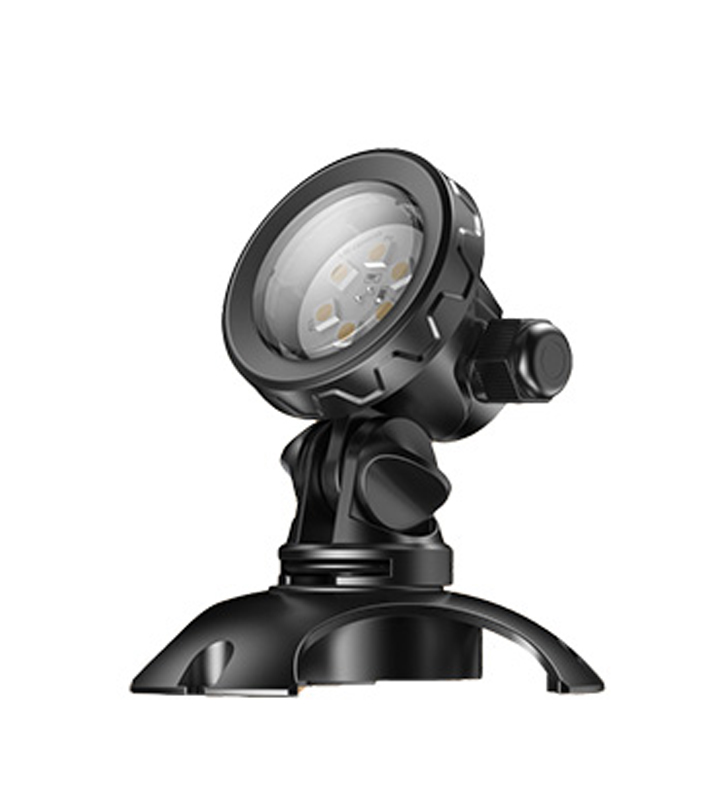
CED SERES Submersible Lamp
The following table summarizes the technical information supplied for the listed configurations. Buyers should confirm the exact specification, accessory package, and transformer arrangement before placing an order, particularly when selecting a multi-light version.
| Model | Voltage | Power | Beam Angle | Cable Length | Transformer | Light Source | Dimensions |
|---|---|---|---|---|---|---|---|
| CQD-135B | 12VDC | 1 × 6W | 80° | 6.5m | 10VA | Colorful | Φ144 × 98mm |
| CED-105 | 12VDC | 1 × 2W | 120° | 5m | 3.6W | Warm white / colorful | Φ71 × 17mm |
| CED-110 | 12VDC | 1 × 1W | 120° | 5m | 3.6W | Warm white / colorful | Φ56 × 47mm |
| CED-110B | 12VDC | 2 × W | 120° | 5m | 3.6W | Warm white / colorful | Φ56 × 47mm |
| CED-110C | 12VDC | 3 × 1W | 120° | 5m | 3.6W | Warm white / colorful | Φ56 × 47mm |
| CED-120 | 12VAC | 3W | 30° | 5m | 3.6VA | Warm white | Φ72 × 79mm |
| CED-120B | 12VAC | 2 × 3W | 30° | 5m | 10VA | Warm white | Φ72 × 79mm |
| CED-120C | 12VAC | 3 × 3W | 30° | 5m | 10VA | Warm white | Φ72 × 79mm |
| CLD-302 | 12VDC | 3 × 1.2W | 30° | 3m / 2 × 1.5m | 3.6VA | Warm white | Φ76 × 98mm |
The power entry for the CED-110B is listed in the supplied specification as “2 × W.” Because the wattage is incomplete in that record, the exact electrical rating should be confirmed with the supplier before installation. This is especially important when calculating transformer capacity or combining several units in one lighting circuit.
Compact aquariums often benefit from a small lamp that does not dominate the interior. The CED-105 and CED-110 are suitable candidates for this type of application because they have compact dimensions and relatively modest power ratings. Their 120-degree beam angles can distribute light across a broad area without requiring the lamp to be positioned far from the subject.
A compact warm-white setting can make gravel, wood, aquatic plants, and fish colors appear natural and comfortable. Where a more decorative presentation is preferred, the colorful option can create a stronger visual identity. The best choice depends on the aquarium’s dimensions, water clarity, planting density, and the desired mood.
Multi-light configurations can be useful when illumination needs to reach several points. The CED-110B and CED-110C provide multiple light elements in the same family, while the CED-120B and CED-120C offer multiple 3W units with a narrower beam. These configurations can be arranged to create repeated highlights or to distribute light across separate decorative features.
Using several light sources can also produce a more balanced appearance than using one extremely bright lamp. Multiple points of illumination reduce the risk that a single object receives all the attention while other parts of the display remain dark. In an aquarium, this can help create visual depth from the foreground to the background.
The 30-degree beam models are designed for concentrated lighting. The CED-120, CED-120B, CED-120C, and CLD-302 can be considered when the goal is to emphasize specific objects rather than provide general ambient lighting.
Focused beams are particularly useful for stone arrangements, ornamental plants, water jets, underwater sculptures, and pond edges. They can also be used to create a layered nighttime garden effect, with certain features highlighted while other areas remain softly illuminated.
Colorful lighting can transform an ordinary aquarium or water feature into a more expressive display. The CQD-135B offers a colorful light source, while the CED-105, CED-110, CED-110B, and CED-110C are listed with warm-white/colorful light-source options. The CED-120 series and CLD-302 are specified with warm-white light sources.
Some models include colorful covers. The CED-120 includes three covers, the CED-120B includes six, the CED-120C includes nine, and the CLD-302 includes eight pieces. These covers may help users modify the appearance of the emitted light or adapt the product to a decorative color scheme. The exact color arrangement should be checked with the supplier because the supplied specification identifies the quantity but not the individual colors.
Ordinary indoor lamps are usually designed for dry environments and are not appropriate for immersion or continuous splash exposure. They may also require mains-voltage power and lack suitable mounting systems. The CED SERES Submersible Lamp is designed around the conditions of aquatic and outdoor use, giving it a clear functional advantage in wet installations.
The difference is not only the lamp housing. The overall system includes low-voltage operation, transformer specifications, cable lengths, and optional mounting accessories. These elements are important because aquatic lighting performance depends on the complete installation rather than the light source alone.
Above-water lighting can illuminate the surface of a pond or aquarium, but it may produce shadows beneath floating plants, decorations, or water movement. It can also create glare on glass surfaces when positioned incorrectly. Submersible lighting provides another direction of illumination and can reveal details that overhead lighting misses.
Underwater placement also allows a more integrated appearance. The lamp can be positioned behind stones, beside a plant group, or near a water outlet so that the light source is less visually prominent. This is valuable in decorative applications where the effect of the light is more important than the appearance of the fixture itself.
Many entry-level underwater lamps are available in only one wattage, one beam angle, and one mounting arrangement. Such products may be adequate for a basic installation, but they provide limited flexibility when the project changes.
The CED SERES range offers several power levels, beam patterns, light colors, cable lengths, and accessory combinations. This allows users to select a model according to the actual installation rather than adapting the installation to a single fixed product. The range is therefore suitable for both small aquarium projects and more elaborate garden or pond displays.
Higher-power mains lighting can provide strong brightness, but it may introduce greater electrical complexity, more heat, larger housings, and higher energy consumption. The CED SERES range emphasizes low energy consumption and low-voltage operation. Its power ratings, from compact 1W units to larger multi-light configurations, support targeted illumination without requiring excessive output for every application.
Lower power does not automatically mean that a lamp is suitable for every aquarium. Users must still consider tank depth, water clarity, plant requirements, and the intended visual result. However, a selection of modest-power lamps can be more efficient and controllable than one oversized light operating continuously.
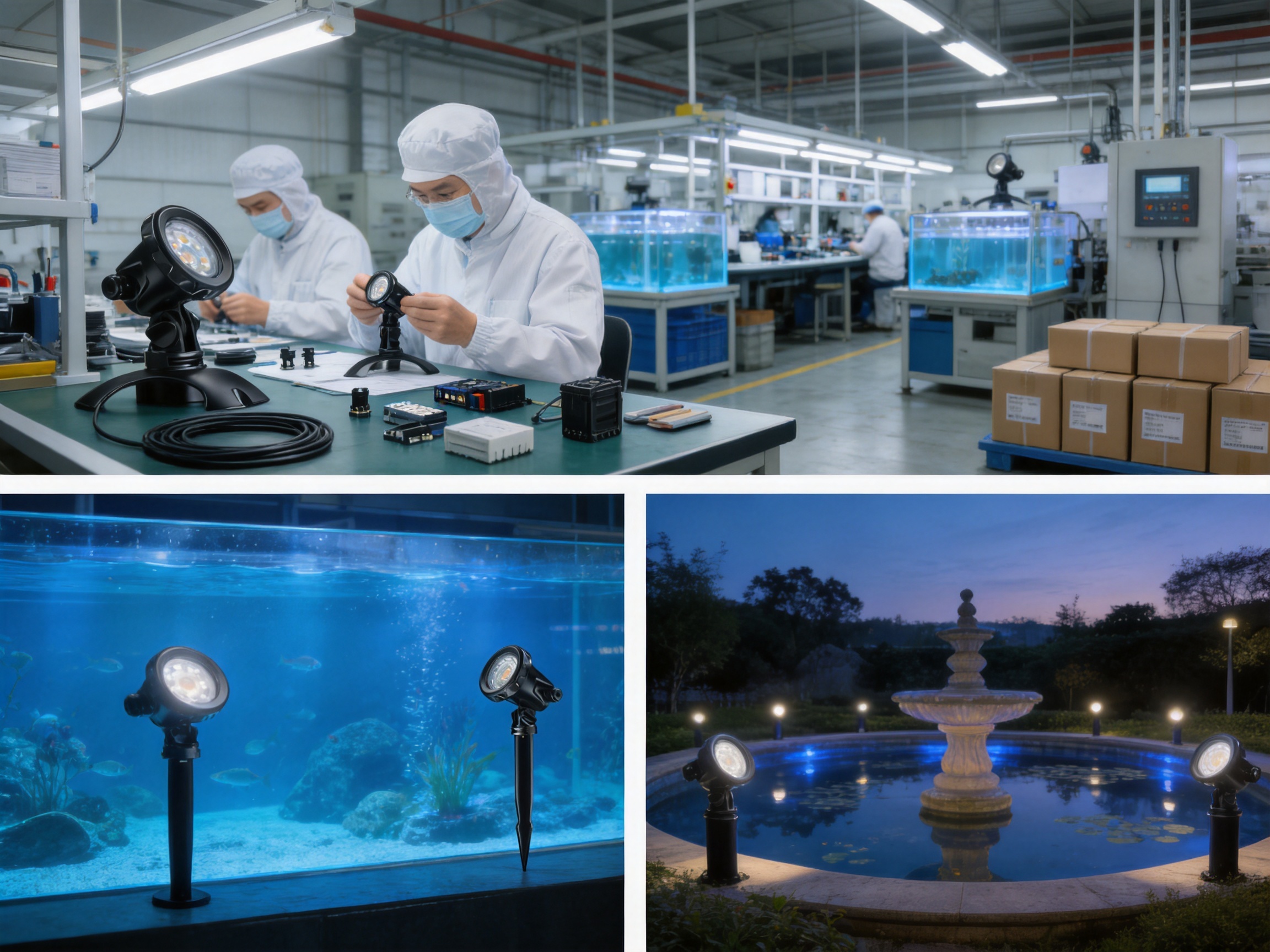
The product is associated with Sensen Group Co., Ltd., a company established in November 1985. According to the supplied company information, the group has developed through more than 30 years of activity and has continued innovating in aquarium products, aquaculture machinery, industrial equipment, and related fields.
This broad industry experience is relevant to submersible lighting because aquatic products require an understanding of water environments, equipment integration, customer installation habits, and long-term product use. A company that works across aquarium pets, aquaculture machinery, and industrial equipment can draw on knowledge from several connected sectors.
The company reports that its headquarters contains multiple functional departments, including the Sensen Research Institute, Sensen Business School, Quality Control Department, Personnel and Administrative Information Department, and Financial Department. The presence of dedicated research and quality-control functions indicates an organizational structure capable of supporting product development, production coordination, and quality management.
The supplied information also identifies several wholly owned subsidiary corporations, including ZHOUSHAN GRECH, ZHEJIANG JIALU, JIANGSU SENSEN, CHONGQING SENSEN, ZHONGSHAN SENSEN, TIANJIN SENSEN, ROLL-TAIL PET COMPANY, and MARINE ORIGANISM. In addition, the group maintains an import and export company and holds interests in several trading companies.
A group structure of this scale can support manufacturing in several ways. It may improve access to specialized production resources, facilitate distribution across different markets, and allow related businesses to share engineering, procurement, quality, and logistics experience. It also gives the company a wider understanding of product demand in domestic and international markets.
Submersible lighting requires more than selecting an LED and placing it inside a housing. The manufacturer must consider sealing, heat management, cable routing, corrosion resistance, optical distribution, mounting stability, transformer matching, and long-term exposure to humidity. The variation among the CED SERES models suggests a product-development approach based on different application requirements.
The range includes both direct-current and alternating-current low-voltage models, broad and narrow beam angles, single and multiple light configurations, and several accessory packages. This variety indicates that the product family has been developed as a system rather than as one generic lamp repeated in different colors.
Research capability is also important when products are sold across different regions. Aquarium sizes, pond construction methods, voltage conventions, installation practices, and consumer expectations can vary. A manufacturer with dedicated research and business functions is better positioned to collect market feedback and update product designs over time.
Water-related electrical products require consistent production quality. A small defect in a seal, cable entry, housing joint, or connector can compromise the performance of the entire unit. Quality-control procedures are therefore central to product reliability.
The company’s stated Quality Control Department provides an organizational foundation for monitoring product conformity. In practical terms, suitable quality control should cover component inspection, assembly accuracy, wiring, transformer compatibility, light output, housing integrity, accessory completeness, and final packaging.
Consistent dimensions are also important. The listed product measurements, cable lengths, power ratings, and accessory quantities give distributors and installers information needed for planning. Reliable production helps ensure that a selected model can be replaced, reordered, or combined with related equipment without unexpected variation.
More than three decades of operational development can help a manufacturer improve purchasing, production scheduling, inventory management, packaging, and after-sales support. These capabilities matter to wholesalers and project customers as much as the lamp’s technical specifications.
A product may be technically attractive, but commercial success also depends on stable supply, clear documentation, appropriate packaging, and responsive communication. The company’s import and export activities and broad sales network suggest experience in serving both domestic and foreign markets.
For international buyers, this experience can simplify procurement. Product families with recognizable model numbers, defined accessories, and standardized specifications are easier to list, compare, and distribute. The availability of multiple configurations can also help distributors address different customer segments without sourcing from several unrelated manufacturers.

Before installing a CED SERES Submersible Lamp, the user should identify the desired lighting effect and measure the distance between the transformer, cable route, and lamp position. The listed cable lengths range from 3m to 6.5m, so the selected model should match the physical layout without requiring unsafe extensions or tightly stretched cables.
The transformer must be placed in a dry, protected location with adequate ventilation. It should not be submerged, placed where water can collect, or covered by materials that prevent heat dissipation. Cable connections should be kept away from standing water unless they are specifically designed and rated for that environment.
The lamp should be positioned securely. A ground stake is suitable for soil and landscaped areas, while a rubber-foot bracket is better for a stable, smooth surface. The light should not be placed where it can be struck by stones, maintenance tools, pumps, or moving decorative components.
For aquariums, users should consider the behavior of fish and the growth pattern of plants. A lamp placed too close to glass may create unwanted reflections. A lamp aimed directly toward the viewer may cause glare. In many cases, positioning the lamp at an angle or partially behind a decorative feature creates a softer and more attractive result.
For ponds and garden features, the depth and movement of water should be considered. A fountain outlet, waterfall, or rapidly moving stream may require a more secure mounting position than a quiet ornamental pond. The cable should be routed so that it does not become a tripping hazard or interfere with routine garden maintenance.
Beam angle should be selected according to the size and distance of the target. A broad 120-degree beam is effective when the lamp is close to a wide subject. A narrow 30-degree beam is better when the lamp is farther away or when the objective is to emphasize a particular feature.
The 80-degree CQD-135B configuration can be used where a moderate spread is preferred. It may be suitable for a central decorative object or a medium-sized area that needs more direction than a broad floodlight but less concentration than a narrow spotlight.
Warm white light generally supports a natural appearance and can make a display feel calm and refined. Colorful light is more dramatic and can be useful for special events or decorative scenes. When both effects are used in one environment, the colors should be coordinated rather than placed randomly.
Too many strong colors can make an aquarium appear visually crowded and may make it difficult to observe fish or plants. A restrained arrangement, such as warm white illumination for the main subject and color around the background, often creates a more balanced result.
The low power ratings of the range make it possible to design targeted lighting scenes with modest energy consumption. Users can reduce unnecessary operating time by connecting lighting to a timer or control system suitable for the installation. Aquariums should maintain a regular light cycle, while garden lighting can be scheduled for evening hours.
Energy efficiency should be assessed as part of the complete system. The lamp, transformer, control equipment, and operating schedule all affect consumption. A correctly sized transformer and an appropriate number of lamps can help avoid needless losses and excessive output.
Routine maintenance helps preserve both appearance and performance. The lamp surface should be checked for algae, mineral deposits, dirt, or biological growth. Deposits can reduce light output and change the beam pattern. Cleaning should be performed with methods and materials that do not damage the housing, lens, cable, or sealing surfaces.
Before cleaning or repositioning the lamp, the power supply should be switched off and disconnected according to safe operating procedures. The cable should be inspected for cuts, abrasion, exposed conductors, or loose connections. Any damaged component should be removed from service until it has been properly evaluated or replaced.
In outdoor applications, seasonal inspection is especially useful. Soil movement, plant growth, storms, and maintenance work can change the lamp’s position or place stress on the cable. In aquariums, changes in water chemistry, algae growth, and equipment rearrangement can affect the lighting result.
Transformers should also be checked for signs of overheating, moisture exposure, or physical damage. The transformer rating must be compatible with the total connected load. Multi-light models should not be connected to an undersized power supply.
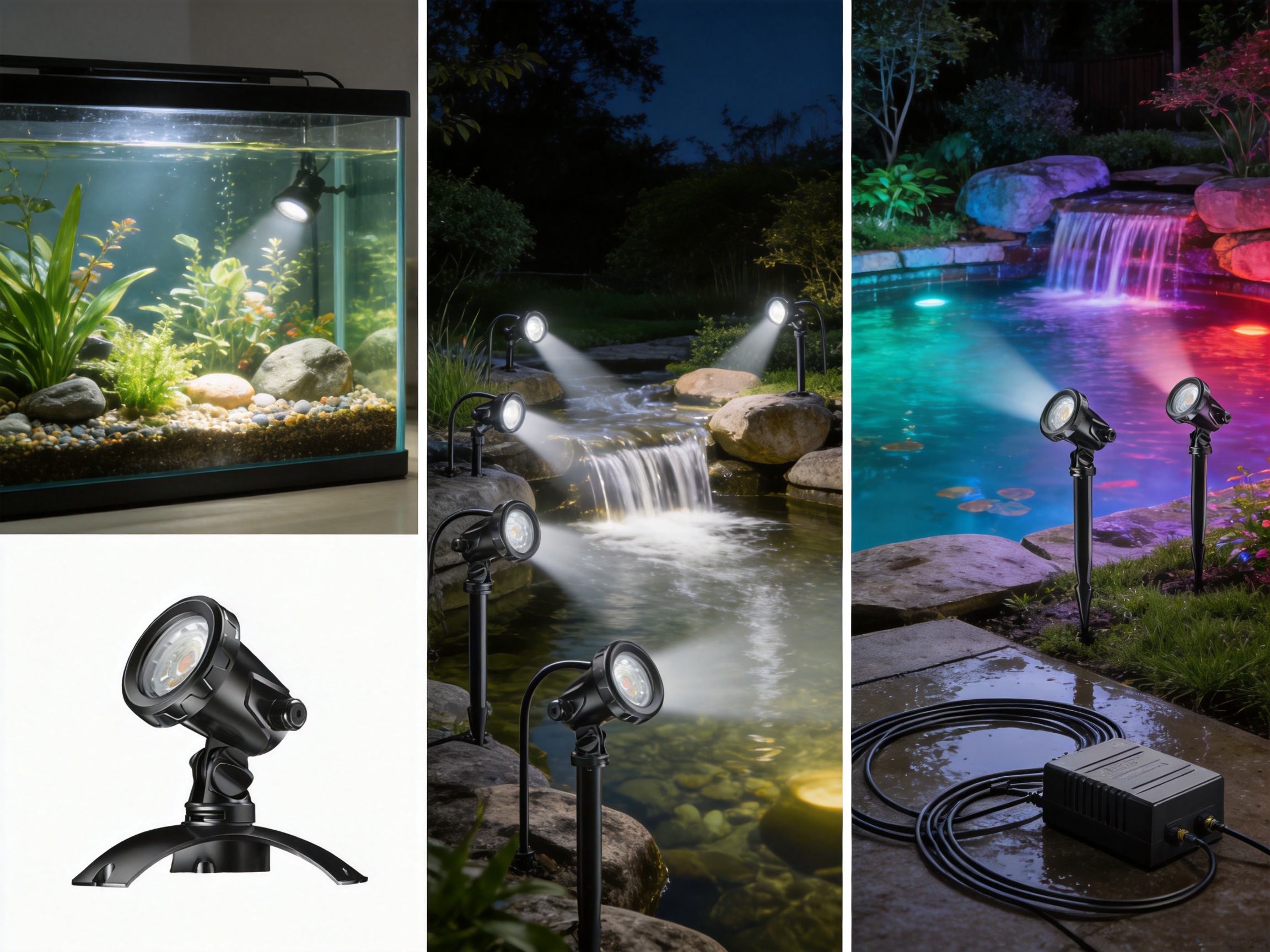
The CED SERES Submersible Lamp can be used in home aquariums, public displays, ornamental ponds, fountains, water walls, garden landscapes, and other decorative aquatic installations. Its range of beam angles and mounting accessories allows it to serve both small-scale and larger visual projects.
In a home aquarium, the lamp can highlight aquatic plants, driftwood, rocks, or a central decorative structure. In a garden pond, it can illuminate fish, water movement, a pond edge, or a small waterfall. In a fountain, a narrow beam can emphasize the rising water column, while a broad beam can illuminate the basin.
Water walls and architectural features may benefit from multiple lamps positioned at regular intervals. The multi-light configurations can help create a repeated pattern across a long installation. The low-voltage format also supports discreet placement where a larger lighting fixture would distract from the design.
Retail aquarium displays, hospitality environments, and exhibition installations can use colorful models to create a stronger visual identity. Because the range includes warm-white and colorful choices, the same general product family can be applied to different display themes.
It is designed for aquarium, pond, fountain, garden, and other aquatic or outdoor lighting applications. Its amphibious, waterproof, and corrosion-resistant design makes it suitable for locations exposed to immersion, splashing, or humidity when installed correctly.
The listed models use either 12VDC or 12VAC. The exact voltage depends on the model, so the lamp should be connected only to the specified transformer or power supply.
The product is intended for aquatic applications, including aquarium environments. Users should follow the product installation instructions, protect all electrical connections, and inspect the lamp and cable before use.
The CED-120, CED-120B, CED-120C, and CLD-302 are listed with 30-degree beam angles. These models are suitable for focused highlighting.
The CED-105, CED-110, CED-110B, and CED-110C use 120-degree beams. The CQD-135B uses an 80-degree beam and provides an intermediate distribution pattern.
Yes. The CQD-135B is listed with a colorful light source. The CED-105, CED-110, CED-110B, and CED-110C are listed with warm-white/colorful options. The CED-120 series and CLD-302 are listed with warm-white light sources.
Depending on the model, mounting options include ground stakes, mounting brackets, and brackets with rubber feet. The accessory quantity varies by configuration.
The listed cable lengths range from 3m to 6.5m. Most models have 5m cables, the CQD-135B has a 6.5m cable, and the CLD-302 is listed with 3m and 2 × 1.5m cable sections.
Several models are specifically available in multi-light configurations. However, the combined load must remain within the capacity of the transformer and the complete electrical system. The exact connection method should be confirmed before installation.
Buyers should confirm the model number, voltage, power, beam angle, cable length, light color, dimensions, transformer rating, and included accessories. The listed power entry for the CED-110B is incomplete, so its precise wattage should be verified with the supplier.
It is designed specifically for wet and outdoor environments and combines low-voltage operation with underwater installation, optical options, multiple mounting accessories, and several power configurations. Standard indoor lamps generally do not provide the same combination of environmental protection and installation flexibility.
The product is associated with Sensen Group Co., Ltd., an established manufacturer involved in aquarium products, aquaculture machinery, industrial equipment, and related fields.
The CED SERES Submersible Lamp is a flexible lighting family for aquariums, ponds, fountains, water walls, and garden features. Its most significant advantages are low-voltage operation, amphibious waterproof and corrosion-resistant construction, strong optical distribution, and a broad choice of beam angles and configurations.
The product range is practical because it does not force every installation into the same format. Compact models can provide discreet lighting for smaller aquariums, while multi-light versions can support larger displays. Broad beams are available for general coverage, and narrow beams are available for focused highlighting. Warm-white, colorful, and colorful-cover options allow users to adjust the visual character of the installation.
The manufacturing background of Sensen Group Co., Ltd. adds further value. Its long operating history, research and quality-control structure, broad subsidiary network, and experience in aquarium and industrial sectors provide a foundation for product development and commercial supply. These strengths are particularly relevant for aquatic lighting, where dependable construction, consistent specifications, and appropriate accessories are essential.
When selected according to the tank or landscape layout, installed with the correct transformer, and maintained properly, the CED SERES Submersible Lamp can provide an efficient and visually effective alternative to ordinary above-water or indoor lighting. Its combination of technical variety and aquatic-oriented construction makes it suitable for both practical illumination and creative environmental design.
Sensen Group Co., Ltd. Product specification sheet for the CED SERES Submersible Lamp.
Sensen Group Co., Ltd. Corporate information and company history supplied for product presentation.
CED SERES Submersible Lamp model data, including voltage, power, beam angle, cable length, transformer rating, accessories, light source, and dimensions.
General principles of low-voltage lighting design for aquarium, pond, fountain, and garden applications.
General installation and maintenance considerations for electrical products used near water.


 No. 61-79, Baima Street, Maao Town, Dinghai District, Zhoushan City, Zhejiang Province, China.
 0086 580 8082088 / 8081168
 0086 580 8080978
 songhua@sunsun-china.com