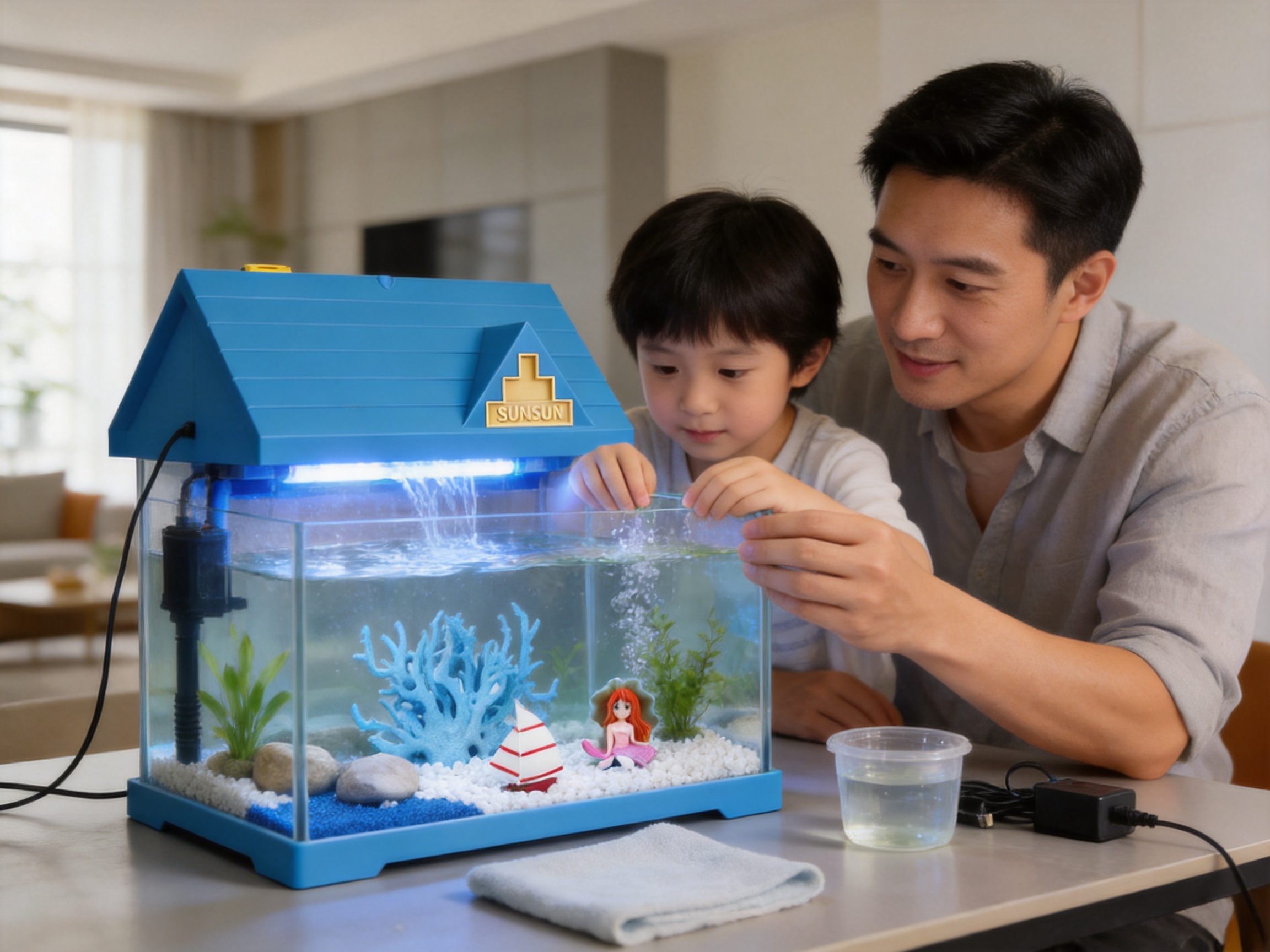
Modern homes often need products that combine practical function, attractive design, and an appropriate sense of scale. A large aquarium can create an impressive visual centerpiece, but it may require considerable floor space, more water, heavier equipment, and a higher level of maintenance. A compact desktop aquarium offers a different experience. It can bring the beauty of aquatic life into a study, bedroom, office, children's room, reception area, or living room without dominating the surrounding space.
The TF-250 Hut Diary desktop fish tank is designed for this compact-aquarium lifestyle. It is a 7.5-liter desktop aquarium that combines a small aquatic environment with integrated LED lighting, a water pump, double-layer filtration, and a clear super-white glass viewing area. Its design is also intended to support a creative parent-child activity rather than functioning only as a container for fish. The cabin-themed concept encourages users to create a miniature scene, personalize the aquarium, and experience the enjoyment of hands-on decoration.
This approach gives the product a distinctive position in the small fish tank market. It is not simply a basic desktop bowl, nor is it a scaled-down version of a large professional aquarium system. Instead, it is a compact, structured, and visually focused aquarium kit for users who want manageable aquatic enjoyment, convenient daily operation, and an opportunity to express creativity.
The product is manufactured by Sensen Group Co., Ltd., a company with a long history in aquarium products, aquaculture machinery, industrial equipment, and related pet industries. Through decades of development, the group has established research, quality control, production, management, and sales capabilities designed to support a broad range of aquarium applications. These organizational strengths are important because a small aquarium still depends on coordinated design, stable components, appropriate filtration, reliable lighting, and consistent production standards.
1. Product Overview and Design Positioning
The TF-250 Hut Diary is a desktop fish tank identified by the model designation TF-250. Its external dimensions are approximately 270 millimeters in length, 220 millimeters in width, and 336 millimeters in height. With a capacity of approximately 7.5 liters, it belongs to the compact aquarium category and is intended for limited-space environments.
The vertical proportion of the aquarium helps it make efficient use of a desktop or shelf area. Rather than spreading widely across a surface, the design uses height to create a more noticeable visual presence. This is useful in rooms where horizontal space is limited. The tank can be positioned on a suitable stable table, cabinet, counter, or other supporting surface that can safely carry the combined weight of the aquarium, water, equipment, and decorative materials.
The cabin diary concept gives the aquarium a more emotional and imaginative identity. The product presentation emphasizes the idea of lighting up childhood dreams and preserving pleasant memories. This language reflects the aquarium's role as a lifestyle product. It is intended to provide visual enjoyment and a small creative project, not merely serve as technical aquarium equipment.
The concept also supports family participation. Children can observe fish behavior, learn how water and filtration work, and help arrange approved decorative materials under adult supervision. Parents can use the aquarium as a simple introduction to aquatic care, responsibility, observation, and design. Because the tank is relatively compact, it may be more approachable for beginners than a larger system requiring extensive equipment selection and installation.
Decorative theme materials are not included in the package. This is an important point for buyers. The cabin or miniature landscape shown in promotional materials may be used as inspiration, but customers should choose safe, aquarium-appropriate decorations separately. All decorative elements must be clean, non-toxic, stable in water, and free from sharp edges that could injure fish or damage the tank.
Compact Dimensions for Flexible Placement
The footprint of approximately 270 by 220 millimeters allows the TF-250 to fit into many everyday indoor environments. It can serve as a decorative feature on a work desk, reception counter, bookshelf, or side cabinet. The compact footprint can also make it suitable for apartments, dormitories, small offices, classrooms, and other spaces where a traditional aquarium might be impractical.
Although the tank is small, its height and clear glass construction help provide visual depth. Aquatic plants, hardscape elements, and carefully selected decorations can be arranged vertically to create layers. This can make the aquarium appear more spacious than its actual water volume while preserving a tidy and organized appearance.
Placement should always take safety into account. A filled aquarium is much heavier than an empty aquarium because water contributes substantial weight. The supporting surface must be level, stable, water-resistant, and strong enough for the complete setup. The tank should also be positioned away from direct sunlight, extreme temperature changes, electrical hazards, and locations where it may be knocked over.
2. Main Product Specifications
The following table summarizes the principal technical information provided for the TF-250 Hut Diary desktop fish tank.
| Item |
Specification |
| Model |
TF-250 Hut Diary |
| Approximate dimensions |
Length 270 mm × Width 220 mm × Height 336 mm |
| Approximate capacity |
7.5 liters |
| LED lighting |
4 watts, blue and white light |
| Water pump |
APJ-230G, 2.5 watts |
| Filtration |
Built-in filter media box and large filter cotton |
| Glass |
Super-white glass with a clear viewing field |
| Product category |
Small fish tank and desktop aquarium |
Measurements are taken by hand, so a small dimensional variation may occur. Buyers should treat the listed measurements as approximate and rely on the physical product for final size confirmation. The stated capacity is also an approximate nominal value. The actual water volume may be lower after accounting for substrate, decorations, filter components, and the recommended operating water level.
3. Integrated LED Lighting System
The TF-250 includes a 4-watt LED lighting system with blue and white light. Its high-brightness design uses SMD lamp beads and a stated scientific light ratio. A control button allows the user to turn the lighting on or off conveniently.
Lighting is one of the most visible components of a desktop aquarium. It affects how fish, plants, decorations, and water movement appear throughout the day. A well-positioned light can make a compact tank look brighter and more attractive, while insufficient or poorly distributed illumination can make the aquarium appear dull.
The combination of blue and white light is intended to create a balanced visual effect. White light helps reveal the natural colors of fish and decorative elements. Blue light can add depth and a calm aquatic atmosphere. In a small aquarium used as an interior decoration, this combination may help the tank function as a subtle visual feature during evening hours.
The integrated structure also simplifies installation. Users do not need to select a separate lamp, find a suitable mounting system, or manage another power connection. This can make the product more accessible to beginners and reduce the visual clutter associated with multiple independent accessories.
Lighting and Daily Aquarium Management
Although LED lighting is convenient, it should be operated as part of a consistent aquarium routine. Fish and aquatic organisms benefit from a regular day-and-night schedule rather than continuous illumination. Excessive lighting may encourage unwanted algae growth, especially when the aquarium receives additional light from windows or room lamps.
Users who keep live plants should select species suitable for a compact aquarium and the available light intensity. The supplied 4-watt system is an integrated product feature, but plant requirements vary. Low-light plants may be more appropriate for a small desktop setup than species that require intense professional lighting and supplemental carbon dioxide.
The light should be kept dry and operated according to the product instructions. Electrical connections should be positioned safely away from splashing water. Before performing maintenance, users should switch off and unplug electrical components as appropriate.
4. Double-Layer Filtration for Clearer Water
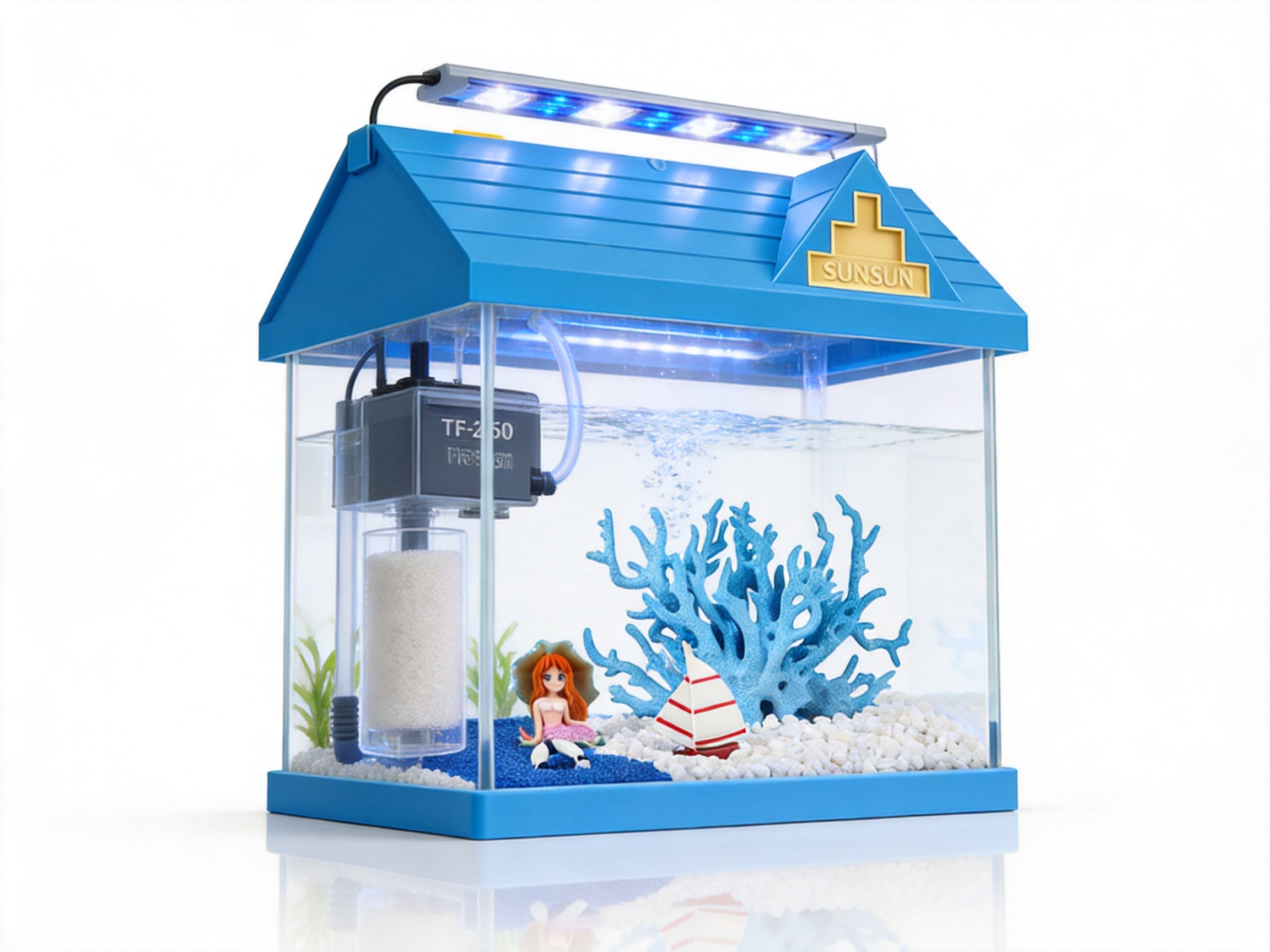
One of the most important advantages of the TF-250 is its double-layer filtration system. The product includes a built-in filter media box and large filter cotton. This arrangement is designed to improve water quality and reduce the frequency of water changes when the aquarium is maintained correctly.
Filtration performs several important functions. Mechanical filtration captures suspended particles, uneaten food, debris, and other visible impurities. Biological filtration provides a surface where beneficial microorganisms can develop. These microorganisms contribute to the natural processing of fish waste and help support a more stable aquatic environment.
The built-in filter media box creates a dedicated space for filter material. This is more organized than placing loose filter media randomly inside a small aquarium. The large filter cotton increases the available mechanical filtration area and can help collect particles as water passes through the system.
For a desktop aquarium, an integrated filtration system offers a significant convenience advantage. Small tanks have limited internal space, so a separate external filter may appear oversized or create unnecessary visual obstruction. A built-in system keeps the equipment visually coordinated with the aquarium and helps preserve the usable display area.
Why Filtration Matters More in Small Aquariums
Small aquariums often require careful management because their limited water volume can change more quickly than the water in a larger aquarium. Waste concentration, temperature, and water chemistry may fluctuate faster if the tank is overstocked, overfed, or neglected.
The TF-250's filtration system can support water clarity and help manage routine impurities, but no filter can replace responsible aquarium care. The filter should be operated continuously unless maintenance or an emergency requires otherwise. Filter cotton should be rinsed or replaced according to its condition and the manufacturer's guidance. If it is cleaned, users should avoid using detergents or harsh chemicals that could harm aquatic life.
Filter media should generally be handled carefully so that beneficial microorganisms are not removed unnecessarily. Cleaning all media at the same time may disrupt biological stability. A gradual and appropriate maintenance routine is preferable, particularly after the aquarium has matured.
Feeding should also be controlled. Excess food quickly becomes waste, and in a small aquarium this can affect water quality. Fish should receive only an amount they can consume within a short period. Uneaten food should be removed whenever possible.
5. Super-White Glass and Visual Clarity
The TF-250 uses super-white glass to create a clear viewing field and a high light-transmission effect. This material selection supports the visual purpose of the aquarium. An aquarium is both a living environment and a display object, so transparency and color presentation are central to the user experience.
Compared with glass that has a stronger visible tint, super-white glass can provide a cleaner appearance. Fish colors, plant tones, substrate textures, and decorative details may appear more natural and vivid. The result is particularly valuable in a small aquarium, where every visible section contributes to the overall impression.
Clear glass also improves observation. Users can monitor fish activity, water movement, plant condition, and the accumulation of debris more easily. Children can observe aquatic behavior through an unobstructed viewing area, which supports the educational value of the product.
Glass still requires appropriate care. Abrasive cleaning materials may scratch the surface, and hard objects should not be dragged across the panels. Algae should be removed with aquarium-safe tools. The outside surface can be cleaned with a soft cloth, while the inside should be maintained using materials intended for aquarium use.
Visual Design as a Competitive Advantage
Many entry-level desktop aquariums focus primarily on low cost and basic water containment. While affordability can be useful, a basic container may not provide a complete visual experience. It may require separate lighting, filtration, and accessories, resulting in a less coordinated appearance.
The TF-250 takes a more integrated approach. The combination of super-white glass, built-in lighting, internal filtration, and a cabin-inspired appearance creates a more complete presentation. Buyers do not need to assemble a collection of unrelated components before the aquarium can become a decorative feature.
This does not mean that the TF-250 is intended to replace large aquariums or specialized aquascaping systems. Instead, its competitive strength lies in usability, compactness, visual coordination, and accessibility. It is designed for users who want a finished desktop aquarium concept with room for personal creativity.
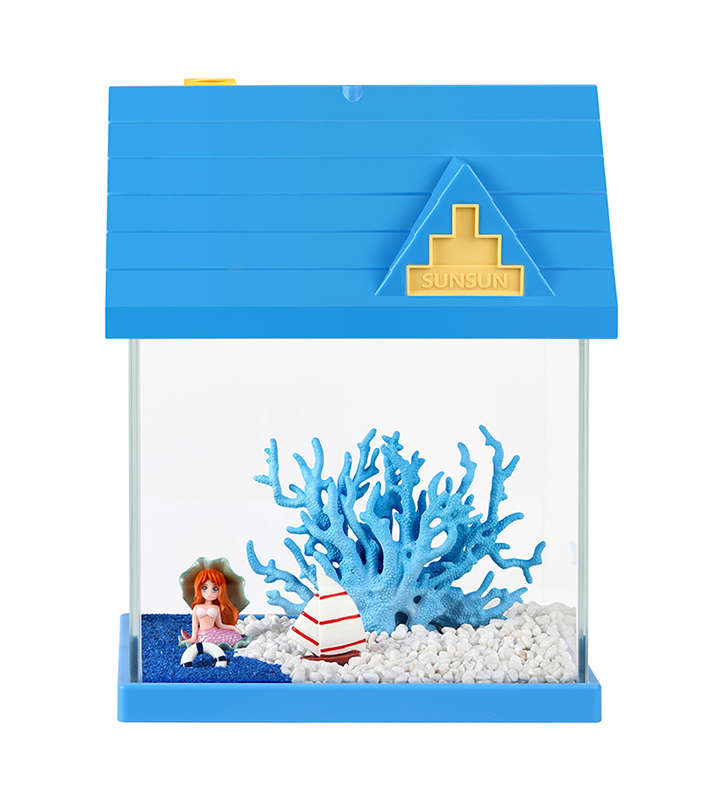
TF-250 Hut Diary desktop fish tank
6. A Creative Parent-Child Aquarium Experience
The TF-250 is positioned as more than a fish container. Its Hut Diary concept encourages parents and children to participate in the creative process. This can include planning a miniature theme, arranging safe decorative materials, observing aquatic organisms, and developing a routine for feeding and maintenance.
Hands-on projects can help children understand how living systems require care. A child may learn that fish need clean water, suitable food, adequate oxygen, stable conditions, and a safe environment. These lessons can be introduced through daily observation rather than through abstract explanations alone.
The aquarium can also stimulate imagination. A cabin-inspired theme may lead children to create a small story or landscape around the aquatic environment. They can think about where a miniature house might be placed, how plants could represent a garden, or how different colors could create a particular atmosphere. The product therefore combines an aquarium with an open-ended creative activity.
Adult supervision remains essential. Children should not handle electrical connections, move the filled aquarium, add unapproved materials, or change water without assistance. Decorative objects should be checked by an adult before entering the aquarium. Small parts may also present a safety concern for young children and should be kept away from children who might swallow them.
Educational Value of a Desktop Aquarium
A compact aquarium can introduce several basic scientific concepts. Children can observe how water moves through a filter, how light affects the appearance of aquatic plants, and how fish respond to their surroundings. They can keep a simple observation record and note changes in fish behavior, water clarity, or plant growth.
The aquarium also offers an opportunity to discuss responsibility. Routine tasks such as feeding at the correct time, checking the equipment, and observing water conditions can become part of a family schedule. These activities are simple, but they demonstrate that living creatures depend on consistent care.
Because the TF-250 has a manageable size, it may be less intimidating for families who are new to aquariums. A large aquarium can involve more equipment, heavier maintenance, and greater initial complexity. A small system allows beginners to learn fundamental habits before considering a more advanced setup.
7. Practical Benefits Compared with Basic Desktop Tanks
The small aquarium market includes bowls, open containers, decorative jars, and compact aquariums with varying levels of equipment. The TF-250 offers several advantages over the most basic alternatives.
First, it includes an integrated LED light. A simple bowl may require an external lamp or may be used without dedicated lighting. The built-in light gives the user more control over the aquarium's appearance and provides illumination for compatible aquatic plants.
Second, the TF-250 includes a water pump and a double-layer filtration structure. A basic container without filtration may accumulate waste quickly and require frequent manual cleaning. Although regular water changes remain necessary, filtration can improve convenience and help maintain a clearer display.
Third, the super-white glass offers a more refined viewing experience than a low-clarity container. The aquarium is designed as a display product, so visual quality is part of its value.
Fourth, the product provides a coordinated design rather than a collection of separate accessories. Matching lighting, filtration, and tank structure can create a cleaner appearance and simplify setup.
Fifth, the cabin diary concept gives the aquarium a distinctive emotional and creative direction. Buyers can personalize the interior and create a themed display instead of settling for a generic container.
These advantages should be considered alongside the product's compact capacity. A 7.5-liter aquarium is appropriate only for aquatic life suitable for that volume. It should not be overstocked, and users should research species compatibility before adding fish or other organisms.
8. Suitable Use Environments
The TF-250 can fit a variety of indoor environments when placed on a suitable support surface. In a home office, it can provide a calming visual break during work. In a living room, it can serve as a small decorative feature. In a child's room, it can become part of a supervised learning activity. In a reception area or small office, it can add a natural element without requiring the floor space of a large aquarium.
Its compact dimensions may also suit apartments and other residences where space is limited. The aquarium can be used by beginners who want to explore fishkeeping without making a large initial commitment. It may also appeal to experienced aquarium owners who want a small secondary display or a simple desktop project.
The aquarium should not be placed where vibrations, direct heating, air-conditioning drafts, or frequent impact may affect the system. A stable indoor temperature is generally preferable. Direct sunlight can increase temperature and encourage algae, so a location away from strong window exposure is recommended.
Users should also consider access to electrical power and maintenance space. The aquarium should be positioned where the light and pump can be connected safely and where routine cleaning can be performed without difficulty.
9. Recommended Setup Process
Before setup, inspect the aquarium, pump, lighting, filter components, and glass panels for visible damage. Read the product instructions and confirm that the intended support surface is level and strong enough.
Rinse appropriate substrate and decorative materials with clean water. Do not use soap, household cleaners, painted objects of unknown composition, metal items that may corrode, or materials with sharp edges. Theme materials are not included with the product, so users must select decorations carefully.
Install the filter media according to the product design. Confirm that the filter cotton and media box are positioned correctly and that water can pass through the intended filtration path.
Place the aquarium on its final support surface before filling it. Moving a filled aquarium can place stress on the glass and seams. Add substrate and decorations in a balanced arrangement. Avoid placing excessive weight against the glass or blocking the pump inlet and outlet.
Add treated water gradually. Tap water may contain chlorine or other substances that are harmful to fish, so an appropriate aquarium water conditioner may be necessary. Allow the system to operate and establish suitable conditions before introducing aquatic life.
Start the pump and check water circulation. Confirm that there are no leaks, unusual noises, or blocked passages. Test the LED light and make sure the electrical connections remain dry.
The aquarium should ideally complete an appropriate biological cycling process before fish are added. New aquarium owners should learn about the nitrogen cycle and test water parameters when necessary. A small aquarium may be compact, but it still benefits from the same fundamental principles of responsible fishkeeping.
Choosing Aquatic Life Responsibly
The 7.5-liter capacity places clear limits on stocking. Users should not select fish solely because they are small at the time of purchase. Adult size, swimming behavior, activity level, oxygen requirements, compatibility, and waste production all matter.
In many cases, a compact aquarium may be more suitable for carefully selected small aquatic organisms, plants, or a simple low-bioload setup than for multiple active fish. Buyers should consult reliable aquarium care guidance and obtain advice from qualified aquarium professionals before making a stocking decision.
Overstocking is one of the most common causes of poor water quality. It can overwhelm filtration, increase maintenance demands, and create stress for aquatic life. A modest, carefully planned setup is generally more successful than an overcrowded display.
10. Maintenance and Long-Term Operation
Regular observation is the foundation of aquarium care. Users should check whether the pump is operating, whether water is circulating, whether the light is functioning, and whether fish appear active and healthy. Changes in behavior, breathing, color, appetite, or position may indicate a problem.
Water changes should be performed according to the aquarium's condition, stocking level, test results, and maintenance schedule. A filter can improve water clarity, but it does not eliminate the need for partial water changes. New water should be prepared appropriately and added at a suitable temperature.
The filter cotton should be inspected for clogging. If it becomes heavily blocked, water flow may decrease and the pump may operate less effectively. Cleaning or replacing the material should follow the product instructions. Filter media should not be exposed to detergents, disinfectants, or untreated hot water.
Algae management is also part of routine care. Some algae growth is natural, but excessive growth may result from too much light, too much food, or an imbalance in the aquarium. Adjusting the lighting schedule, reducing feeding, removing algae manually, and improving maintenance may help.
The super-white glass should be cleaned with suitable aquarium tools. Users should avoid pressing sharp gravel or hard debris against the glass. Exterior surfaces should be dried around electrical components, and water spills should be addressed promptly.
During maintenance, electrical equipment should be switched off when required. Never allow a pump to operate without sufficient water. The pump should not be handled with wet hands when connected to power. Safe electrical practice is essential for any aquarium, regardless of size.
11. Manufacturing Strengths and Product Development Capability
The performance of an aquarium depends not only on its visible design but also on how its components are developed, assembled, tested, and supported. Sensen Group Co., Ltd. has operated since 1985 and has developed experience across aquarium pets, aquaculture machinery, industrial equipment, and related product categories.
The company states that it has established a range of functional departments, including a research institute, business school, quality control department, personnel and administrative information department, and financial department. This type of organizational structure supports the development of products that require coordination between design, engineering, production, inspection, documentation, and customer service.
A research and development capability can help a manufacturer improve lighting arrangements, pump performance, filtration layouts, material selection, and user convenience. In a compact aquarium, these elements must fit into a limited space without creating excessive noise or obstructing the viewing area. Product development therefore requires attention to both engineering and appearance.
Quality control is equally important. Glass products must be checked for appearance and integrity. Pumps and lighting components must be assembled correctly. Filter structures must allow appropriate water flow. Packaging must protect the aquarium during storage and transportation. Consistent inspection helps reduce the risk of defects reaching customers.
The group also operates several wholly owned subsidiary companies and maintains interests in trading companies, according to the supplied company information. This broader business network can support manufacturing, distribution, import and export operations, and market access. For international customers, an established export structure can be valuable when sourcing aquarium products for distribution or project use.
Production Coordination for Integrated Aquarium Products
An integrated desktop aquarium is not made from a single component. It requires coordination between the glass body, filter structure, water pump, LED lighting, electrical parts, packaging, and product instructions. Each part must work with the others.
The TF-250 demonstrates this integrated approach through its combination of a clear tank, 4-watt LED light, 2.5-watt APJ-230G water pump, built-in filter media box, and large filter cotton. The specifications are organized as a complete product system rather than as unrelated accessories.
Manufacturing coordination also affects the user experience. A properly designed filter should be easy to access. A correctly positioned light should illuminate the display effectively. A suitable pump should provide circulation without creating an unnecessarily disruptive appearance. A well-designed package should protect the product while keeping setup instructions understandable.
The company's long-term specialization in aquarium and aquatic equipment provides a foundation for this type of product development. Industry experience does not eliminate the need for continuous testing and improvement, but it can provide valuable knowledge about common user requirements, equipment compatibility, and market expectations.
12. Advantages for Distributors and Retailers
For distributors and retailers, the TF-250 offers a clear product story. It can be presented as a compact aquarium with integrated lighting and filtration, a family creativity product, and a decorative desktop feature. This gives retailers several ways to communicate its value to different customer groups.
Customers who are new to fishkeeping may appreciate the integrated equipment and manageable size. Parents may respond to the parent-child DIY concept. Office buyers may focus on the compact footprint and visual appeal. Aquarium hobbyists may be interested in using it as a small planted display or a specialized secondary tank, provided the setup is appropriate for the selected aquatic life.
The product can also be displayed effectively in retail environments. A functioning demonstration unit can show the clarity of the super-white glass, the appearance of the blue and white LED light, and the visual effect of water circulation. Clear display signage should explain that theme materials are not included and that the aquarium's capacity is approximately 7.5 liters.
Retailers should provide responsible stocking guidance rather than encouraging customers to place too many fish in the tank. Good advice improves customer satisfaction and protects the reputation of the product category. Accessories such as aquarium-safe decorations, water conditioner, maintenance tools, compatible plants, and suitable food may be offered separately.
13. Product Limitations and Realistic Expectations
A balanced product evaluation should recognize that the TF-250 is a compact aquarium, not a large-volume aquatic ecosystem. Its small capacity means that water quality can change quickly if the aquarium is overfed, overstocked, or poorly maintained. Users should not expect a small tank to provide the same stability as a substantially larger aquarium.
The integrated filtration system helps support water quality, but it does not make maintenance unnecessary. The LED light improves visibility and appearance, but plant selection must still match the available conditions. The super-white glass provides a clear view, but it must be protected from scratches and cleaned properly.
Because decorative theme materials are not included, buyers who want to recreate a particular cabin or miniature scene will need to source suitable materials independently. Any decoration must be safe for aquatic life and compatible with the available space.
These limitations are not weaknesses unique to the TF-250. They are normal considerations for compact aquariums. The product performs best when buyers understand its intended use, select an appropriate stocking plan, and follow a consistent maintenance routine.
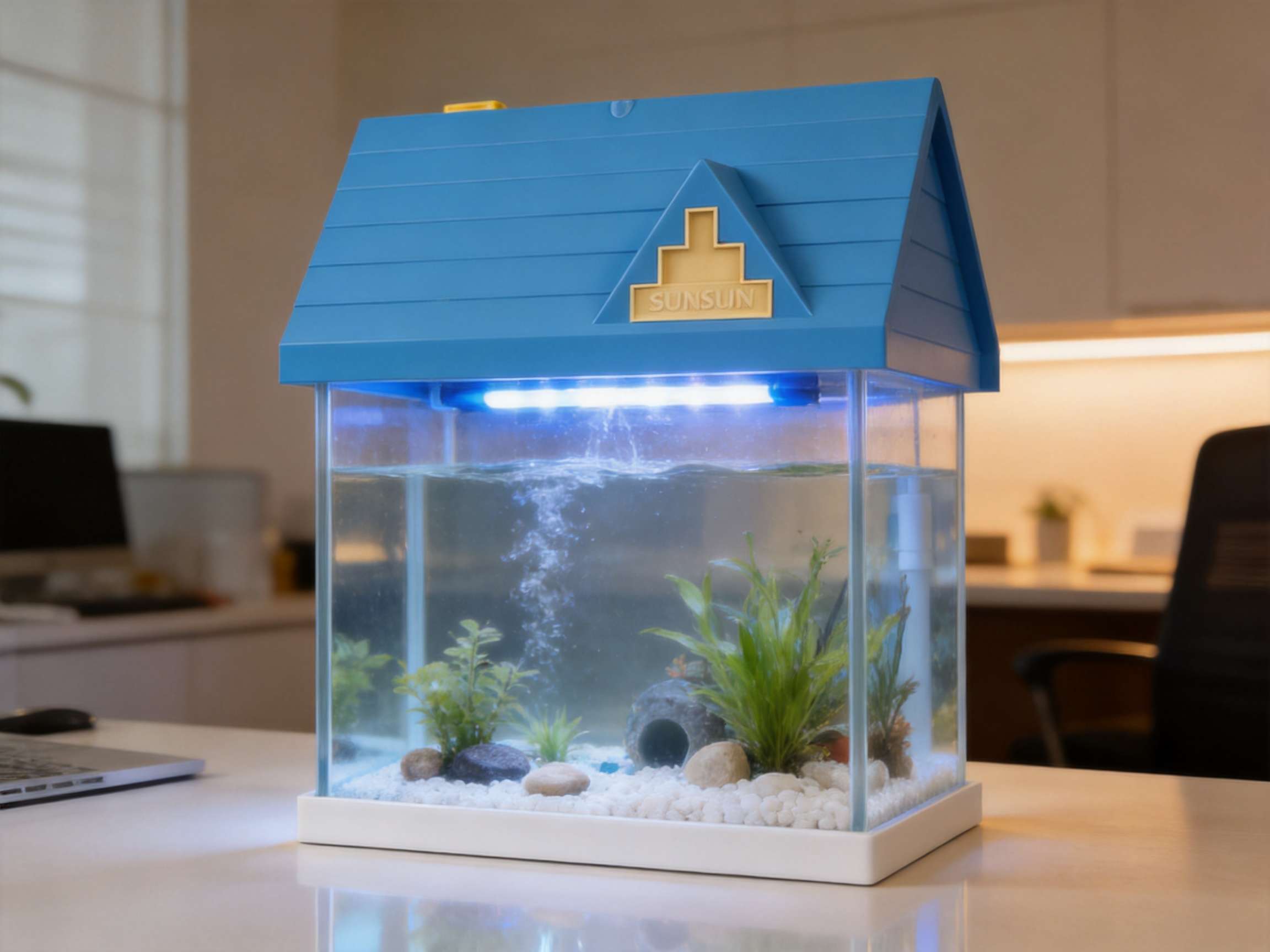
14. Why the TF-250 Is a Strong Choice for Beginners
Beginners often need a product that is understandable without being completely bare. A simple bowl may appear easy to use, but it can leave the owner without adequate circulation, filtration, or lighting. A large aquarium may provide greater stability but can introduce more equipment and maintenance complexity.
The TF-250 occupies a practical middle position. It is small enough to fit into everyday spaces and simple enough to approach as a first aquarium, while still providing a pump, filter structure, integrated LED lighting, and clear glass construction.
Its visual design can also encourage users to remain engaged. An attractive aquarium is more likely to receive regular attention. The cabin diary concept gives the owner a reason to personalize the display, observe changes, and maintain the aquarium as part of the home environment.
For families, the tank can provide a shared project. For individual users, it can offer a quiet and creative hobby. For offices, it can create a small natural focal point. This flexibility is one of the product's strongest practical advantages.
15. Why the TF-250 Is Suitable for Modern Interior Spaces
Interior design increasingly includes natural elements, small decorative objects, and products that combine function with emotional value. A desktop aquarium can contribute movement, light, color, and a sense of life without requiring a large installation.
The TF-250's vertical form and compact footprint allow it to fit into modern rooms where space is carefully managed. Its clear glass and integrated illumination support a clean visual appearance. The cabin-inspired concept adds character, helping the aquarium look more like a designed interior object than a purely technical device.
The aquarium can be coordinated with different design styles. Natural wood, stone-colored substrate, and green plants can create a calm landscape. Bright safe decorations can create a more playful family display. Minimal arrangements can emphasize the clarity of the glass and the movement of the water.
Since the decoration is not fixed as part of the package, users have room to adapt the aquarium to personal preferences. This flexibility helps the product remain relevant across different rooms, age groups, and design approaches.
16. Frequently Asked Questions
Q1: What is the water capacity of the TF-250?
The approximate capacity is 7.5 liters. The actual operating water volume may be lower after substrate, filter components, plants, and decorations are added.
Q2: What are the dimensions of the aquarium?
The listed dimensions are approximately 270 millimeters long, 220 millimeters wide, and 336 millimeters high. Because measurements may be taken by hand, a small variation of approximately one centimeter may occur.
Q3: Does the aquarium include lighting?
Yes. The TF-250 includes a 4-watt LED lighting system using blue and white light. A button is provided to switch the light on or off.
Q4: What type of filter does the aquarium use?
The aquarium uses a double-layer filtration arrangement consisting of a built-in filter media box and large filter cotton. The design is intended to support water purification and help reduce the frequency of water changes when proper maintenance is followed.
Q5: What water pump is included?
The stated water pump is an APJ-230G model with a power rating of 2.5 watts.
Q6: Is the aquarium suitable for children?
It can be suitable as a supervised family and parent-child activity. Children can help with creative decoration and observation, but adults should manage electrical connections, water changes, aquarium movement, and the selection of safe materials.
Q7: Are the cabin decorations included?
No. The theme material shown for the cabin diary concept is for reference only and is not included in the package. Buyers must obtain suitable aquarium-safe decorations separately.
Q8: Can any fish be kept in this aquarium?
No. The aquarium's 7.5-liter capacity limits the type and number of aquatic organisms that can be kept. Buyers should research adult size, behavior, compatibility, waste production, and water requirements before stocking the tank.
Q9: Does the integrated filter eliminate water changes?
No. Filtration supports water clarity and water quality management, but regular observation, partial water changes, appropriate feeding, and filter maintenance are still necessary.
Q10: Is super-white glass beneficial?
Super-white glass is designed to provide a clearer viewing field and high light transmission. It can help users see fish, plants, and decorations with less visual color distortion and can enhance the aquarium's display effect.
Q11: Where can the aquarium be placed?
It can be placed on a stable, level, water-resistant surface such as a suitable desk, cabinet, counter, or shelf. The supporting surface must be strong enough to carry the filled aquarium. Direct sunlight, extreme temperature changes, impact risks, and unsafe electrical locations should be avoided.
Q12: What makes this product different from a simple fish bowl?
The TF-250 provides integrated LED lighting, a water pump, double-layer filtration, super-white glass, and a structured desktop aquarium design. It also offers a cabin-themed creative concept, while a basic bowl generally provides only a container without integrated equipment.
17. Final Assessment
The TF-250 Hut Diary desktop fish tank is designed for users who want a compact aquarium with more structure and functionality than a basic bowl. Its 7.5-liter capacity, compact dimensions, integrated 4-watt blue-and-white LED light, APJ-230G water pump, double-layer filtration, and super-white glass work together to create a complete desktop aquarium experience.
Its strongest product advantages are integration, visual clarity, compact placement, and creative flexibility. The built-in filter media box and large filter cotton support easier water management. The LED system improves visibility and atmosphere. The super-white glass provides a clearer viewing field. The cabin diary concept transforms setup into a family-friendly creative activity.
The product also benefits from the manufacturer's long-term experience in aquarium products, aquaculture machinery, industrial equipment, and related industries. Research, quality control, production coordination, and international business capabilities provide a foundation for developing and supplying integrated aquarium systems.
At the same time, responsible use remains essential. A compact aquarium must not be overstocked, decorations must be aquarium-safe, and the filtration system cannot replace regular maintenance. Buyers who understand these requirements can use the TF-250 as an attractive, educational, and manageable introduction to aquatic life.
For homes, offices, families, beginners, and retailers seeking a distinctive small aquarium product, the TF-250 offers a balanced combination of function and emotional appeal. It is compact enough for modern spaces, equipped enough for practical use, and open-ended enough to support personal creativity.
References
1. Sensen Group Co., Ltd. Product specification information for the TF-250 Hut Diary desktop fish tank.
2. Sensen Group Co., Ltd. Product feature information concerning LED lighting, double-layer filtration, super-white glass, and integrated water circulation.
3. Aquarium maintenance principles concerning filtration, water changes, biological cycling, stocking levels, and responsible fishkeeping.
4. General guidance on aquarium-safe decorative materials, electrical safety, and compact aquarium placement.
5. General principles of LED aquarium lighting, mechanical filtration, biological filtration, and aquatic display design.


 English
 русский
 España
 Portugal
 عربي


 No. 61-79, Baima Street, Maao Town, Dinghai District, Zhoushan City, Zhejiang Province, China.
 0086 580 8082088 / 8081168
 0086 580 8080978
 songhua@sunsun-china.com