

 English
 русский
 España
 Portugal
 عربي
Li Mei | Aquarium Equipment Sales Specialist
Home / Author / Li Mei | Aquarium Equipment Sales Specialist / A Practical Guide to the HCB Rear Side Filter Fish Tank
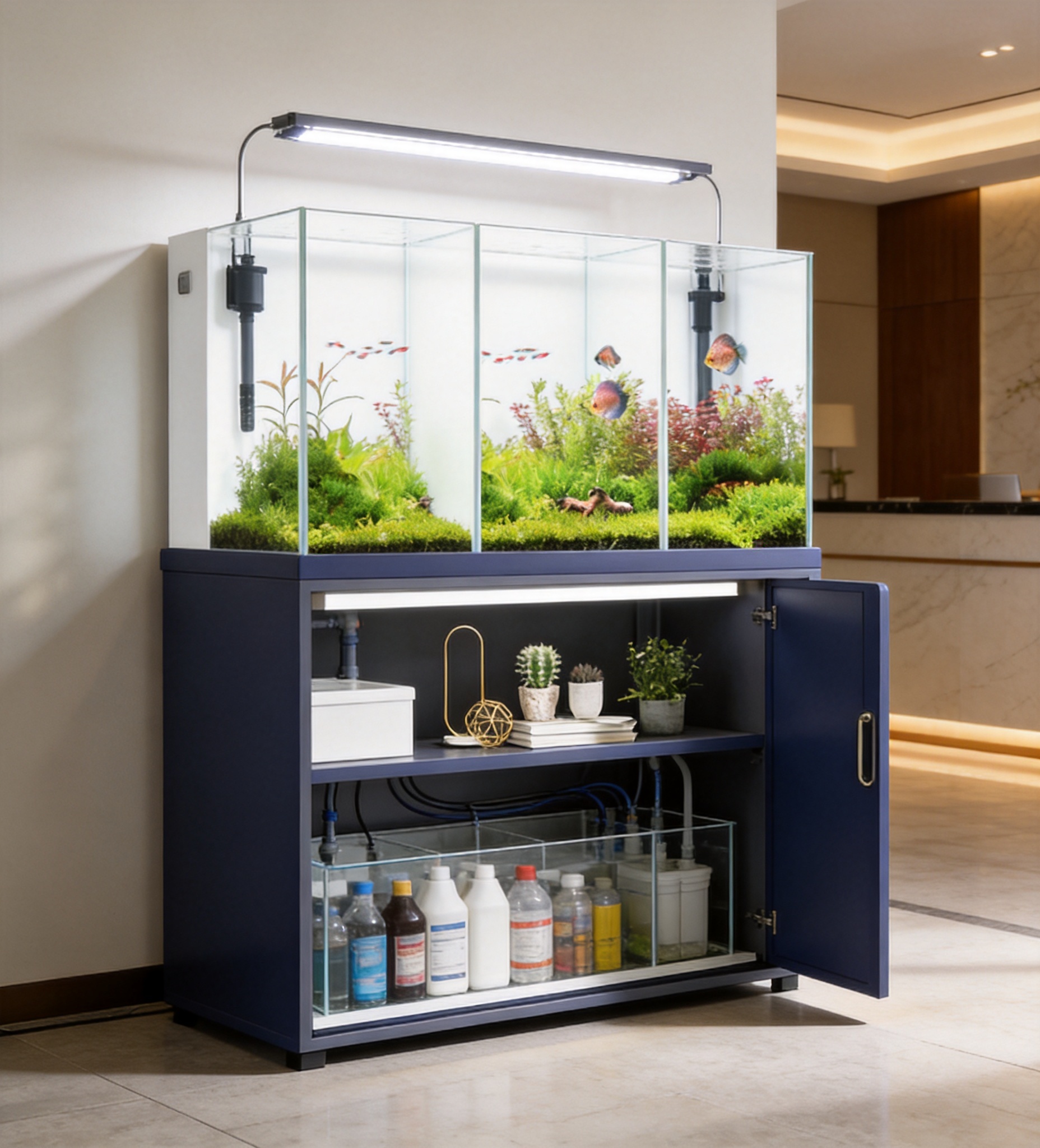
Choosing a complete aquarium involves much more than selecting a glass container. A modern aquarium must combine clear viewing, reliable filtration, suitable lighting, convenient storage, stable water circulation, and an appearance that fits naturally into the surrounding room. The HCB rear side filter fish tank is designed around this complete-use concept. It brings the aquarium, filtration system, water pump, lighting, and base cabinet together in a coordinated structure for residential, office, hospitality, and commercial environments.
Available in HCB-400B and HCB-500B models, the series provides a compact but capable format for aquarists who want an attractive display aquarium without building a separate technical system around it. Both models use three-sided super white glass, rear-side filtration, a full-spectrum LED water plant light, and integrated cabinet storage. The result is a more organized aquarium installation with fewer visible components and a cleaner overall presentation.
The product is manufactured by Sensen Group Co., Ltd., a company with a long operating history in aquarium products, aquaculture machinery, industrial equipment, and related pet industries. Since its establishment in 1985, the group has developed an extensive production and marketing structure supported by research, quality control, administration, finance, business training, subsidiaries, and import and export operations. This background is important because a complete aquarium requires coordination across several technical areas rather than expertise in glass alone.
This article examines the HCB rear side filter fish tank in detail. It explains the product structure, model differences, filtration advantages, lighting system, cabinet design, materials, installation considerations, maintenance requirements, competitive strengths, and the manufacturing capabilities behind the product.
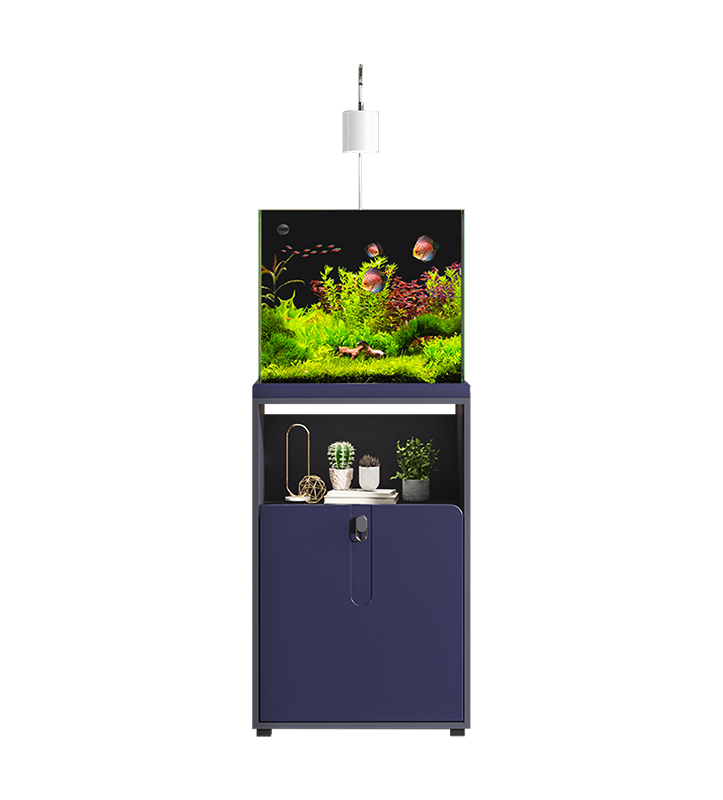
HCB rear side filter fish tank
Content
The HCB rear side filter fish tank is a freestanding aquarium system with an integrated filtration area positioned along the rear side of the tank. Instead of placing a large external filter beside or below the aquarium, the water treatment equipment is incorporated into the rear structure. This arrangement helps reduce visual clutter and allows the aquarium to remain a complete furniture-style unit.
The design is especially suitable for users who want a refined aquarium display but do not want to assemble a collection of separate accessories. The aquarium includes a matching water pump, a dedicated lamp configuration, a rear filtration system, and a base cabinet. Each part is selected to work within the dimensions of the corresponding tank model.
For a new aquarium owner, this integrated approach reduces the number of purchasing decisions. There is no immediate need to determine which external filter, pump, cabinet, and light should be combined. For an experienced hobbyist, the same design offers a clean foundation that can be customized with substrate, plants, decorative elements, and livestock according to personal preferences.
The HCB series can be used for ornamental fish, aquatic plants, and mixed aquascaping arrangements. The full-spectrum LED system is intended to support the visual presentation of plants and the natural appearance of the aquarium. As with any aquarium, the final suitability depends on the selected species, planting density, water parameters, biological maturity, and maintenance routine.
The range currently includes two principal models: HCB-400B and HCB-500B. The HCB-400B is the more compact option, while the HCB-500B provides a wider footprint and slightly greater capacity. The models share the same basic design philosophy, but their dimensions, water volume, and lamp ratings differ.
Specification |
HCB-400B |
HCB-500B |
Tank dimensions |
Length 400 mm x width 400 mm x height 456 + 380 mm |
Length 500 mm x width 450 mm x height 456 + 380 mm |
Capacity |
72 liters |
86 liters |
Base cabinet height |
790 + 25 mm |
790 + 25 mm |
Glass material |
Three sides of super white glass |
Three sides of super white glass |
Lamp configuration |
ADT-110C, 10 watts |
ADT-120C, 20 watts |
Water pump |
HQJ-700G, 8 watts |
HQJ-700G, 8 watts |
Filtration system |
HCB-400B integrated rear filter |
HCB-500B integrated rear filter |
The stated capacity is 72 liters for the HCB-400B and 86 liters for the HCB-500B. Actual operating water volume can be lower after allowing for substrate, decorations, equipment space, and the recommended waterline. Buyers should also consider the filled weight of the aquarium, cabinet, water, glass, and decorative materials when selecting the installation location.
The tank section uses a height specification of 456 + 380 millimeters, while the base cabinet is listed at 790 + 25 millimeters. These figures indicate that the aquarium and support structure together create a substantial piece of furniture. Before installation, the floor should be level, stable, and capable of supporting the fully assembled system.
One of the most visible advantages of the HCB series is its use of three-sided super white glass. Compared with ordinary glass, low-iron or super white glass is valued for its clearer appearance and reduced color distortion. This is particularly beneficial in an aquarium because water, plants, fish, and decorative stones are viewed through the glass from multiple angles.
Clearer glass allows the colors of fish and aquatic plants to appear more naturally. Green leaves can look brighter, light-colored fish can be seen with greater definition, and the overall aquascape can appear more open. The three-sided format also permits viewing from the front and both side directions, making the aquarium more flexible as a room divider, corner display, reception feature, or central decorative element.
The product information describes the glass as transparent, durable, and scratch-resistant. Even with scratch-resistant material, careful handling remains important. Hard sand grains, abrasive cleaning tools, and rough decorative objects should not be dragged across the viewing surfaces. Proper cleaning tools and routine maintenance help preserve the glass clarity over time.
Many competing aquariums in the same general size category use conventional glass or provide only one primary viewing side. The HCB design offers a more display-oriented alternative by combining high-clarity glass with three-sided visibility. This can create a stronger visual presence without requiring a much larger aquarium.
Glass quality also affects the perceived quality of the entire product. A well-organized cabinet and attractive lighting cannot compensate for significant color distortion or visible surface defects. By selecting super white glass for the principal viewing sides, the product places visual clarity at the center of the aquarium experience.
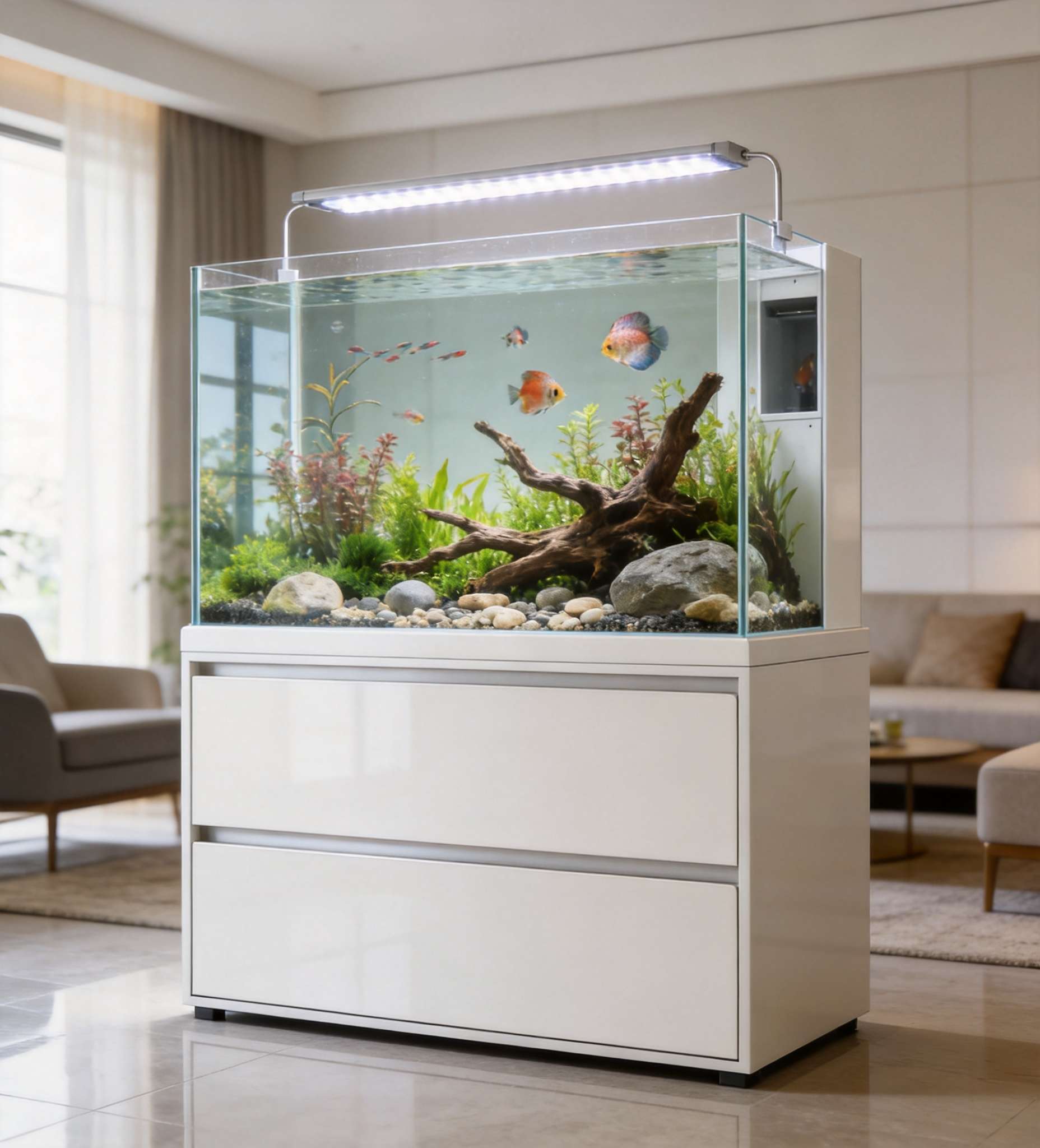
The integrated rear side filter is the central functional feature of the HCB fish tank. Filtration is essential because fish waste, uneaten food, decaying plant material, and other organic matter can gradually reduce water quality. A filtration system circulates water through treatment media and returns it to the aquarium, supporting cleaner and more stable conditions.
In the HCB design, the filtration area is positioned at the rear rather than being attached externally to the side of the tank. This improves the visual appearance of the installation and keeps the technical components concentrated in one organized zone. The rear filter can also help preserve the open character of the main display area, which is useful for aquascaping.
The product information describes the rear-side filtration arrangement as supporting cleaner circular filtration. Continuous circulation helps prevent stagnant areas and distributes treated water throughout the aquarium. The HQJ-700G water pump is rated at 8 watts and is used across both listed models. Its role is to move water between the aquarium and the filtration section.
A rear filter can offer practical advantages over a conventional external filter for many users. External filters often require hoses, intake pipes, return pipes, valves, and additional space around or below the aquarium. They can provide excellent performance when correctly installed, but the installation is more complex and the hoses remain visible. The HCB rear-side configuration reduces this external equipment footprint.
Compared with a small internal filter suspended inside the display area, the rear filtration design can preserve more usable aquascaping space. It also reduces the number of visible devices in front of the fish and plants. This creates a cleaner appearance, particularly in living rooms, offices, hotel lobbies, and retail environments where the aquarium is expected to function as part of the interior design.
Users should still inspect the filter compartments regularly. Mechanical filter material must be rinsed or replaced according to the waste load, while biological media should be handled carefully to preserve beneficial bacteria. Filter maintenance should use aquarium-safe water practices. Washing all biological media under chlorinated tap water can damage the bacterial population that supports biological filtration.
Water circulation should be checked after installation and after every maintenance procedure. The pump inlet must remain unobstructed, the water level must be adequate, and the return path must not be blocked by plants, substrate, or decorative materials. A correctly maintained rear filter can provide reliable everyday circulation while keeping the aquarium visually uncluttered.
Lighting serves two purposes in an aquarium: it makes the display attractive and provides usable light for aquatic plants. The HCB series includes a full-spectrum LED water plant light as part of its standard configuration. The HCB-400B uses the ADT-110C lamp with a 10-watt rating, while the HCB-500B uses the ADT-120C lamp with a 20-watt rating.
The difference in lamp rating corresponds to the difference in tank footprint and display area. The larger HCB-500B requires a higher stated lamp power to illuminate its broader presentation area. The lighting configuration is therefore matched to each model rather than treating both tanks as identical units.
Full-spectrum lighting can improve the appearance of fish, plants, substrate, and ornaments by providing a balanced visual presentation. For planted aquariums, light is one of several important growth factors. Plant species, carbon availability, nutrient balance, water temperature, planting density, and photoperiod all influence results. The included light provides a designed starting point, while advanced aquascapers may adjust planting choices and operating schedules according to their requirements.
LED lighting is also practical for a modern aquarium because it can provide strong visual illumination in a compact format. The low-wattage configurations listed for the HCB series help keep the lighting system integrated into the overall design. Reduced power consumption may also be beneficial for users who operate the aquarium for several hours each day, although actual energy use depends on operating time and local electricity rates.
A consistent lighting schedule is recommended. Excessive lighting can encourage unwanted algae, while insufficient or irregular lighting can reduce plant performance and diminish the visual balance of the display. Using a timer, if compatible with the installation, can make the daily cycle more consistent.
The base cabinet is more than a support platform. Its double-layer storage design converts the space beneath the aquarium into a functional storage area. Aquarium supplies can include food, nets, cleaning tools, water conditioners, test equipment, spare filter materials, electrical accessories, and maintenance containers. Keeping these items in the cabinet helps reduce clutter around the aquarium.
Storage is especially valuable in compact rooms. Without integrated storage, aquarium equipment is often placed on nearby shelves, inside unrelated cabinets, or on the floor. These arrangements can make maintenance less convenient and reduce the visual quality of the installation. The HCB cabinet creates a designated location for aquarium-related items while preserving a clean surrounding area.
The double-layer concept provides more flexibility than a single open shelf. Users may organize frequently used tools in one area and reserve another area for supplies that are needed less often. Separating dry equipment from liquids can also improve organization and reduce the risk of accidental spills affecting electrical components.
The cabinet colors available for the series include China Red, Mediterranean Blue, Lake Blue, Hermes Orange, Turquoise, Quiet Yellow, and Warm and White. This range allows the aquarium to serve as either a restrained interior feature or a more expressive decorative object. Color selection can be coordinated with furniture, wall finishes, commercial branding environments, or the visual theme of an aquascape.
Cabinet appearance is an important competitive factor because an aquarium is often displayed in a visible part of a room. Some tanks require owners to purchase a separate stand that may not match the tank in size, finish, or structural design. The integrated cabinet of the HCB series is developed as part of the complete product, providing a more unified appearance from the beginning.
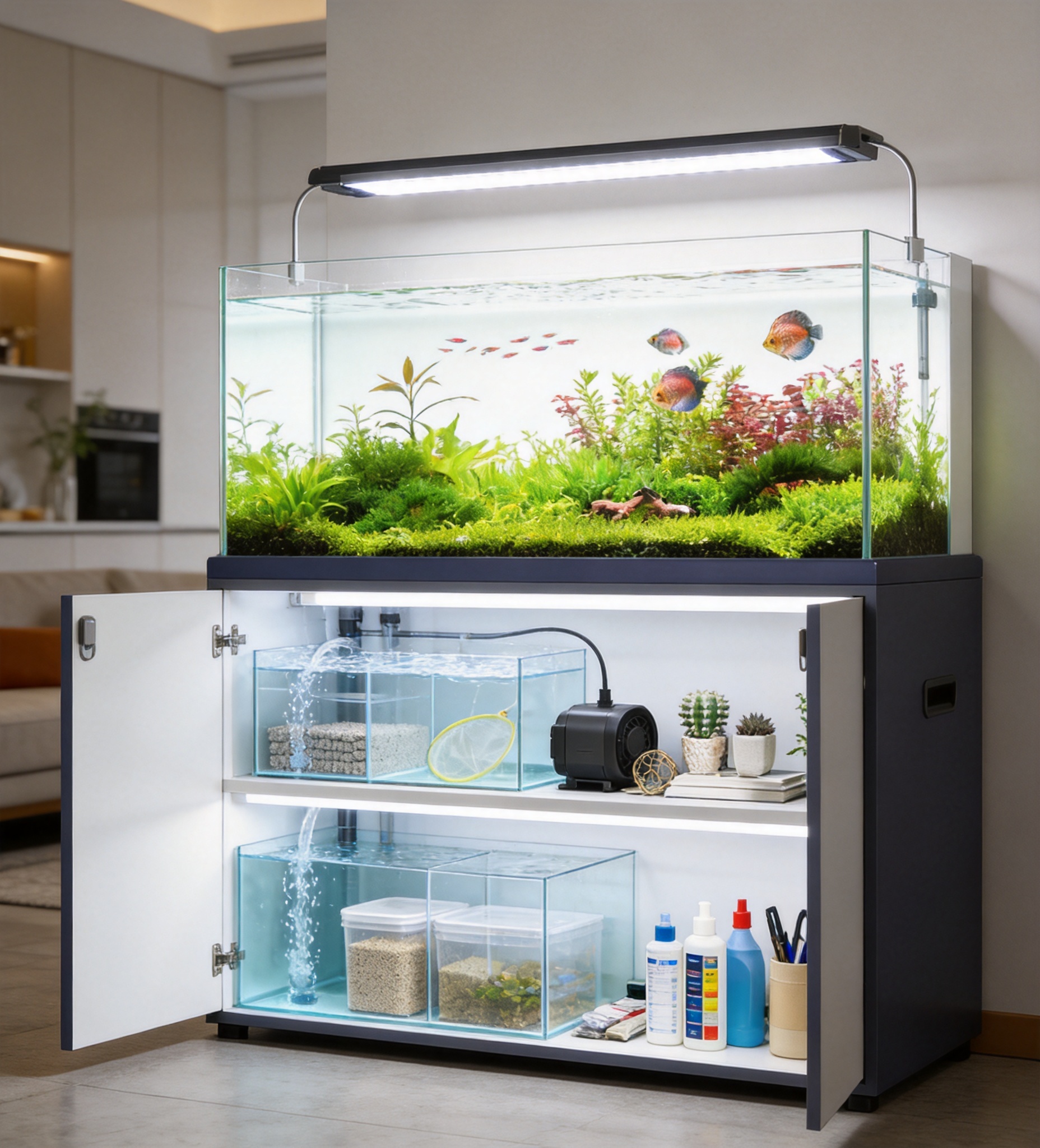
The HCB rear side filter fish tank offers several advantages when compared with a conventional aquarium assembled from unrelated components. The first is visual integration. The tank, lamp, filter, pump, and cabinet are designed to function as one system, rather than appearing as separate items added at different times.
The second advantage is reduced installation complexity. A conventional setup may require the user to select an aquarium, stand, filter, pump, lighting unit, tubing, storage solution, and support accessories. Compatibility must be checked for dimensions, flow, electrical load, installation clearance, and appearance. The HCB series simplifies this process by offering a coordinated product configuration.
The third advantage is efficient use of space. Rear filtration removes the need for a large external filter beside the tank. The base cabinet provides storage beneath the aquarium, while the main display area remains available for fish and aquascaping. This is useful where floor space is limited or where a neat appearance is important.
The fourth advantage is multi-angle visibility. Three-sided super white glass provides more viewing opportunities than a basic front-view aquarium. A user can position the tank against a wall, near a corner, or in an open area depending on which sides should remain visible. The design can therefore adapt to different room layouts.
The fifth advantage is coordinated lighting. The included full-spectrum LED lamp is matched to the product series, avoiding the immediate need to search for a compatible light. This is particularly helpful for first-time buyers who may not know how lamp size, brightness, mounting, and spectrum relate to tank dimensions.
These advantages do not mean that an integrated aquarium is suitable for every type of aquarist. Large public displays, heavily stocked systems, demanding coral environments, or advanced high-flow planted aquariums may require specialized equipment beyond the supplied configuration. However, for a compact ornamental or planted aquarium, the HCB structure offers a balanced combination of presentation, convenience, and organization.
The HCB-400B is appropriate for users who prioritize a smaller footprint. With a listed capacity of 72 liters and a 400 by 400 millimeter tank footprint, it can be easier to place in a compact living area, office, bedroom, study, or reception space. Its 10-watt ADT-110C lamp is configured for the smaller display.
The HCB-500B provides a larger display surface and a listed capacity of 86 liters. Its 500 by 450 millimeter footprint gives aquascapers additional horizontal space for arranging stones, wood, plants, and open swimming areas. The 20-watt ADT-120C lamp is configured for the larger model.
The decision should not be based only on water capacity. Users should measure the installation area, consider the visual scale of the room, and evaluate the floor’s load-bearing capability. Clearance around the aquarium is also important. There should be enough space to open the cabinet, carry out water changes, clean the glass, and access the rear filtration area.
The selected model should also match the planned livestock. A greater volume generally provides more water stability than a smaller volume, but neither model should be overstocked. Fish species, adult size, territorial behavior, swimming requirements, and compatibility all need to be considered before purchase.
Selection consideration |
HCB-400B |
HCB-500B |
Best suited for |
Compact rooms and smaller displays |
Larger display areas and broader aquascapes |
Listed capacity |
72 liters |
86 liters |
Display footprint |
400 x 400 millimeters |
500 x 450 millimeters |
Light configuration |
10-watt ADT-110C |
20-watt ADT-120C |
Primary advantage |
Space efficiency |
Greater display area |
A complete aquarium system requires coordinated manufacturing. The glass must be processed and assembled accurately, the filtration structure must be designed around the tank dimensions, the lamp must fit the display, the pump must support circulation, and the cabinet must provide suitable support and storage. A manufacturer with experience across aquarium equipment can coordinate these relationships more effectively than a seller offering unrelated components from different sources.
Sensen Group Co., Ltd. has operated since November 1985 and has continued developing products in aquarium pets, aquaculture machinery, and industrial equipment. Its broad industry involvement provides a foundation for understanding water movement, equipment integration, product assembly, and the practical needs of aquarium users.
The group has established functional departments including a research institute, business school, quality control department, personnel and administrative information department, and financial department. From a manufacturing perspective, the presence of dedicated research and quality control functions supports a structured approach to product development and production management.
The company also operates wholly owned subsidiary corporations and maintains interests in several trading companies, together with an import and export company. This wider organization can support material coordination, production distribution, domestic sales, and international market service. For buyers and distributors, a broad business structure can be valuable when consistent product supply and after-sales communication are important.
The aquarium industry includes many products that look similar from a distance but differ in the quality of their glass, seals, cabinet construction, pump compatibility, lighting integration, and replacement support. Manufacturing strength is therefore not limited to the visible design. It also concerns the ability to repeat the same dimensions, configurations, and component relationships across production batches.
The HCB series demonstrates this integrated manufacturing approach through its model-specific filter systems, matching lamp configurations, shared water pump arrangement, and coordinated cabinet. The existence of two clearly defined models allows production to be organized around known dimensions and component combinations rather than relying entirely on customized assembly at the point of sale.
Quality control is particularly important for aquariums because the product contains water for long periods and carries considerable weight. Proper glass inspection, structural assembly, sealing, packaging, and transport handling are all essential. Retailers and installers should inspect the aquarium after delivery, before filling, and after positioning it on a suitable level surface.
The aquarium should be installed on a flat, stable floor with sufficient load capacity. Uneven support can create stress on the glass and cabinet. The cabinet should be assembled and positioned according to the manufacturer’s instructions, and the aquarium should not be placed on an improvised surface that does not provide uniform support.
Before adding water, inspect the glass, seams, cabinet, filter compartments, pump connections, lamp mounting points, and electrical cables. Confirm that the rear filtration area is clear and that the pump can be accessed for future maintenance.
Rinse suitable substrate and decorations before placing them in the tank. Avoid using materials with sharp edges that could damage the glass or injure fish. Arrange heavy stones and wood carefully so that they remain stable and do not press against the tank walls.
Fill the aquarium gradually. This allows the user to observe whether the substrate shifts, decorations remain stable, and the water returns correctly through the rear filtration system. The pump should be operated only with an adequate water level. Running a water pump without sufficient water can cause overheating, noise, or damage.
Electrical equipment should be arranged with safe cable routing. A drip loop should be used where appropriate so that water cannot run directly along a cable into a power outlet. The installation area should remain dry, and power should be disconnected before handling submerged equipment.
A new aquarium should be biologically matured before it receives a full livestock load. The filtration system needs time to develop beneficial microorganisms. Water testing and gradual stocking are more reliable than immediately adding many fish after filling the aquarium.
Routine maintenance helps preserve both aquarium health and product appearance. The viewing glass should be cleaned with aquarium-safe tools. Algae buildup should be removed before it becomes difficult to control, and cleaning tools should be kept free of sand or grit that could scratch the glass.
The rear filter should be checked at regular intervals. Mechanical media collects suspended debris and may eventually restrict water flow. It should be cleaned or replaced according to the aquarium’s bioload and water clarity. Biological media should not be replaced unnecessarily, because it houses microorganisms that contribute to biological filtration.
The HQJ-700G water pump should be inspected for debris and reduced flow. Plant fragments, snails, substrate particles, and accumulated sediment may affect the pump inlet or impeller. Disconnect the pump from the power supply before cleaning it.
Water changes should be carried out according to water test results, livestock needs, and the aquarium’s maintenance schedule. New water should be prepared appropriately for the fish and plants. Sudden changes in temperature or water chemistry can stress aquatic life.
The lighting schedule should be adjusted to the needs of the chosen plants and the level of algae growth. If algae increases significantly, users should evaluate light duration, nutrient input, feeding, circulation, and maintenance rather than simply increasing cleaning frequency.
The cabinet should be kept dry and organized. Spilled water, wet cleaning cloths, and leaking containers should be removed promptly. Aquarium products and chemicals should be stored securely and separately from food, children, and pets.
In a home, the HCB series can function as a living room feature, a study display, an entryway accent, or a decorative unit in a dining area. Its integrated cabinet and multi-angle glass make it more visually complete than a basic tank placed on a generic stand.
In an office, an aquarium can contribute to a more welcoming reception area or waiting room. The enclosed storage helps keep maintenance supplies out of sight, while the rear filtration layout reduces visible equipment around the display.
Hotels, restaurants, retail stores, and interior design projects may use the aquarium as a focal point. The available cabinet colors provide opportunities to coordinate the product with a specific design theme. A blue or turquoise cabinet may reinforce a water-related visual identity, while warm colors can create a stronger decorative accent.
For commercial users, maintenance access and operating reliability are especially important. The aquarium should be placed where staff can reach the cabinet and filtration area without disturbing customers. A regular maintenance schedule should be assigned, and livestock should be selected for compatibility with the available care resources.
Long-term value in an aquarium depends on durability, ease of maintenance, component compatibility, and the ability to remain attractive after years of use. A clear glass tank with a coordinated cabinet can continue serving as a room feature even when the aquascape changes.
The integrated design may also reduce the need to replace mismatched accessories. When the aquarium, lighting, pump, and filtration system are designed as one product, there is less immediate pressure to upgrade basic components simply because they do not fit aesthetically or dimensionally.
Responsible use also matters. The lamp should be operated only for the time required by the plants and display. The pump should be maintained so that it circulates water efficiently. Water changes should be planned to avoid unnecessary waste, and livestock should be selected with consideration for adult size and long-term care.
Durability does not eliminate the need for care. Glass should be protected from impact, the cabinet should not be overloaded, and electrical equipment should be kept dry. Proper handling during transport and installation is equally important because many aquarium problems originate from movement, uneven support, or accidental impact.
The main feature is the integrated rear-side filtration system. It keeps filtration equipment within the rear structure of the aquarium, helping maintain a cleaner appearance and reducing the need for a large external filter beside the tank.
The listed models are HCB-400B and HCB-500B. The HCB-400B has a stated capacity of 72 liters, while the HCB-500B has a stated capacity of 86 liters.
Both models use three-sided super white glass. This material is designed to provide clear viewing and a more natural presentation of fish, plants, and decorations.
Yes. The HCB-400B includes the ADT-110C 10-watt lamp, and the HCB-500B includes the ADT-120C 20-watt lamp. The lighting is described as a full-spectrum LED water plant light.
Both listed models use the HQJ-700G water pump with an 8-watt rating.
Yes. The base cabinet uses a double-layer storage design. It can be used to organize aquarium food, cleaning tools, spare filter materials, water treatment supplies, and other maintenance accessories.
Yes. The included full-spectrum LED lamp is intended for water plants, and the tank can be arranged as a planted aquarium. Plant selection should be matched to the available light, water conditions, carbon availability, and maintenance level.
The HCB-400B is generally the more space-efficient choice because it has the smaller footprint and lower stated capacity. The HCB-500B may be preferred when the room can accommodate a wider aquarium and the user wants more aquascaping space.
The rear filter offers a more integrated appearance and can reduce visible hoses and equipment. An external filter may provide different capacity or configuration options for specialized applications, but it generally requires more installation space and additional external connections.
Users should check the floor level, structural support, cabinet assembly, glass condition, filter access, pump connections, lamp mounting, cable routing, and available clearance for maintenance. The aquarium should be filled gradually after it has been positioned securely.
The product is manufactured by Sensen Group Co., Ltd., an organization established in 1985 with business activities covering aquarium products, aquaculture machinery, industrial equipment, and related fields.
The HCB rear side filter fish tank is a complete aquarium furniture system built around clear viewing, integrated filtration, practical storage, and coordinated lighting. Its strongest advantages are the three-sided super white glass, rear filtration layout, full-spectrum LED water plant light, matching water pump, and double-layer cabinet.
The HCB-400B and HCB-500B give buyers a choice between a more compact 72-liter configuration and a larger 86-liter configuration. Both models are designed for users who want an organized aquarium without the visual complexity of multiple unrelated accessories.
Compared with a basic glass tank and separate stand, the HCB series offers a more unified appearance and a simpler starting point. Compared with an aquarium using a visible external filter, its rear-side filtration helps keep hoses and technical components out of sight. Compared with a single-view display aquarium, its three-sided super white glass provides greater visual flexibility.
The product’s value is also connected to the manufacturing organization behind it. Sensen Group combines long-term industry experience with research, quality control, subsidiary production resources, marketing operations, and international business capabilities. These strengths support the development of coordinated aquarium systems rather than isolated components.
For households, offices, hospitality areas, and retail spaces seeking a refined medium-sized aquarium, the HCB rear side filter fish tank presents a practical balance between appearance and function. With correct installation, responsible stocking, regular filter care, and an appropriate lighting schedule, it can provide a stable foundation for an attractive aquatic display.
1. Product specification sheet for the HCB rear side filter fish tank, including model dimensions, capacities, glass material, lamp configurations, water pump, and filtration system.
2. Product feature information for the HCB series, including ultra-white glass, rear-side filtration, double-layer storage, and full-spectrum LED water plant lighting.
3. Manufacturer company information for Sensen Group Co., Ltd., including company history, organizational structure, subsidiaries, research activities, quality control, and market operations.
4. General aquarium maintenance principles concerning water circulation, mechanical filtration, biological filtration, lighting schedules, safe installation, and gradual stocking.
5. General aquascaping and aquatic plant care principles concerning light, water quality, plant selection, nutrient management, and algae control.


 No. 61-79, Baima Street, Maao Town, Dinghai District, Zhoushan City, Zhejiang Province, China.
 0086 580 8082088 / 8081168
 0086 580 8080978
 songhua@sunsun-china.com