

 English
 русский
 España
 Portugal
 عربي
Li Mei | Aquarium Equipment Sales Specialist
Home / Author / Li Mei | Aquarium Equipment Sales Specialist / HLG/HLW Self-Priming Circulating Water Pumps for Demanding Water Systems
Content
Reliable water movement is essential in large aquariums, aquaculture installations, ornamental ponds, industrial water features, circulation systems, and many other water-management applications. A pump must do more than move water from one location to another. It must provide adequate flow, maintain useful pressure at the required height, connect conveniently with the piping system, and continue operating consistently under demanding conditions. When installation conditions are complex or the water source is positioned below the pump, self-priming capability becomes especially valuable.
The HLG/HLW Series Self-priming Circulating Water Pump has been developed for applications that require substantial circulation capacity, strong lifting performance, and practical installation dimensions. The series includes multiple models covering outputs from 29 m³/h to 37 m³/h and maximum heads from 16 m to 21 m. Depending on the model, users can select 220V or 380V, 50Hz electrical configurations, with rated power ranging from 1500W to 3000W.
With a common tube diameter of Φ63/Φ60 and model-specific housing lengths, the series offers a straightforward solution for systems that need high-volume circulation through relatively large-diameter pipework. The HLG and HLW ranges share important performance characteristics while providing different dimensional configurations, allowing equipment designers, contractors, and end users to choose a pump that better matches available installation space and system requirements.
The series is manufactured by Sensen Group Co., Ltd., a company with a long history in aquarium products, aquaculture machinery, industrial equipment, and related water-management technologies. Since its establishment in 1985, the group has expanded its production, research, quality-control, and sales capabilities across several related industries. That background supports the development of water pumps designed not only as individual products, but also as components within complete aquatic and industrial systems.
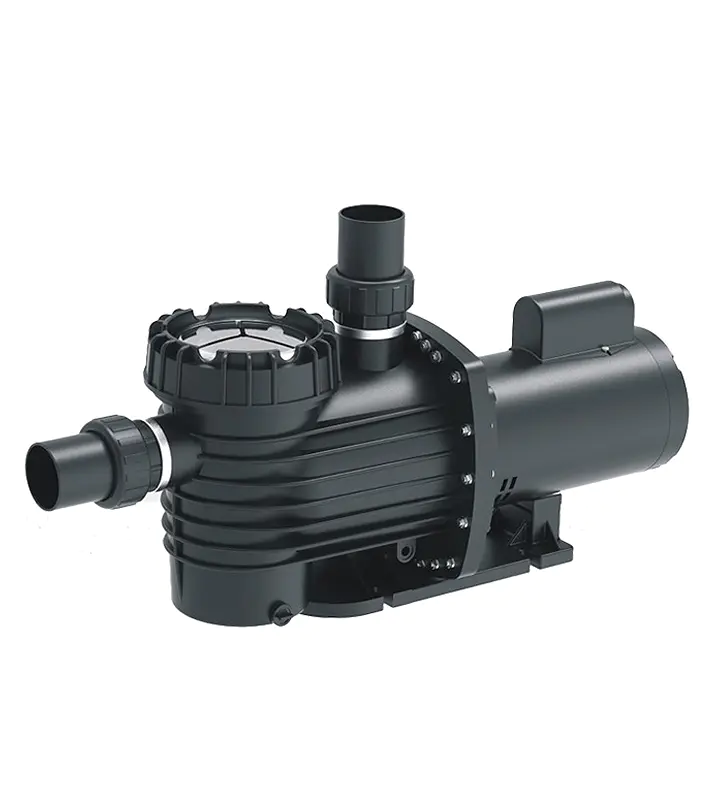
HLG/HLW Series Self-priming Circulating Water Pump
The principal function of the HLG/HLW Series is to circulate a large quantity of water through a connected system. The available outputs begin at 29 m³/h for the 200 models and rise to 37 m³/h for the HLW-400. These capacities make the series suitable for installations where a small aquarium pump would be inadequate and where a stable, continuous water exchange is necessary.
High-volume circulation can benefit many types of installations. In large aquariums, it helps distribute treated water throughout the tank and associated filtration equipment. In aquaculture systems, it supports water turnover and movement between tanks, treatment units, and reservoirs. In garden water features, it can provide the circulation required for streams, cascades, large fountains, or decorative pools. In industrial or technical installations, the pump can be incorporated into a process where water must be transferred through a defined pipe network.
The HLG/HLW series is not limited to a single flow and head combination. The model range allows users to select between different hydraulic capabilities. The entry models offer 29 m³/h and a 16 m maximum head. The 300 models increase the maximum head to 18 m, while the higher-capacity variants offer up to 35 m³/h or 37 m³/h and up to 20 m or 21 m of head. This graduated arrangement helps users avoid selecting a pump that is unnecessarily large or too weak for the intended system.
It is important to understand that the listed output is a rated specification and actual operating flow depends on the complete installation. Pipe length, fittings, elevation, valves, filters, bends, and other resistance factors all influence the final flow rate. Nevertheless, the published performance range gives installers a clear starting point for pump selection and system planning.
One of the main features of the series is its self-priming configuration. In a conventional pump installation, air trapped in the suction line may prevent the pump from moving water effectively. The operator may need to fill the pump chamber or suction pipe manually before operation. A self-priming design is intended to simplify this process by helping the pump establish water circulation after the system has been correctly installed.
This characteristic is especially useful where the pump cannot be positioned directly below the water source or where the suction arrangement is not as simple as a flooded-inlet installation. It can reduce the amount of manual preparation required during startup and make the equipment more practical for water systems with changing operating conditions.
Self-priming does not remove the need for correct installation. The pump must still be connected to suitable piping, the suction side must be properly sealed, and the equipment must be used according to applicable electrical and operating requirements. Operators should also confirm that the pump is not run dry and that the system has adequate water available for priming and continuous circulation.
Compared with a basic non-self-priming circulation pump, the HLG/HLW design can offer an important practical advantage where startup conditions are variable. It is particularly relevant for larger tanks, outdoor systems, equipment rooms, and installations in which the pump is positioned away from the water source. The self-priming function can make commissioning more efficient and reduce dependence on repeated manual filling.

The HLG/HLW family includes two closely related product groups. The HLG models have housing dimensions of 657 × 273 × 316 mm for the listed models. The HLW models are generally more compact in length, with the HLW-200 and HLW-300 measuring 605 × 273 × 316 mm, while the HLW-350 and HLW-400 measure 625 × 273 × 316 mm. The width and height remain consistent at 273 mm and 316 mm across the listed configurations.
The following table summarizes the published specifications.
| Model | Voltage | Power | Output | Maximum Head | Tube Diameter | Dimensions L × W × H |
|---|---|---|---|---|---|---|
| HLG-200 | 220V/50Hz | 1500W | 29 m³/h | 16 m | Φ63/Φ60 | 657 × 273 × 316 mm |
| HLG-200 | 380V/50Hz | 1500W | 29 m³/h | 16 m | Φ63/Φ60 | 657 × 273 × 316 mm |
| HLG-300 | 220V/50Hz | 2200W | 32 m³/h | 18 m | Φ63/Φ60 | 657 × 273 × 316 mm |
| HLG-300 | 380V/50Hz | 2200W | 32 m³/h | 18 m | Φ63/Φ60 | 657 × 273 × 316 mm |
| HLG-400 | 380V/50Hz | 3000W | 35 m³/h | 20 m | Φ63/Φ60 | 657 × 273 × 316 mm |
| HLW-200 | 220V/50Hz | 1500W | 29 m³/h | 16 m | Φ63/Φ60 | 605 × 273 × 316 mm |
| HLW-200 | 380V/50Hz | 1500W | 29 m³/h | 16 m | Φ63/Φ60 | 605 × 273 × 316 mm |
| HLW-300 | 220V/50Hz | 2200W | 32 m³/h | 18 m | Φ63/Φ60 | 605 × 273 × 316 mm |
| HLW-300 | 380V/50Hz | 2200W | 32 m³/h | 18 m | Φ63/Φ60 | 605 × 273 × 316 mm |
| HLW-350 | 220V/50Hz | 2600W | 35 m³/h | 20 m | Φ63/Φ60 | 625 × 273 × 316 mm |
| HLW-350 | 380V/50Hz | 2600W | 35 m³/h | 20 m | Φ63/Φ60 | 625 × 273 × 316 mm |
| HLW-400 | 380V/50Hz | 3000W | 37 m³/h | 21 m | Φ63/Φ60 | 625 × 273 × 316 mm |
The choice between the HLG and HLW families should be based on hydraulic requirements, available space, electrical infrastructure, and the layout of the proposed installation. The HLG-200 and HLG-300 models offer the same listed output and head values as the equivalent HLW-200 and HLW-300 models, but the HLW versions have shorter overall dimensions. This may be useful where equipment-room depth or service clearance is limited.
The higher HLW models also provide a broad performance range. The HLW-350 reaches 35 m³/h and a 20 m head, while the HLW-400 reaches 37 m³/h and a 21 m head. These models are appropriate candidates when the system requires stronger hydraulic performance than the 200 and 300 models can provide.
The HLG-400 is rated at 35 m³/h with a 20 m maximum head and uses 380V/50Hz power. It provides a high-performance option within the HLG dimensional configuration. Because electrical requirements vary by site, users should verify whether 220V single-phase or 380V three-phase service is available before final selection.
Water pumps should always be compared according to actual application requirements rather than by nominal power alone. A pump with a high wattage rating is not automatically the best choice if its flow, head, connection size, or installation format does not match the system. The HLG/HLW series presents several practical advantages when compared with basic circulation pumps that offer fewer configurations or lack self-priming capability.
The series provides multiple combinations of power, flow, and head. Users can choose a 1500W model for 29 m³/h and 16 m, a 2200W model for 32 m³/h and 18 m, or a larger model for up to 37 m³/h and 21 m. This structured selection is more flexible than a single-size pump that forces every installation to use the same capacity.
A broader range can support more accurate equipment matching. Selecting a pump close to the actual system requirements may help avoid underperformance caused by insufficient head, while also preventing unnecessary oversizing. Proper matching can simplify system design and support more predictable operating results.
Many simple circulation pumps are designed for flooded-inlet conditions and may not be convenient when air enters the suction pipe. The self-priming arrangement of the HLG/HLW series is a meaningful distinction for installations where startup and suction conditions are not ideal.
This feature can be especially useful in outdoor water features, large filtration systems, aquaculture installations, and equipment layouts where the pump is not immediately adjacent to the water reservoir. It supports more convenient commissioning and can make the overall system easier to manage.
The listed tube diameter of Φ63/Φ60 is suited to high-volume water movement. Larger pipe connections can be beneficial in systems where excessive restriction would reduce flow. When the pipe diameter, fittings, and valves are correctly matched, the pump can be integrated into a circulation network designed for substantial water throughput.
Compared with small pumps equipped with narrow connectors, the series is better aligned with large tanks, commercial displays, substantial ponds, and technical circulation systems. Proper piping design remains essential, but the connection format provides a practical foundation for high-capacity installation.
The availability of both 220V/50Hz and 380V/50Hz configurations for several models allows the product family to serve different electrical environments. A 220V option may be appropriate for certain standard installations, while 380V equipment may be more suitable for industrial facilities or sites with three-phase electrical infrastructure.
This flexibility can reduce the need to redesign an entire system around an unsuitable power supply. However, electrical installation must be performed by qualified personnel, and the selected pump must always match the local power network and applicable safety requirements.
Although the series is designed for high output, the listed width and height are 273 mm and 316 mm across the models. This relatively consistent cross-sectional size can simplify planning for equipment rooms and pump platforms. The different overall lengths of the HLG and HLW families provide additional layout flexibility.
When compared with a larger pump that delivers similar capacity but occupies substantially more space, the series may offer an easier installation in a constrained technical area. The final suitability depends on required maintenance access, ventilation, piping clearance, and local installation standards.
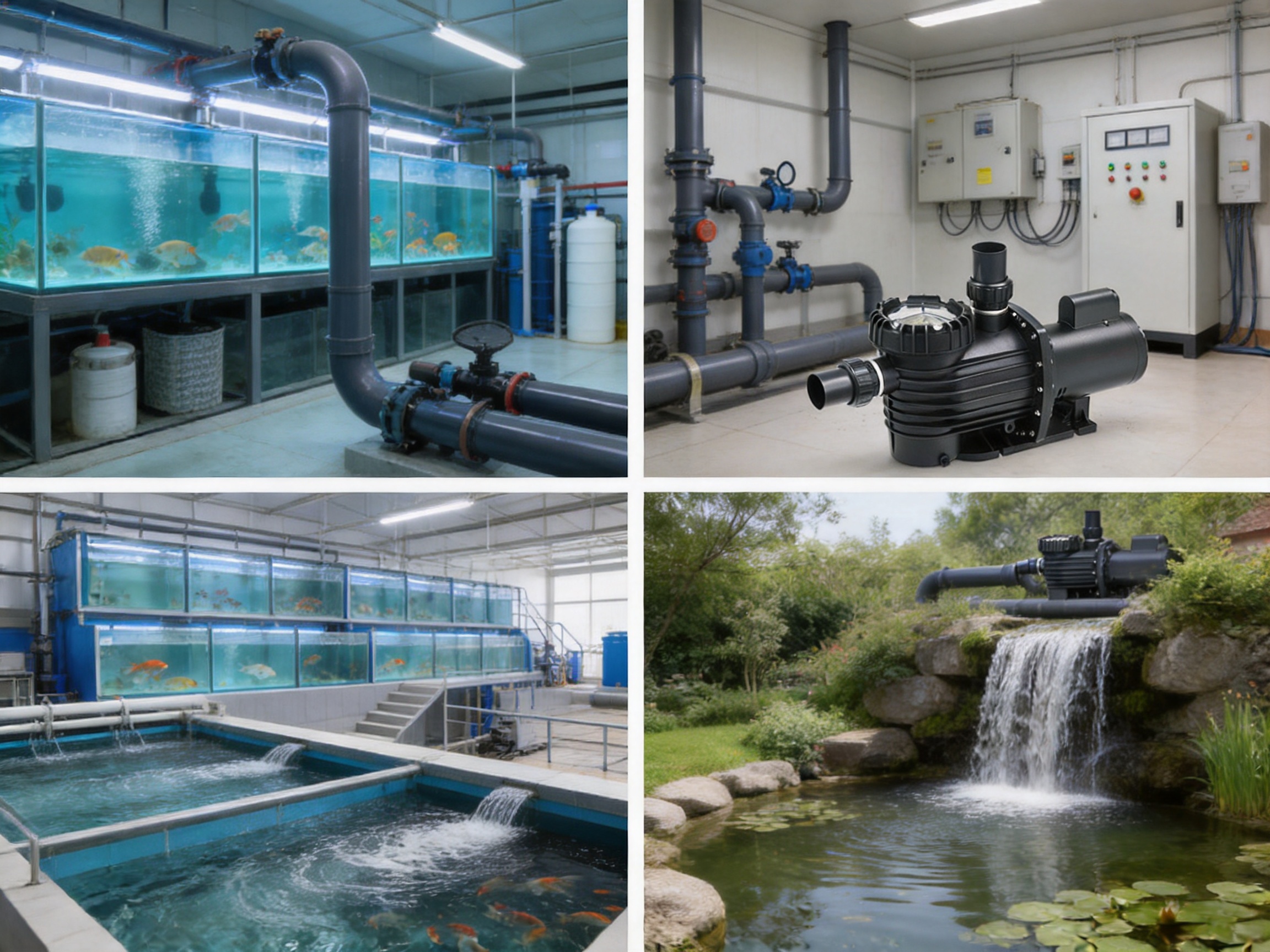
Large aquariums need dependable circulation to move water through filtration, heating, cooling, oxygenation, and treatment equipment. A pump must overcome the resistance of pipes and equipment while maintaining sufficient flow throughout the system. The HLG/HLW series can serve as a circulation component for large aquatic displays, public aquarium support areas, breeding facilities, and commercial fish-holding systems.
In an aquarium application, the selected model should be evaluated against the total water volume, desired turnover rate, filter resistance, vertical lift, and plumbing configuration. The published maximum head should not be treated as the expected flow at every operating point. Instead, the installer should determine the actual system curve and confirm that the selected pump can deliver the required flow at the operating head.
Aquaculture installations often require water to move between tanks, biological filters, settling chambers, reservoirs, and treatment devices. The self-priming feature may be helpful during startup or in layouts where the pump is positioned below or beside the main water source. The high-volume ratings are also relevant to systems where water must be circulated continuously across several connected units.
For aquatic life, water quality and operating stability are critical. The pump should therefore be integrated with appropriate filtration, screens, valves, emergency overflow arrangements, and monitoring equipment. Operators should inspect the suction side regularly and ensure that debris, biological material, or other obstructions do not restrict the inlet.
Large garden ponds, landscape water features, streams, waterfalls, and decorative circulation systems may require more capacity than a standard ornamental pump can provide. The HLG/HLW series offers the output and head range needed for larger installations, particularly where water must be raised to a considerable elevation or pushed through a long pipe route.
For a waterfall, the required pump size depends on the width of the spillway, desired water depth, elevation difference, pipe length, and number of bends. For a fountain or circulation feature, nozzle design and pressure loss also affect the required operating point. A pump should be selected using the actual flow requirement at the required height rather than by maximum output alone.
The self-priming design can be valuable in outdoor installations where the pump room, reservoir, or service pit is arranged separately from the visible water feature. It can simplify starting the system after maintenance, seasonal shutdown, or water-level changes, provided that the suction line and pump body are correctly prepared.
Outdoor applications require attention to weather protection, drainage, electrical safety, and access for cleaning. The pump itself should be installed in a suitable protected environment, with controls and wiring selected for the operating conditions. The use of a high-capacity pump does not replace the need for proper filtration and debris management in open ponds.
The pump family can also be considered for industrial water circulation, equipment cooling arrangements, process-water movement, and other technical systems where the required medium and operating conditions are compatible with the pump design. Its output range, available voltage options, and large connection size provide a useful basis for integration into engineered systems.
Before using the pump in an industrial process, engineers should verify fluid temperature, chemical compatibility, solids content, viscosity, operating pressure, duty cycle, and required control method. The published specifications identify the principal electrical and hydraulic ratings, but application-specific conditions must be assessed separately.
In industrial equipment, consistent circulation can support heat transfer, wash-down systems, filtration loops, and water-reuse arrangements. The pump may be installed as part of a larger package that includes isolation valves, non-return valves, strainers, pressure gauges, flow sensors, and automatic controls.
The 380V/50Hz configurations are particularly relevant to facilities with industrial electrical distribution. The 220V/50Hz options provide an alternative for suitable installations where that supply is available. In all cases, the motor protection system should be correctly sized and coordinated with the installation’s electrical requirements.
The capabilities behind a water pump are closely connected to the manufacturer’s experience, production organization, engineering resources, and quality-control processes. Sensen Group Co., Ltd. has operated since November 1985 and has developed business activities across aquarium products, aquaculture machinery, industrial equipment, and related fields.
This cross-industry experience is relevant to the HLG/HLW series because water circulation requirements are not limited to one market. Aquarium equipment, aquaculture facilities, garden systems, and industrial installations all require practical knowledge of fluid movement, system integration, product durability, and user operation.
The group has established functional departments that include a research institute, business school, quality-control department, personnel and administrative information department, and financial department. A dedicated research structure can support product development and technical improvement, while a quality-control department provides an organizational foundation for inspection and process management.
The company also operates several wholly owned subsidiary corporations and maintains interests in trading companies across different regions. This broader organizational structure supports production, distribution, market feedback, and service coordination. For international customers, an established export and sales network can be valuable when selecting equipment for overseas projects.
Water-pump performance depends on the relationship between hydraulic design, motor power, casing configuration, connection geometry, and operating conditions. Continuous product development allows manufacturers to refine these relationships and offer models for different system requirements. The multiple configurations within the HLG/HLW range reflect an approach based on product-family development rather than a single standardized pump size.
The availability of different model ratings also supports project-specific selection. Instead of treating every installation as identical, the manufacturer provides alternatives with different output, maximum head, power, and dimensions. This is useful for system designers who must balance performance, electrical availability, and equipment-room space.
A water pump must be produced with attention to dimensional consistency, motor assembly, sealing, electrical connections, rotating components, and hydraulic passages. A structured quality-control function can help coordinate inspection throughout these stages. Final users and installers should still inspect delivered equipment for transport damage and confirm that the nameplate data corresponds to the ordered model.
Manufacturing quality is also connected to traceability and communication. A well-organized supplier should be able to identify model specifications, electrical variants, dimensions, and application information clearly. The HLG/HLW specification structure provides a concise reference for these essential selection factors.
Experience in aquarium pets, aquaculture machinery, and industrial equipment gives the manufacturer exposure to different operating environments. Aquarium systems emphasize water quality and reliable circulation. Aquaculture systems emphasize biological stability and large-volume turnover. Industrial systems emphasize engineered integration, electrical compatibility, and process requirements.
Although every installation remains application-specific, experience across these markets can help inform product design and customer support. It also allows the company to understand how pumps are used as part of complete systems rather than as isolated devices.
Correct installation is essential for achieving the intended performance of any self-priming circulation pump. The pump should be placed on a stable foundation that can support its operating weight and limit unnecessary vibration. Sufficient space should be left around the unit for inspection, cleaning, electrical access, and future maintenance.
The suction pipe should be as direct as practical, with unnecessary bends and restrictions avoided. Every suction-side connection must be properly sealed because air leakage can interfere with priming and reduce performance. Pipework should be supported independently so that excessive mechanical load is not transferred to the pump connections.
The discharge line should be designed according to the required flow and head. Valves, filters, check valves, elbows, and other fittings create resistance, and their combined effect should be included in system calculations. Oversized or poorly arranged fittings can affect the operating point, while undersized pipes may generate excessive losses.
The tube diameter listed for the HLG/HLW series is Φ63/Φ60. Installers should verify the actual external and internal dimensions of the connected pipe and use suitable adapters or fittings where necessary. The connection method must be compatible with the selected piping material and must provide a secure, watertight joint.
Before initial operation, the system should be checked for leaks, adequate water level, correct valve position, and unobstructed flow. The electrical supply must match the model’s voltage and frequency. A suitable protective device should be installed, and grounding should follow local electrical regulations.
Routine maintenance helps preserve water-pump performance. Operators should inspect the pump, pipework, valves, and surrounding area at regular intervals. Unusual noise, vibration, reduced flow, overheating, or repeated loss of prime may indicate a blockage, air leak, worn component, incorrect valve position, or another system issue.
The suction side should be protected from large debris and excessive contamination. In pond and aquaculture applications, leaves, algae, fish waste, sediment, and other materials can restrict the inlet or affect the hydraulic components. A suitable strainer or pre-filtration arrangement may help reduce the amount of debris entering the pump, provided that the strainer itself is maintained.
Maintenance should be performed with the pump isolated from the electrical supply. Valves should be closed where necessary, and the system should be depressurized before opening any component. Electrical work should be completed only by qualified personnel.
Seasonal systems may require special procedures during shutdown and restart. Outdoor water features can be affected by freezing conditions, while aquaculture systems may need uninterrupted circulation. Operators should establish a site-specific maintenance schedule based on water quality, operating hours, debris levels, and the importance of continuous service.
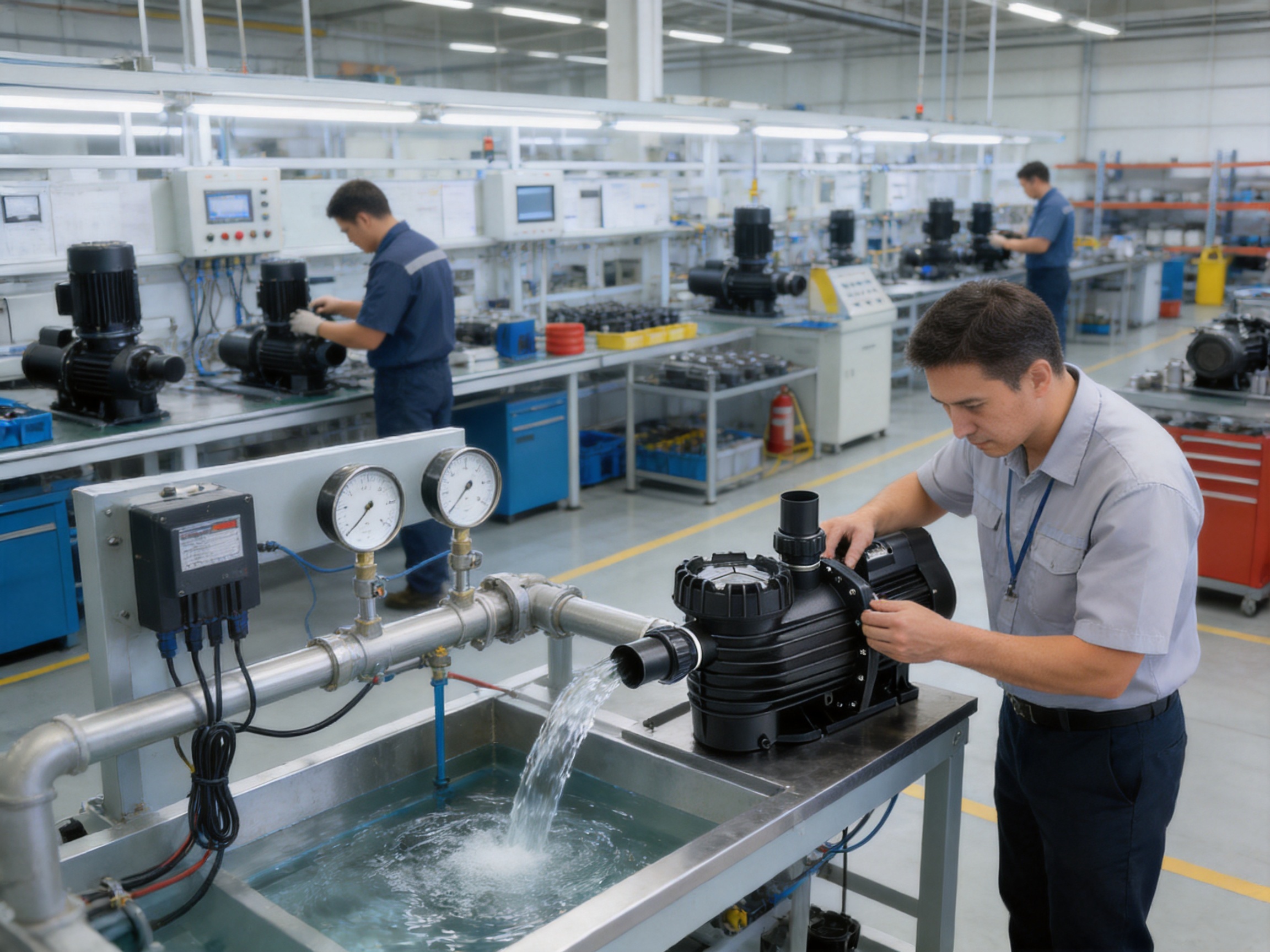
Efficiency in a water system is not determined by motor wattage alone. It depends on how effectively the pump, pipework, valves, filtration equipment, and control strategy work together. A pump that is correctly matched to the system can deliver the required circulation without excessive restriction or unnecessary oversizing.
The HLG/HLW range supports this approach by offering several performance levels. Designers can begin with the required flow and operating head, then evaluate the available models. The 1500W models may be appropriate for systems requiring 29 m³/h and 16 m, while the 2200W models provide 32 m³/h and 18 m. Where higher capacity or greater lift is needed, the 2600W and 3000W models extend the range to 35 m³/h or 37 m³/h and up to 21 m.
Using a large-diameter connection can also help reduce unnecessary velocity and friction losses compared with a smaller pipe, although the entire system must be designed consistently. Pipe diameter alone does not guarantee efficiency; length, internal roughness, elevation, fittings, and flow requirements must all be considered.
Controls may be added to manage operating schedules, protection, and system coordination. The specific control method should be selected according to the motor configuration and the installation’s electrical standards. Where variable flow is required, the system designer should confirm compatibility before applying any speed-control equipment.
Before ordering an HLG/HLW pump, customers should prepare a clear specification for the intended application. Important information includes the required flow rate, total dynamic head, pipe diameter, pipe length, elevation difference, water characteristics, electrical supply, available installation space, and expected operating schedule.
The required flow should be stated at the actual operating head rather than only as a free-discharge target. If the pump must supply several branches, the designer should determine whether the branches operate simultaneously and calculate the combined requirement. If filters or heat exchangers are included, their pressure losses should be added to the system calculation.
The electrical configuration must also be confirmed. Several models are offered in both 220V/50Hz and 380V/50Hz versions, while some higher-capacity variants are listed only with 380V/50Hz. Ordering the correct electrical version is essential for safe installation and proper operation.
Customers should also verify dimensions before preparing the foundation or pump room. The HLG and HLW families have different overall lengths, and the HLW-350 and HLW-400 are longer than the HLW-200 and HLW-300. Service access should be considered in addition to the product’s listed dimensions.
The series is designed for self-priming, high-volume water circulation. It can be used in large aquariums, aquaculture systems, garden water features, and compatible industrial or technical water installations.
The highest listed output is 37 m³/h, provided by the HLW-400 model. Its maximum listed head is 21 m.
The HLG-200 and HLW-200 models are listed with an output of 29 m³/h and a maximum head of 16 m. They are available in 220V/50Hz and 380V/50Hz configurations.
The HLG-300 and HLW-300 models are listed with an output of 32 m³/h and a maximum head of 18 m. Both voltage configurations are available for these models.
Both models are listed at 2200W, 32 m³/h, 18 m maximum head, and Φ63/Φ60 tube diameter. Their listed lengths differ: the HLG-300 measures 657 mm, while the HLW-300 measures 605 mm. Both have a width of 273 mm and a height of 316 mm.
The HLW-400 has the highest listed maximum head at 21 m. It is rated at 3000W and 37 m³/h and uses a 380V/50Hz electrical configuration.
It can be considered for large garden ponds and decorative water systems when the required flow, head, water quality, electrical supply, and installation conditions are compatible with the product specifications. Outdoor installation should include suitable weather protection and electrical safety measures.
No. Self-priming helps the pump establish circulation under suitable conditions, but the suction pipe must still be correctly sealed, the pump must have access to water, and the system must be installed according to proper hydraulic and electrical practices.
The listed tube diameter for the series is Φ63/Φ60. Installers should confirm the exact pipe and fitting dimensions before beginning installation.
No. The HLG-200, HLG-300, HLW-200, HLW-300, and HLW-350 are listed with both 220V/50Hz and 380V/50Hz versions. The HLG-400 and HLW-400 are listed with 380V/50Hz.
Selection should be based on required operating flow, total dynamic head, pipe resistance, electrical supply, installation dimensions, and application conditions. A qualified system designer should confirm the final selection for complex or critical installations.
The HLG/HLW Series Self-priming Circulating Water Pump is manufactured by Sensen Group Co., Ltd., an established supplier involved in aquarium products, aquaculture machinery, industrial equipment, and related water technologies.
The HLG/HLW Series Self-priming Circulating Water Pump is designed for demanding water systems that require substantial circulation, useful lifting capability, and practical installation flexibility. Its model range covers outputs from 29 m³/h to 37 m³/h and maximum heads from 16 m to 21 m, with power ratings from 1500W to 3000W.
The combination of self-priming capability, Φ63/Φ60 tube connections, multiple voltage options, and different housing lengths gives the series a strong position for large aquariums, aquaculture facilities, ponds, water features, and compatible industrial applications. Compared with basic pumps that offer only one configuration or require flooded-inlet installation, the series provides broader selection and greater layout flexibility.
Its value is also supported by the manufacturer’s long-term experience in aquatic products, aquaculture machinery, and industrial equipment. Research resources, quality-control organization, subsidiary companies, and an international sales structure provide a foundation for product development and customer service.
For the best results, the pump should be selected according to the complete hydraulic system rather than by power rating alone. Correct pipe sizing, careful installation, suitable electrical protection, routine maintenance, and appropriate operating controls are essential. When these factors are properly addressed, the HLG/HLW Series can serve as a capable circulation solution for high-volume water-management projects.
1. Product specification sheet for the HLG/HLW Series Self-priming Circulating Water Pump, including model ratings, dimensions, voltage, power, output, maximum head, and tube diameter.
2. Manufacturer profile and corporate information for Sensen Group Co., Ltd., including company history, research organization, quality-control structure, subsidiaries, and industry activities.
3. General principles of centrifugal and self-priming pump selection for aquarium, aquaculture, garden, and industrial water systems.
4. General guidance on hydraulic head, pipe friction, system resistance, and circulation-pump installation.
5. General electrical safety practices for 220V/50Hz and 380V/50Hz motor-driven equipment.


 No. 61-79, Baima Street, Maao Town, Dinghai District, Zhoushan City, Zhejiang Province, China.
 0086 580 8082088 / 8081168
 0086 580 8080978
 songhua@sunsun-china.com