

 English
 русский
 España
 Portugal
 عربي
Li Mei | Aquarium Equipment Sales Specialist
Home / Author / Li Mei | Aquarium Equipment Sales Specialist / Why a Well-Designed Tabletop Aquarium Makes a Better Home Aquatic Environment
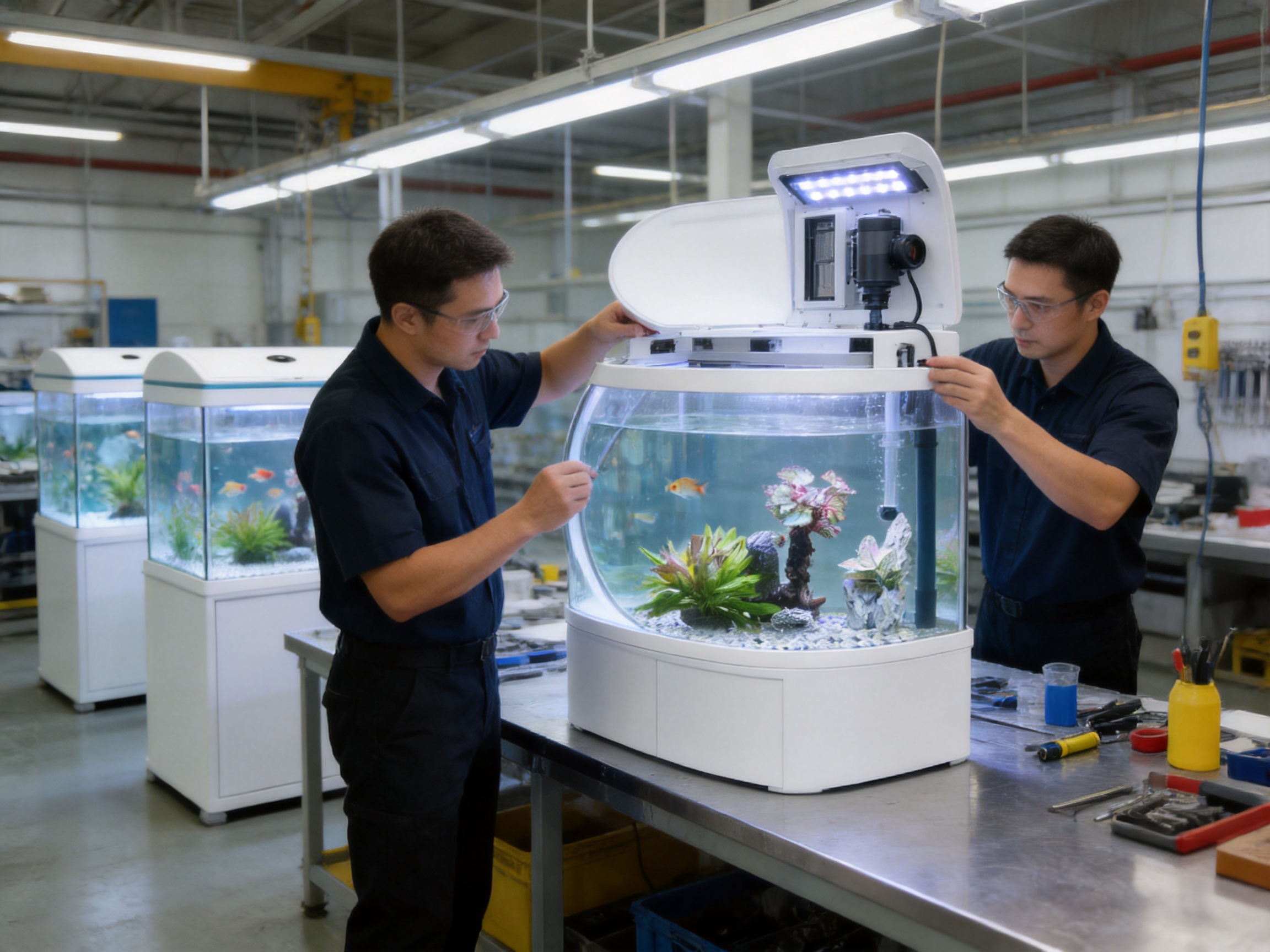
A home aquarium is more than a transparent container for fish. It is a small living environment that combines water management, lighting, filtration, visual design, and daily care. When these elements are designed to work together, even a compact aquarium can become a stable habitat and an attractive part of a room. The HRG series tabletop fish tank has been developed around this principle, combining a clean modern appearance with integrated top filtration, energy-efficient LED lighting, durable glass construction, and several size options for different household and commercial settings.
The series is available in five configurations: HRG-300, HRG-380, HRG-500, HRG-600, and HRG-800. These models range from a compact 7-liter aquarium to a 135-liter aquarium. Such a range allows users to select a suitable capacity without changing to a completely different design concept. A small desktop setup can support a carefully planned display, while the larger versions can become a more prominent living feature in a home, office, reception area, retail environment, or hospitality space.
Its design is based on practical integration. The upper cover, lighting system, filtration area, pump, glass body, and base are coordinated as one product rather than treated as unrelated accessories. This approach helps reduce visual clutter, simplifies installation, and gives the aquarium a more finished appearance than many basic tanks that require multiple external devices.
Content
Many aquarium buyers want an attractive display but do not want a complicated installation. Conventional aquariums often require a separate filter, a separate lamp, additional brackets, exposed cables, and careful arrangement of multiple components. Although this modular approach can offer flexibility, it can also create a crowded appearance and increase the number of parts that must be installed, maintained, and replaced.
The HRG series takes a more unified approach. Its top filtration system is incorporated into the aquarium structure, while the LED lighting is positioned to illuminate the tank from above. The result is a neat tabletop presentation with fewer visible external components. This is particularly useful for users who are placing the aquarium in a living room, study, bedroom, office, reception counter, or another location where appearance matters as much as function.
The product design also reflects the idea that an aquarium should be easy to understand. The major operating elements are located in familiar positions: water is circulated through the upper filtration area, illumination comes from the top, and the tank body provides a clear viewing window. This straightforward arrangement can make routine observation and basic maintenance more convenient for beginners.
Its minimalist appearance is supported by a rich white color scheme and a curved-edge glass form. The design avoids excessive decoration and instead emphasizes the movement of fish, aquatic plants, water, and light. This gives the aquarium a calm visual character that can complement both contemporary and traditional interior spaces.
An aquarium placed on a tabletop should not appear like a temporary project assembled from unrelated equipment. It should look intentional and balanced. The HRG series addresses this need through its coordinated cover frame and base. Since the overall dimensions include the upper cover frame and base, users can plan the placement area more accurately before installation.

HRG series tabletop fish tank
One of the most practical advantages of the series is the availability of five model sizes. A single aquarium size cannot suit every room, stocking plan, furniture surface, or visual preference. The HRG range gives users more control over the relationship between aquarium volume and available space.
| Model | Overall Size | Lighting Power | Pump Power | Capacity |
| HRG-300 | 29 x 20 x 32 cm | 3.5 W | 2.5 W | 7 L |
| HRG-380 | 38 x 26 x 40 cm | 5.5 W | 2.5 W | 19 L |
| HRG-500 | 50 x 30 x 45 cm | 7 W | 8 W | 29 L |
| HRG-600 | 60 x 30 x 54 cm | 7 W | 8 W | 72 L |
| HRG-800 | 80 x 30 x 64 cm | 14 W | 12 W | 135 L |
The HRG-300 is the most compact option. Its 7-liter capacity is suitable for small decorative aquatic arrangements where space is limited. It can be used as an introduction to aquarium keeping, provided that stocking and maintenance are appropriate for a small volume. Smaller aquariums require careful attention because water conditions can change more quickly, but their compact footprint makes them accessible to people who do not have room for a large installation.
The HRG-380 increases the capacity to 19 liters while maintaining a manageable overall size. It offers more room for arranging decorative elements and may provide greater flexibility for a carefully selected aquatic display. Its dimensions make it appropriate for desks, counters, shelves designed to support the load, and other stable surfaces.
The HRG-500 provides a 29-liter capacity and a wider 50-centimeter viewing area. This additional width can improve the visual presentation of plants, ornaments, and swimming space. It also creates a stronger display presence without becoming as demanding in terms of floor area as a large aquarium.
The HRG-600 has a 72-liter capacity and a 60-centimeter width. At this size, the aquarium becomes a substantial interior feature. It can support a more developed aquascape, a larger visual composition, and greater water volume than the smaller models. Because a filled aquarium is heavy, this model should be positioned on a suitable stand or surface designed to support its total load.
The HRG-800 is the largest model in the series. With an 80-centimeter width, 64-centimeter height, and 135-liter capacity, it is designed for users who want the aquarium to become a central visual element. Its 14-watt lighting system and 12-watt pump are matched to the larger tank format. This model is suitable for larger domestic rooms, office areas, commercial displays, and hospitality environments where a more substantial aquatic presentation is desired.
The range also helps retailers, designers, and project buyers create consistent installations in different spaces. Several rooms can use the same design language while selecting different capacities. This is more efficient than mixing unrelated tank styles and brands to fit different locations.
Water quality is one of the most important factors in aquarium performance. Fish, plants, beneficial microorganisms, decorations, and the aquarium owner all depend on an effective circulation and filtration system. The HRG series uses integrated top filtration to support the purification of aquarium water while preserving a clean external appearance.
Top filtration is practical because it uses the upper area of the aquarium, where the filter can remain accessible without taking up a large amount of space inside the display. Water is lifted toward the filtration section, passes through the appropriate filter media, and then returns to the tank. This movement helps circulate the water and can collect suspended particles before they remain in the aquarium.
An integrated system has several advantages over a basic tank sold without filtration. First, the filter is designed as part of the aquarium structure. Second, the upper cover and filtration area can be coordinated visually. Third, users do not need to search for a separate filter that matches the tank size and appearance. Finally, a built-in design can reduce the number of exposed hoses and external brackets around the aquarium.
Filtration does not eliminate the need for responsible aquarium care. Regular water changes, appropriate feeding, suitable stocking, filter-media maintenance, and observation remain essential. However, an integrated filter provides a reliable foundation for these practices. The circulation system can help distribute oxygen and heat, reduce stagnant areas, and support a more consistent aquatic environment.
The pump power varies by model, from 2.5 watts in the HRG-300 and HRG-380 to 12 watts in the HRG-800. This model-specific selection reflects the different water volumes and tank dimensions. A small aquarium does not need the same pump capacity as a 135-liter aquarium, while a larger aquarium needs stronger circulation to move water effectively through its filtration system.
Compared with many entry-level aquariums that rely on an external hang-on filter or a separate internal device, the integrated top-filter structure gives the HRG series a more organized appearance. It also supports a simpler purchasing experience because the main circulation equipment is included in the product concept rather than left entirely to the customer.
For commercial buyers, integrated filtration can also simplify product presentation. A retailer can display the aquarium as a complete system rather than explaining how several separate components must be combined. In an office or hospitality setting, the reduced visual clutter can be especially valuable because the aquarium must fit into a professional environment.
Users should inspect the filtration area regularly and follow appropriate maintenance procedures for the filter media and pump. Debris should not be allowed to block the water path. Filter media should be cleaned or replaced according to its condition, while biological media should be handled carefully so that beneficial microorganisms are not unnecessarily removed.
The aquarium should also be positioned on a level surface. A stable installation protects the glass body, helps maintain proper water flow, and reduces the risk of stress on the tank structure. Before filling the tank, users should confirm that the base is secure and that the supporting furniture is strong enough for the fully filled aquarium.
The glass body is a central part of any aquarium because it determines both safety and visual quality. The HRG series uses high-strength glass designed to provide a clear viewing surface and a durable enclosure for the aquatic environment. High-quality glass helps viewers see fish, plants, and decorations with less visual distortion and supports a brighter, more attractive display.
The product description emphasizes the role of high-definition glass in improving the viewing experience. In a tabletop aquarium, this benefit is particularly important because the tank is often observed from a relatively close distance. A clear front panel allows the aquarium to function as a living picture, with the movement of fish and the changing reflections of light adding depth to the room.
The tank shape uses hot bending technology, described as a single straight face with double arc edges. This construction gives the aquarium a distinctive appearance without relying on excessive exterior decoration. The straight front viewing area provides a stable visual field, while the curved edges soften the overall profile and help create a more elegant transition between the front and side surfaces.
Hot bending is also an important manufacturing process because it requires controlled heating, forming, cooling, and inspection. The glass must be shaped accurately so that the final structure has a consistent appearance and suitable fit with the upper cover and base. Proper process control is essential for producing repeatable results across multiple units.
The curved-edge design can offer a more continuous viewing effect than a simple box-shaped tank. It reduces the abrupt visual break at the corners and gives the aquarium a smoother profile. This is useful in interior spaces where the tank may be seen from different angles rather than only from directly in front.
Although the glass is designed for strength, users should still handle the aquarium carefully. It should not be dragged across a surface, exposed to sudden impact, or placed on an uneven support. Cleaning tools should be suitable for aquarium glass, and hard particles should be removed before wiping to reduce the chance of scratching.
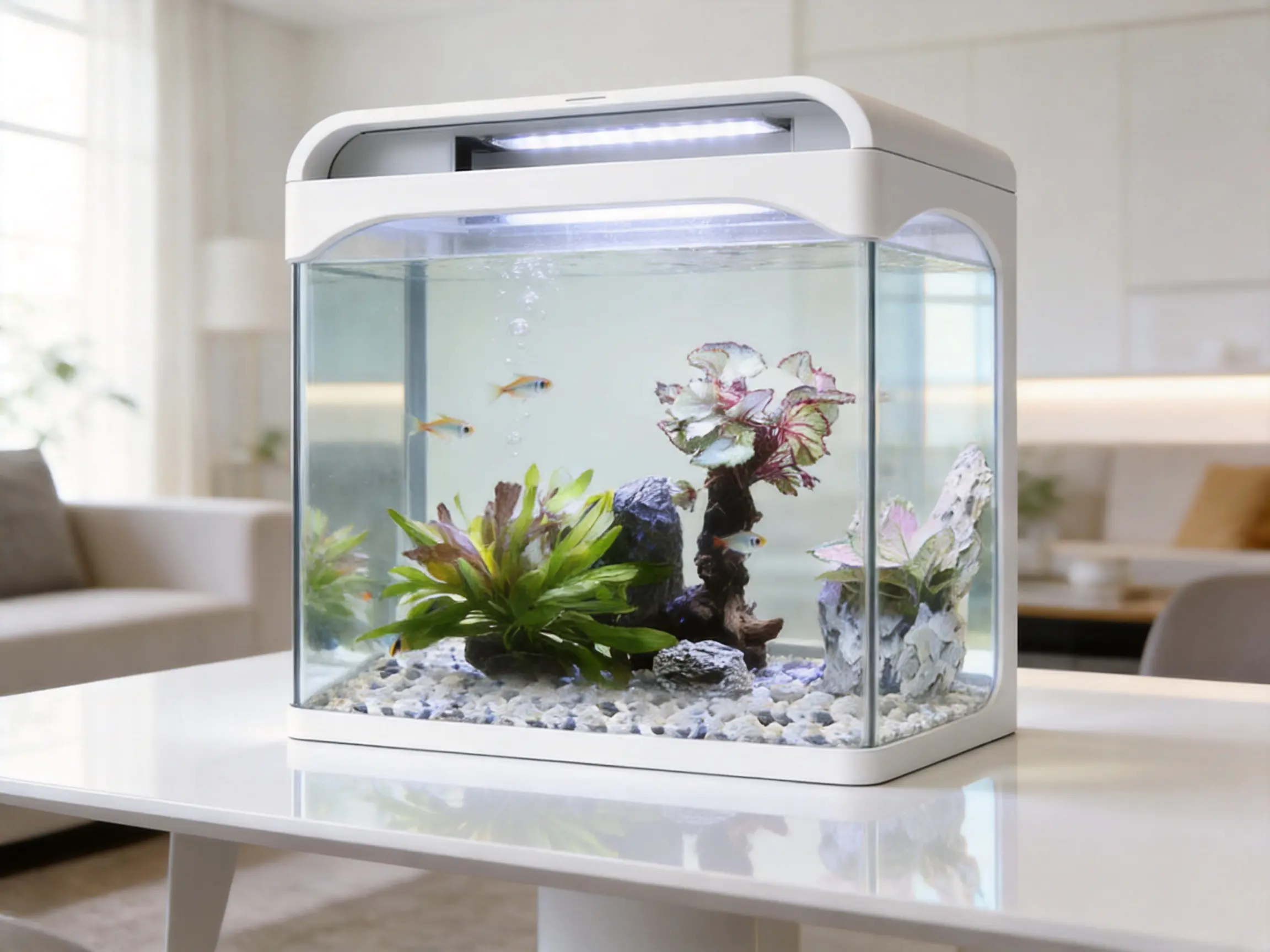
Lighting serves several purposes in an aquarium. It makes fish and decorations visible, creates a more attractive display, establishes a daily rhythm, and can support suitable aquatic plants when the light intensity and duration are appropriate. The HRG series uses high-brightness LED lighting designed to provide illumination with relatively low power consumption and long-lasting performance.
The lighting power is matched to the model size. The HRG-300 uses a 3.5-watt lamp, followed by 5.5 watts for the HRG-380, 7 watts for the HRG-500 and HRG-600, and 14 watts for the HRG-800. This range provides a practical balance between tank size, visual brightness, and energy use.
LED technology offers several advantages over older lighting formats. LEDs can provide strong illumination from a compact unit, generate less excess heat than many traditional lamps, and operate efficiently for extended periods. Their small size also allows them to be incorporated into the upper structure without making the aquarium look heavy or industrial.
For a home or office user, low energy consumption can help reduce the ongoing operating cost of the aquarium. The saving from one small lamp may appear modest, but the aquarium may operate every day for many months or years. Efficient lighting is therefore relevant to both household budgets and responsible energy use.
Lighting should be managed according to the needs of the aquarium. Fish generally benefit from a stable day-and-night cycle, while plants require an appropriate period of illumination rather than continuous light. Excessive lighting can encourage algae growth, especially when combined with excess nutrients. A balanced schedule and regular observation are more important than simply operating the lamp for the maximum possible time.
The lamp also contributes to the visual identity of the product. A bright, evenly presented aquarium can make the white structure, clear glass, plants, and fish appear more refined. In commercial spaces, attractive illumination can encourage visitors to pause and observe the display. In domestic spaces, it can create a calm focal point during the evening.
Compared with a basic aquarium that requires the buyer to purchase an additional lamp, the integrated LED system offers better initial coordination. The lighting is already considered in relation to the tank dimensions and cover structure. This reduces the risk of using a lamp that is too weak, too large, visually unsuitable, or difficult to mount.
The performance of an aquarium depends not only on its visible design but also on the production systems behind it. A reliable aquarium manufacturer must coordinate glass processing, hot bending, structural assembly, pump integration, lighting installation, filtration design, electrical safety, packaging, and quality inspection.
The manufacturer of the HRG series has developed experience across aquarium products, aquaculture machinery, industrial equipment, and related fields. This broad technical background is valuable because aquarium systems combine several disciplines. The product is not simply a glass container; it is an integrated water-circulation and lighting appliance that must be designed for long-term domestic and commercial use.
The company has established multiple functional departments, including research and development, quality control, education and training, personnel administration, finance, and information management. The presence of dedicated research and quality functions supports a more systematic approach to product development than an informal assembly operation.
Research and development contributes to product improvement in areas such as aquarium shape, filtration layout, pump selection, lighting integration, user convenience, and manufacturing efficiency. A product series with multiple capacities requires careful coordination so that each model maintains the same overall design language while receiving appropriately sized components.
Quality control is especially important in aquarium manufacturing. The glass must be checked for visible defects, dimensions, edge quality, and proper fit. The hot-bent structure must be inspected for consistent forming. Pumps and lighting components must operate correctly. The filtration route must be checked for proper circulation. The completed aquarium should also receive a practical inspection before packaging and shipment.
Manufacturing strength is also reflected in the ability to support different product categories and supply markets. A company with experience in aquarium pets, aquacultural machinery, and industrial equipment can apply lessons from one field to another. Knowledge of pumps, water movement, materials, electrical components, and large-scale production can contribute to the development of more dependable aquarium systems.
The organization operates through a broad corporate structure that includes wholly owned subsidiaries and trading interests in different regions. This network can support purchasing, production coordination, logistics, sales, and customer service. For distributors and project buyers, a stable supply structure is an important advantage because availability and consistency matter as much as the appearance of an individual product.
Advanced manufacturing should not be understood only as the use of automated machinery. It also includes process discipline, repeatable specifications, engineering coordination, quality documentation, trained personnel, and the ability to improve products over time. These elements help transform a successful concept into a reliable series that can be produced in multiple sizes.
The curved-edge shape of the HRG aquarium requires more than ordinary flat-glass assembly. Hot bending technology involves heating the glass to a controlled forming temperature, shaping it with suitable tooling, and cooling it in a managed way. The purpose is to achieve the intended single straight face and double arc edge while preserving clarity and structural integrity.
After forming, the glass must be integrated with the base and upper cover frame. Accurate fit is important because the tank body, filtration area, lamp, and cover must work together as a complete structure. A mismatch could affect appearance, access, water circulation, or the stability of the top components.
Coordinated manufacturing also helps maintain consistency between models. While the HRG-300 and HRG-800 have very different dimensions and capacities, both should express the same design principles: clear viewing, integrated filtration, efficient lighting, and a clean tabletop appearance.
Component matching is another manufacturing strength. The pump must be appropriate for the water volume and filtration layout. The lighting system must illuminate the display without creating unnecessary complexity. The cover must accommodate the lamp and filtration area while maintaining a finished appearance. The base must support the tank and distribute its load properly.
These relationships are difficult to manage when components are purchased and assembled without a unified design plan. An integrated product allows the manufacturer to test the interaction of the major parts as one system. This can reduce compatibility problems that customers sometimes experience when buying separate aquarium equipment from different sources.
The HRG series competes in a market that includes bare glass tanks, low-cost plastic aquariums, traditional rectangular aquariums with external equipment, and highly specialized premium systems. Its main advantage is the balance between integration, appearance, functionality, and size choice.
A bare glass tank may have a lower initial price, but it usually does not include lighting, filtration, or a coordinated cover. The buyer must select and install each component separately. This can create additional cost, require more technical knowledge, and result in an untidy appearance. The HRG series provides a more complete starting point for users who want a ready-designed system.
Small plastic aquariums may be lightweight and inexpensive, but they can be more vulnerable to scratching, visual distortion, and a temporary appearance. High-strength glass gives the HRG series a clearer and more substantial viewing experience. The hot-bent edge design also provides a more refined profile than a basic molded container.
Traditional aquariums with external filters can offer flexibility, but their hoses, brackets, and cables may occupy visible space around the tank. The integrated top filtration of the HRG series reduces this visual complexity. It does not remove the need for maintenance, but it can make the equipment arrangement more orderly.
Some premium aquariums focus on advanced digital controls, specialized lighting programs, or highly customized filtration. Those products can be attractive to experienced enthusiasts, but they may be more expensive and more complicated for beginners or general interior applications. The HRG series emphasizes dependable core functions and accessible operation rather than unnecessary complexity.
The five-model range is another competitive strength. Customers can choose a compact aquarium for limited space or a larger unit for a stronger visual effect without abandoning the product family. Distributors can also offer a coherent series to different customer groups, from first-time aquarium owners to commercial buyers.
Energy efficiency provides an additional advantage. High-brightness LED lighting and model-matched pump power help the aquarium perform its essential functions without relying on oversized equipment. Efficient components can reduce operating costs and support more sustainable everyday use.
Appearance is also a meaningful differentiator. Aquarium buyers often make decisions based on how the product will look in a room. The rich white color, clear glass, straight front face, and double curved edges create a decorative object rather than a purely technical appliance. This makes the product suitable for design-conscious users who want aquatic life to complement their furniture and interior decoration.
The smallest models can be used in personal spaces where a full-size aquarium would be impractical. A study, bedroom, home office, or apartment living area may benefit from the presence of a compact aquatic display. The aquarium can introduce movement and natural color without requiring a large footprint.
In an office, a tabletop aquarium can be positioned in a reception area, meeting room, employee lounge, or executive office. The calm movement of fish and water may contribute to a more welcoming atmosphere. The integrated appearance is helpful in professional settings because the equipment does not dominate the surrounding design.
Retail stores can use the series as a product display or as part of a showroom environment. The different sizes allow the retailer to demonstrate several installation possibilities. The larger models can attract attention from a distance, while the smaller models can show how an aquarium fits into a compact living space.
Hotels, restaurants, clinics, and other public interiors can use a well-maintained aquarium as a visual feature. In these applications, reliability, clean appearance, and ease of routine operation are essential. The coordinated structure of the HRG series can make it easier to integrate the aquarium into a counter, display area, or selected furniture arrangement.
Interior designers and project contractors may also appreciate the consistency of the series. A project may require different tank capacities in different rooms, but a unified product family can maintain a consistent aesthetic. This is useful in residential developments, hospitality projects, offices, and retail chains.
Educational settings can use a suitable model to introduce students to aquatic ecosystems, water quality, filtration, and responsible animal care. The integrated filtration system provides a clear example of how water is circulated and purified. Teachers and caretakers must still select appropriate inhabitants and establish a maintenance schedule.
Before installation, users should select a level, stable, and load-bearing surface. The total weight of an aquarium includes the glass body, water, substrate, decorations, equipment, and any other materials placed inside. Larger models require particularly careful support planning.
The aquarium should be positioned away from direct sunlight, extreme temperature changes, and locations where it may be knocked or exposed to household chemicals. Direct sunlight can encourage algae growth and cause excessive temperature variation. A position with convenient access to a safe electrical outlet is also important for the pump and lighting system.
After the tank is cleaned with suitable water, the filtration system should be installed or checked according to the product instructions. The tank should be filled gradually, and the pump should be observed to confirm that water moves through the upper filtration area correctly. Electrical connections should remain dry and should be arranged to reduce the possibility of water running along a cable toward an outlet.
New aquariums require time to establish biological filtration. Users should avoid introducing too many fish immediately. Water parameters, fish behavior, clarity, and temperature should be monitored as the aquarium matures. A slow and responsible setup is better for aquatic life than treating the aquarium as a decorative container that can be fully stocked on the first day.
Feeding should be controlled. Excess food can decompose, increase waste, and reduce water quality. Regular partial water changes are normally more useful than infrequent complete water replacements. The filter should be kept operational, and its media should be cleaned in a way that preserves useful biological activity whenever possible.
The lighting schedule should be consistent. If live plants are used, their requirements should be considered when selecting plant species and arranging the aquarium. If the display contains only fish and decorative materials, the lamp can still provide attractive illumination, but unnecessary over-lighting should be avoided.
A coordinated aquarium design can reduce the number of separate maintenance points. Instead of managing an external filter, independent lamp bracket, loose cover, and multiple visible accessories, the user works with a unified top structure. This can make daily observation more straightforward.
The top filtration area is accessible for inspection, while the glass body provides a broad view of the aquatic environment. Users can quickly notice changes in water clarity, fish activity, plant condition, and equipment operation. Early observation is valuable because small problems are generally easier to correct than advanced water-quality or equipment failures.
The LED lighting system is also simpler to manage than a collection of separate lamps. Its integrated location reduces the risk of incorrect positioning and helps maintain consistent illumination across the tank. If the aquarium is used in a public or commercial space, fewer exposed components may also reduce accidental interference.
Maintenance still requires discipline. A well-designed aquarium cannot replace water testing, appropriate stocking, filter care, glass cleaning, and responsible feeding. Its value lies in making these tasks easier to organize and in providing a stable platform for good aquarium habits.
Aquarium customers increasingly expect products that combine attractive design with dependable manufacturing. They want clear product specifications, consistent dimensions, reliable pumps, practical lighting, and access to a product family that can support future purchasing needs. A manufacturer with long-term experience and a broad organizational structure is better positioned to meet these expectations.
The company behind the HRG series has operated for more than three decades and has developed activities across aquarium pets, aquaculture machinery, and industrial equipment. Long-term participation in these industries provides experience in production management, equipment development, market requirements, and product distribution.
Its research institute and quality control department indicate an emphasis on organized technical development and inspection. These functions are important for continuous improvement. Aquarium products must respond to changes in consumer expectations, energy efficiency requirements, interior design trends, materials, and equipment technology.
The company’s business structure includes production and trading organizations in different regions. Such a network can help support a broad sales system and provide access to domestic and international markets. For wholesalers and distributors, this may offer advantages in product availability, model selection, and long-term cooperation.
The company also promotes a combination of industrial technical development, global marketing, and international brand growth. From a product perspective, this means that manufacturing capability and market service are considered together. A technically sound aquarium is more valuable when it can be supplied consistently, supported by product information, and adapted to the needs of different markets.
For buyers comparing aquarium suppliers, the most important questions include whether the supplier can maintain stable product quality, whether the models have clear specifications, whether replacement components can be managed, and whether the manufacturer understands both domestic and export requirements. The HRG series is supported by a business structure designed to address these broader supply needs.
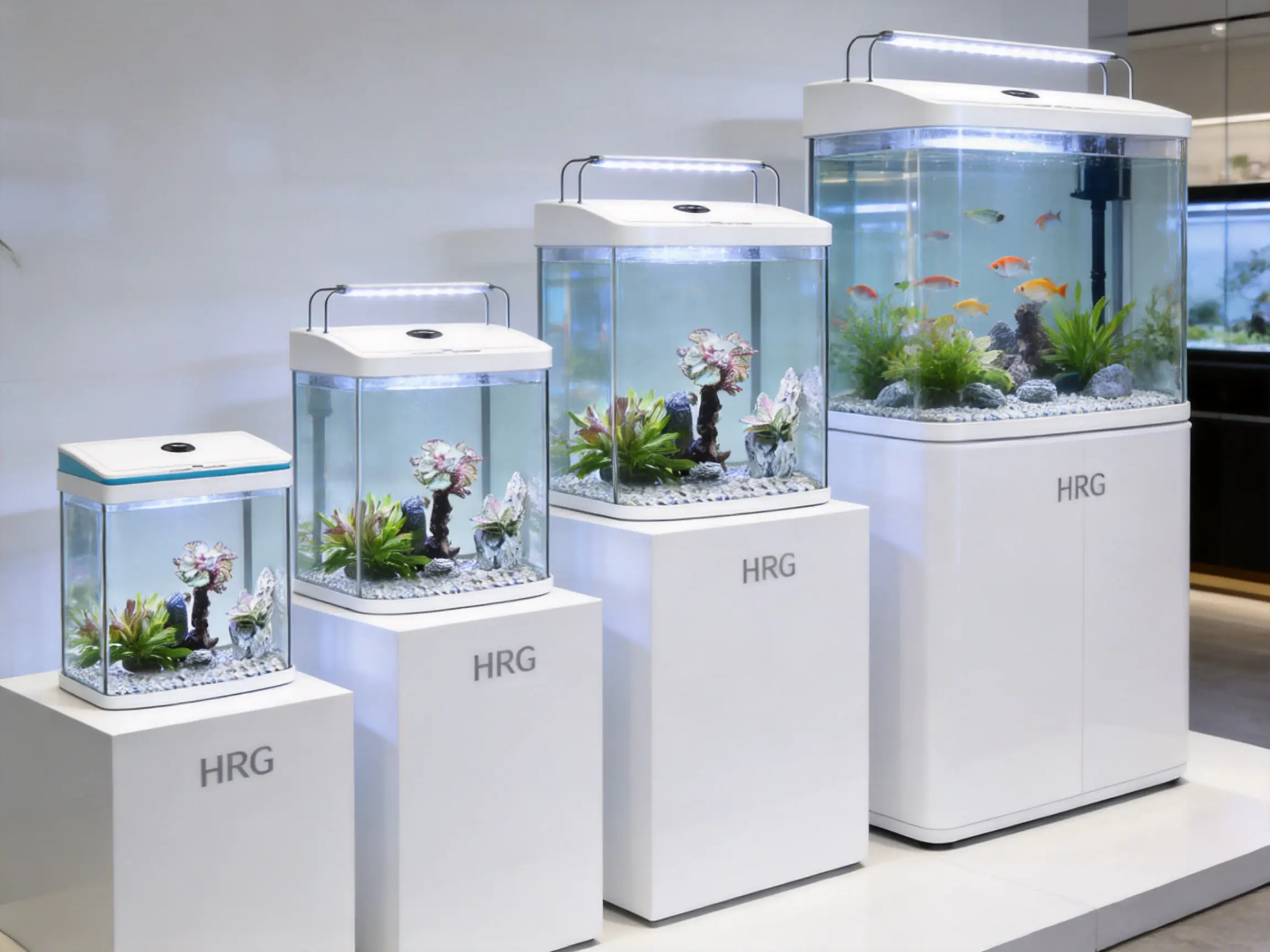
Beginners often prioritize simplicity. They want to avoid purchasing incompatible components and would prefer a product that can be understood quickly. The HRG series responds with a built-in filter, integrated LED lamp, coordinated cover, and clear model specifications.
Experienced aquarium keepers may prioritize visual quality and space efficiency. The high-strength glass, curved-edge construction, and clean upper structure provide a polished foundation for a customized aquatic layout. While advanced users may add their own accessories depending on their needs, the aquarium already offers a coherent base system.
Interior designers may focus on shape, color, proportions, and visual integration. The rich white finish and minimalist form can fit a broad range of decorative styles. Five available sizes allow the designer to match the aquarium to the scale of the room and furniture.
Commercial operators may prioritize reliability, appearance, and ease of routine maintenance. An integrated system can reduce visible equipment and simplify staff training. The larger models can create a stronger display impact, while the smaller models can be used in areas where floor and counter space are limited.
Distributors may prioritize product breadth and supply stability. A series with five capacities allows a distributor to serve more customer segments under one design family. The combination of aquarium equipment, pumps, lighting, and related product experience also supports a broader aquatic product portfolio.
The HRG series is based on four primary design principles. The first is integrated water management through top filtration. The second is visual clarity through high-strength glass and a hot-bent curved-edge shape. The third is efficient illumination through high-brightness LED lighting. The fourth is product adaptability through five size options.
These principles work together rather than operating independently. Filtration supports water quality, clear glass supports observation, lighting supports visibility and presentation, and the range of sizes supports different installation environments. The upper cover and base help combine these functions into a complete tabletop product.
The result is an aquarium that aims to be both functional equipment and interior decoration. It does not depend on excessive ornamentation. Instead, it uses proportion, clean surfaces, curved edges, integrated technology, and appropriate component selection to create a more refined aquatic display.
Its advantages are particularly apparent when compared with products that focus on only one feature. A very inexpensive tank may offer a low entry price but lack filtration and lighting. A highly specialized aquarium may offer more advanced control but involve greater cost and complexity. The HRG series occupies a practical middle position, providing essential integrated functions with a modern presentation and multiple capacities.
The HRG series is a family of tabletop aquariums designed with integrated top filtration, high-brightness LED lighting, high-strength glass, and a coordinated cover and base. It includes five models with capacities from 7 liters to 135 liters.
There are five models: HRG-300, HRG-380, HRG-500, HRG-600, and HRG-800. Their capacities are 7 liters, 19 liters, 29 liters, 72 liters, and 135 liters respectively.
The aquarium uses hot bending technology to create a single straight viewing face with double arc edges. This gives the tank a smoother and more distinctive appearance than a basic rectangular box.
Yes. The series uses an integrated top filtration system designed to circulate and help purify the aquarium water. Routine water changes, filter maintenance, and responsible stocking are still required.
Yes. Each model includes a high-brightness LED lighting system with power matched to its size. The lighting power ranges from 3.5 watts on the HRG-300 to 14 watts on the HRG-800.
The HRG-300 has the smallest footprint and a 7-liter capacity, making it the most compact option. The HRG-380 provides more water volume while remaining relatively compact. The final choice should consider the available surface, intended aquatic inhabitants, and maintenance requirements.
The HRG-800 is the largest model, measuring 80 x 30 x 64 centimeters and holding 135 liters. It is suitable for users who want a more prominent aquarium feature in a home, office, retail, or hospitality environment.
The HRG series provides integrated filtration and lighting, a coordinated upper structure, a finished base, and a modern curved-edge design. A bare glass tank generally requires the buyer to source and install these components separately.
Its integrated design can make it approachable for beginners because the main filtration and lighting functions are already coordinated. However, beginners should still learn about cycling, stocking, feeding, water changes, and the specific needs of their selected fish or aquatic plants.
Yes. Its clean appearance and range of sizes make it suitable for offices, reception areas, retail displays, hotels, restaurants, and other interiors. Commercial users should establish a clear maintenance schedule and ensure that the supporting furniture can carry the filled aquarium safely.
LED lighting provides bright illumination with relatively low power consumption and can operate for a long period when properly maintained. It also has a compact form that can be integrated into the aquarium’s upper structure.
The product highlights hot bending technology for the curved-edge glass construction and integrated assembly for the filtration, lighting, cover, and base. The manufacturer also maintains research and quality control functions that support product development and inspection.
No. Filtration helps manage suspended particles and supports water circulation, but it does not replace regular partial water changes, careful feeding, suitable stocking, and water-quality monitoring.
The surface should be level, stable, and capable of supporting the total weight of the filled aquarium. The product should be kept away from direct sunlight, impact hazards, and unsafe electrical arrangements.
The HRG series tabletop fish tank combines the essential functions of a modern aquarium with a clean and accessible design. Its integrated top filtration supports water circulation, its high-strength glass improves viewing clarity, its hot-bent double arc edges create a refined profile, and its LED lighting provides bright illumination with low power consumption.
The five available models make the series adaptable to different spaces and aquatic display goals. From the compact 7-liter HRG-300 to the 135-liter HRG-800, users can select a capacity that matches their room, furniture, maintenance ability, and desired visual impact.
Its strongest advantage over fragmented aquarium solutions is the coordination of major components. Instead of treating the tank, filter, lamp, cover, and base as separate purchases, the series brings them together as one product concept. This helps create a cleaner appearance, a simpler installation process, and a more consistent user experience.
The manufacturing background behind the product further strengthens its position. Experience in aquarium products, aquacultural machinery, and industrial equipment, combined with research, quality control, organized production, and broad supply capability, provides a foundation for continued improvement and dependable distribution.
For homes, offices, retail stores, hospitality interiors, and other applications, the HRG series offers a practical balance of aquatic functionality and decorative appeal. It is designed for people who want the calming presence of an aquarium without sacrificing order, clarity, energy efficiency, or modern visual quality.
1. Product specification sheet for the HRG series tabletop fish tank.
2. Product feature summary covering integrated top filtration, high-strength glass, and LED lighting.
3. Manufacturing information concerning hot bending technology and aquarium component integration.
4. Corporate background materials covering research, quality control, aquarium equipment, aquacultural machinery, and industrial equipment operations.
5. General aquarium care principles concerning water circulation, responsible stocking, lighting schedules, filter maintenance, and partial water changes.


 No. 61-79, Baima Street, Maao Town, Dinghai District, Zhoushan City, Zhejiang Province, China.
 0086 580 8082088 / 8081168
 0086 580 8080978
 songhua@sunsun-china.com