

 English
 русский
 España
 Portugal
 عربي
Wang Yu | Aquarium Products After-Sales Engineer
Home / Author / Wang Yu | Aquarium Products After-Sales Engineer / Choosing a Compact Acrylic Aquarium for Clear Viewing, Easy Maintenance, and Flexible Setup
Small aquariums are no longer limited to simple glass containers placed on a desk. Modern compact tanks are expected to combine attractive appearance, dependable construction, convenient maintenance, efficient filtration, and compatibility with suitable lighting. The HWK Series Acrylic View Aquarium is designed around these expectations. It offers a range of compact aquarium sizes for homes, offices, bedrooms, reception areas, classrooms, retail displays, and other spaces where a full-size aquarium would be impractical.
The series is available in seven models, with capacities ranging from 3.5 liters to 55 liters. This range allows users to select a tank according to available space, livestock requirements, decoration plans, and maintenance preferences. Although the models are compact, the design focuses on a clear viewing experience, a practical removable base, and the possibility of adding a compatible LED bracket light and filter pump.
For buyers comparing compact aquariums, the most important differences often involve material clarity, accessibility during cleaning, equipment compatibility, size selection, and the reliability of the manufacturer. The HWK Series addresses these areas through an ultra-white, high-transparency viewing structure, a removable base, a coordinated lighting and filtration concept, and a broad model range. These characteristics help it stand apart from basic entry-level tanks that may provide only a container without a complete maintenance strategy.
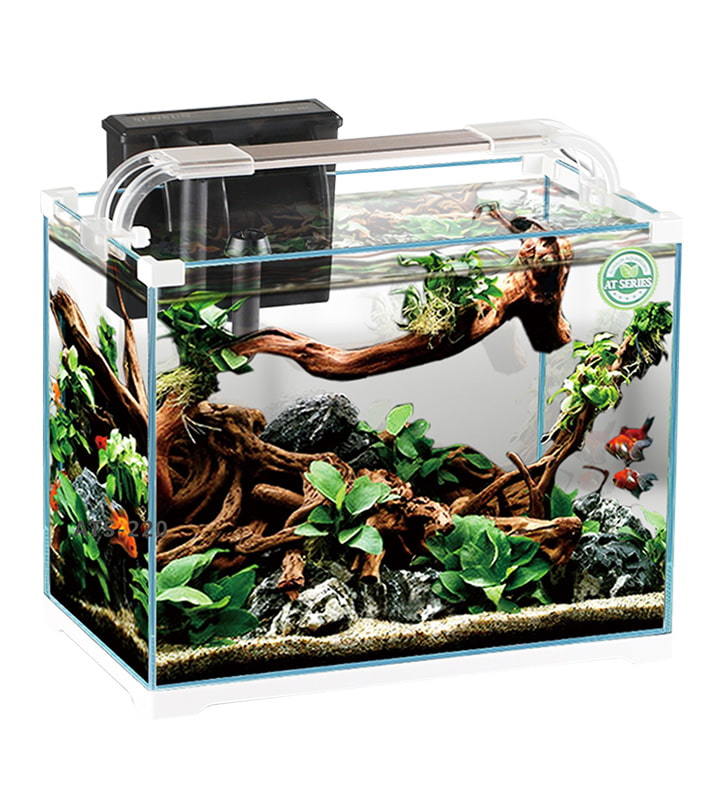
HWK Series Acrylic View Aquarium
Content
The HWK Series Acrylic View Aquarium is categorized as a small fish tank, but its design is intended to provide more than simple water storage. It is a compact display system that can be adapted to different aquatic environments. Depending on the selected model and equipment configuration, it may be used for ornamental fish, aquatic plants, shrimp, or other suitable small aquatic life.
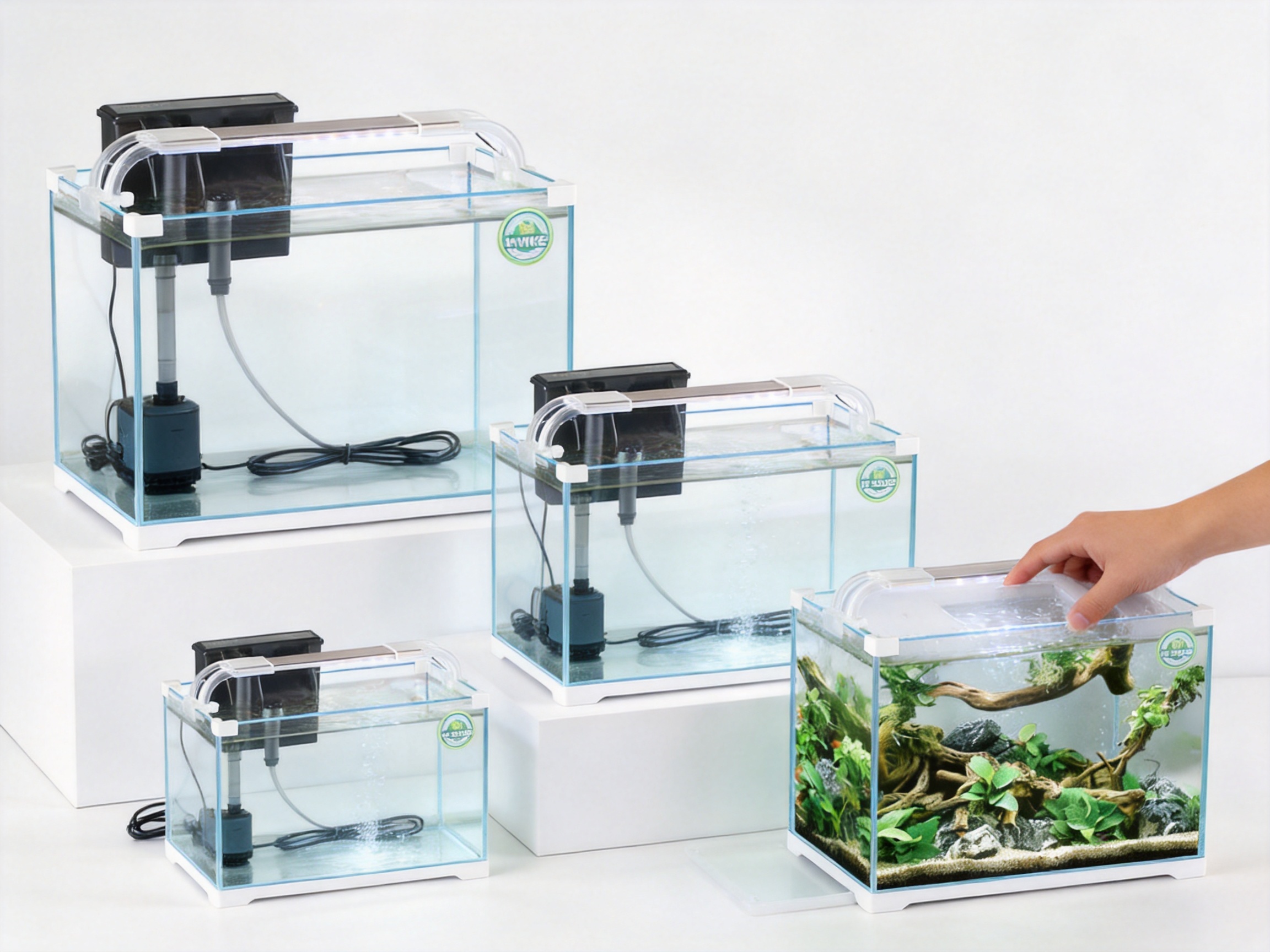
Seven models are available: HWK-180, HWK-230, HWK-280, HWK-350, HWK-420, HWK-500, and HWK-600. The model numbers correspond broadly to the length class of each aquarium, while the actual dimensions and volume vary from one version to another. The smallest model has a compact 3.5-liter capacity, while the largest model offers 55 liters of water volume.
This progression is useful for consumers who want a consistent design language across different room sizes. A person beginning with a small desktop aquarium may choose a smaller version, while a more experienced aquarist may select a larger model for increased swimming space, more aquascaping possibilities, and a wider choice of aquatic inhabitants.
The supplied product information identifies ultra-white glass and high-definition translucency as key visual features. It also highlights a removable base that is intended to make cleaning easier. In addition, the product concept supports a coordinated combination of LED lighting and filtration. The LED bracket light and filter pump are optional rather than standard, allowing the buyer to purchase equipment separately according to the selected model and intended application.
Visibility is one of the primary reasons people purchase an aquarium. Fish, plants, decorative stones, and water movement all contribute to the visual appeal of an aquatic display. If the tank material introduces noticeable color distortion, cloudiness, or poor light transmission, the appearance of the aquarium can be reduced even when the interior decoration is carefully planned.
The HWK Series emphasizes an ultra-white viewing material with high-definition translucency. This approach is intended to provide a clean and bright presentation of the aquarium interior. High transparency can help users observe fish behavior, plant growth, water clarity, and the condition of the substrate more easily than they might with a low-clarity enclosure.
Compared with conventional low-cost tanks that may use ordinary glass or less visually refined materials, a high-transparency design can create a more open appearance. The aquarium may feel brighter and less visually obstructed, which is particularly valuable in small spaces. A compact tank with clear viewing surfaces can function as both a habitat and an interior decoration element.
Clear visibility is also practical. When users can see the entire interior more easily, they can identify uneaten food, debris, algae, damaged leaves, or unusual fish behavior at an earlier stage. This supports more timely maintenance and observation. For new aquarium owners, improved visibility can make it easier to understand how the aquatic environment changes over time.
The viewing quality is especially important when a suitable LED light is installed. Proper illumination can emphasize the shape and color of fish, reveal the structure of aquatic plants, and create a more attractive display during the day or evening. The recommended lamp power varies according to tank size, helping buyers select a light that is more appropriate for the dimensions of the aquarium.
Routine maintenance is essential for any aquarium, regardless of size. Water changes, algae removal, substrate care, and inspection of the tank structure all contribute to a healthier aquatic environment. A design that makes these tasks easier can improve the long-term ownership experience.
The HWK Series includes a removable base intended to support easier cleaning. A removable base can provide better access to areas that might otherwise collect dust, water residue, or debris. It can also make it more convenient to handle the aquarium during maintenance, provided that the tank is emptied or safely prepared according to normal aquarium-handling practices.
This feature gives the series an advantage over basic fixed-base containers. With a permanently integrated base, users may have fewer options for accessing the lower exterior surfaces and may find it more difficult to clean around the support area. The removable design focuses on practical serviceability rather than appearance alone.
Cleaning convenience is particularly important for small aquariums because their limited water volume can make changes in water quality more noticeable. Even a small amount of waste or excess food may have a greater effect in a compact environment than in a much larger aquarium. A design that encourages regular cleaning can therefore support responsible aquarium care.
The removable base also contributes to flexibility during setup. Users can inspect the support area before filling the tank, confirm that the aquarium is positioned correctly, and clean the external surfaces when necessary. These details may appear simple, but they can have a meaningful effect on daily usability.
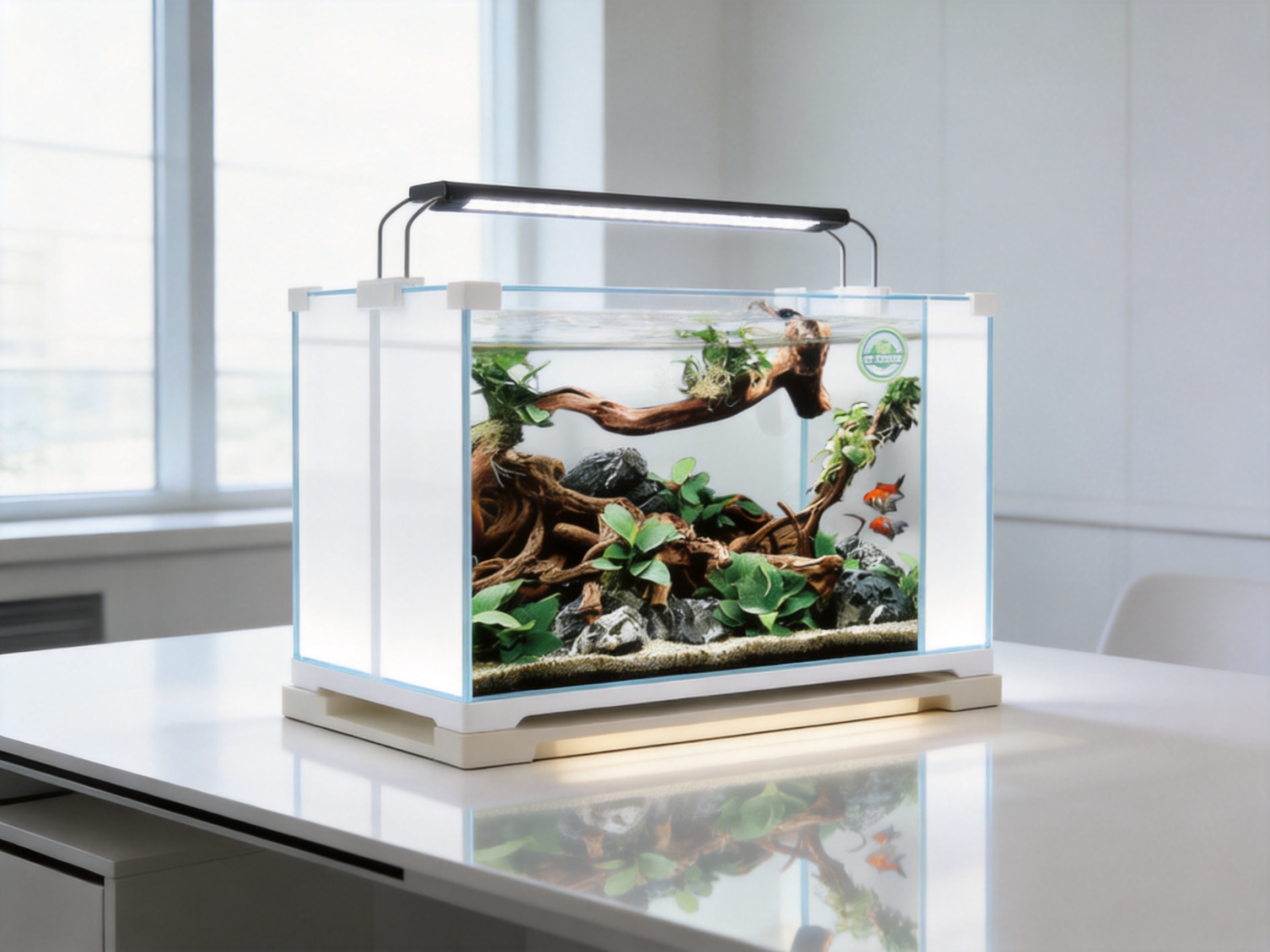
The aquarium is designed to support a coordinated lighting and filtration arrangement. The product information identifies LED bracket lights and filter pumps as optional accessories rather than standard components. This arrangement allows users to purchase equipment separately and select products according to their own needs.
Optional equipment can be beneficial for several reasons. Some users may already own compatible aquarium equipment, while others may wish to choose a lighting style based on the plants they keep or the appearance they want to create. Separating the tank from the accessories can also make the initial purchase more flexible.
The recommended equipment combinations provide a practical starting point. For example, the HWK-180 model is listed with a suggested HJ-111B filter pump rated at 2 watts and an ADP-080J lamp rated at 1.5 watts. The HWK-230 model is paired with a suggested HBL-301 filter pump rated at 2 watts and an ADP-160J lamp rated at 2 watts. Larger models receive recommendations that correspond to their increased dimensions and water volume.
Filtration is important because it supports water circulation and helps manage suspended particles and organic waste. A properly selected filter pump can contribute to a more stable aquarium environment. It may also improve water movement and help distribute heat and dissolved oxygen more evenly, depending on the complete setup and the type of filtration media used.
Lighting is equally important for presentation and plant growth. The appropriate lamp depends on factors such as tank depth, plant species, desired brightness, and the visual effect preferred by the owner. The recommended lamp values in the product data provide a reference point, but users should still consider the specific requirements of their aquatic inhabitants.
Compared with aquarium packages that include fixed, non-replaceable equipment, the separate-accessory approach can offer greater adaptability. Users may replace or upgrade the light and filter without necessarily replacing the tank itself. This can be a useful advantage for hobbyists whose needs change as their aquarium experience develops.
The seven-model range is one of the strongest practical features of the series. A single size cannot suit every room, aquascaping plan, or stocking requirement. By offering several dimensions, the series gives consumers more control over the balance between footprint, capacity, and visual impact.
| Model | Dimensions | Approximate Volume | Suggested Filter Pump | Suggested Lamp |
|---|---|---|---|---|
| HWK-180 | 187 × 146 × 180 mm | 3.5 L | HJ-111B / 2 W | ADP-080J / 1.5 W |
| HWK-230 | 237 × 167 × 200 mm | 5.5 L | HBL-301 / 2 W | ADP-160J / 2 W |
| HWK-280 | 287 × 187 × 220 mm | 8.5 L | HBL-301 / 2 W | ADP-200J / 2.5 W |
| HWK-350 | 351 × 211 × 250 mm | 14 L | HBL-301 / 2 W | ADP-250J / 3.5 W |
| HWK-420 | 426 × 236 × 280 mm | 22 L | HBL-301 / 2 W | ADP-300J / 4.5 W |
| HWK-500 | 506 × 256 × 310 mm | 31 L | HBL-402 / 2 W | ADP-400J / 6.5 W |
| HWK-600 | 606 × 326 × 340 mm | 55 L | HBL-403 / 5 W | ADP-500J / 8 W |
The HWK-180 is suitable for buyers seeking the smallest footprint in the series. Its 3.5-liter volume makes it appropriate for carefully planned decorative applications, although users should always select livestock responsibly and consider the biological needs of the animals rather than choosing them only according to tank size.
The HWK-230 and HWK-280 offer a modest increase in water volume while remaining compact. These models may be suitable for desktop use, small shelves designed to support aquariums, or limited residential spaces. The additional length and height provide more opportunities for simple plant arrangements and decorative layouts.
The HWK-350 and HWK-420 create a middle range for users who want more visual depth and greater flexibility. With volumes of 14 and 22 liters, these tanks can support more substantial layouts than the smallest versions, subject to appropriate stocking and filtration decisions.
The HWK-500 and HWK-600 are the largest models. Their 31-liter and 55-liter capacities provide more room for aquascaping, a wider swimming area, and increased water volume. Larger water volume does not remove the need for maintenance, but it can provide more flexibility in layout and may make changes in water conditions less abrupt when the aquarium is properly managed.
Many compact aquariums compete primarily on price. They may provide a container with minimal information about equipment compatibility, cleaning access, or size selection. The HWK Series is differentiated by treating the aquarium as part of a broader display and maintenance system.
The first advantage is its high-transparency viewing concept. A basic tank may be functional, but a clearer viewing surface can improve both aesthetics and observation. This is especially useful when the aquarium is placed in a visible location, such as a living room, reception desk, office, or retail display.
The second advantage is the removable base. This feature focuses on maintenance convenience and provides a more serviceable structure than a permanently fixed support arrangement. Easy access can encourage more regular cleaning, which is beneficial to the appearance of the aquarium and the stability of its environment.
The third advantage is the range of available sizes. Instead of forcing users to choose between a very small tank and a much larger model, the series provides seven stages. This makes it easier to select a tank according to furniture dimensions, available floor or desktop space, visual requirements, and intended aquatic layout.
The fourth advantage is equipment coordination. The recommended combinations of filter pumps and lamps give users a useful reference when planning a setup. Although the accessories are purchased separately, the recommended models and power levels help reduce uncertainty during selection.
The fifth advantage is upgrade potential. Because the lighting and filtration components are not permanently inseparable from the tank, users may select, replace, or improve accessories as their requirements change. This is more adaptable than a sealed all-in-one package with limited replacement options.
Finally, the product is supported by a manufacturer with extensive experience across aquarium pets, aquaculture machinery, industrial equipment, and related fields. This breadth suggests an organizational understanding of water movement, equipment design, production management, and aquatic applications that goes beyond the manufacture of decorative containers alone.
The company behind the product began its operations in 1985 and has developed through more than three decades of activity. Its business scope includes aquarium pets, aquaculture machinery, industrial equipment, and other connected industries. This long operating history is relevant when evaluating a product that combines a tank body with optional pumps, lighting, and aquatic-use accessories.
A manufacturer with experience in several related technical fields can draw on different areas of knowledge during product development. Aquarium equipment requires attention to water contact, electrical safety considerations, flow behavior, materials, assembly quality, packaging, and user maintenance. Aquaculture and industrial equipment add further experience in production organization, functional testing, component coordination, and large-scale supply.
The company has established functional departments that include a research institute, a business school, a quality control department, personnel and administrative information functions, and financial management. These departments indicate a structured organizational approach rather than a purely informal production model. Research supports product development, quality control supports consistency, and administrative systems help coordinate manufacturing and distribution.
The group also operates several wholly owned subsidiary companies and maintains an import and export operation. This structure can provide broader production capacity and market support. It may also help the company coordinate different product categories, manage supply requirements, and serve customers in domestic and international markets.
For the HWK Series, manufacturing strength is reflected not only in the tank itself but also in the ability to provide a coordinated product family. A product family requires repeatable dimensions, consistent appearance, model differentiation, accessory matching, packaging planning, and documentation. Offering seven sizes with corresponding equipment recommendations requires more planning than producing a single generic aquarium.
Quality control is particularly important for aquariums because the product must contain water safely over an extended period. Dimensional accuracy, surface quality, joints, support stability, and packaging protection all influence the user experience. While the available product information does not provide specific test standards or certification details, the presence of a dedicated quality control function demonstrates that quality management is part of the company’s stated organizational structure.
Continuous innovation is also identified as a central part of the company’s development. In practical terms, innovation for compact aquariums may involve clearer materials, more convenient cleaning structures, better accessory coordination, improved packaging, or more efficient production processes. The HWK Series reflects this product-development direction by combining a refined viewing structure with user-oriented maintenance features.
A compact aquarium can become a focal point when its proportions, lighting, and interior layout work together. The long and relatively narrow format of many models provides a horizontal viewing field that can be used for simple planted layouts, stone arrangements, driftwood compositions, or a clean open-water presentation.
The smaller models can be used for minimalist displays. A limited amount of substrate, a few carefully selected decorative elements, and a modest number of aquatic plants may be enough to create a balanced appearance. Overfilling a small tank can make maintenance more difficult and can reduce the visual clarity that the high-transparency construction is intended to provide.
The larger models offer more room for visual layering. Users may create a foreground, middle ground, and background using different plant heights or decorative materials. This can make the aquarium appear deeper and more dynamic. A compatible LED lamp can emphasize the contrast between open water, foliage, and hardscape.
Lighting should be selected with both appearance and aquatic requirements in mind. A lamp that is too weak may produce a dull presentation or fail to support plants that require stronger illumination. A lamp that is too intense or operated for too long may contribute to unwanted algae growth. The suggested lamp ratings provide a starting point, while actual operation should be adjusted according to the aquarium’s inhabitants and observed condition.
Placement also affects the performance of the aquarium. The tank should be installed on a stable, level surface capable of supporting its filled weight. Larger models, especially the 31-liter and 55-liter versions, require careful consideration of the furniture or stand. The aquarium should be kept away from direct sunlight, excessive heat, vibration, and locations where it may be knocked or exposed to abrupt temperature changes.
Every aquarium requires a maintenance routine. The exact routine depends on the livestock, plants, substrate, filtration method, feeding schedule, and local water conditions. The removable base helps with physical access, but it does not replace water testing, partial water changes, filter care, and responsible stocking.
Before filling the tank, users should inspect the aquarium and its support surface. The tank should be positioned level, and the base should be installed correctly. Equipment should be arranged so that electrical connections remain safe and protected from water. The filter pump should be operated according to its instructions, and the system should be checked for proper circulation before livestock is introduced.
Water should be prepared appropriately for the intended aquatic life. Temperature, pH, hardness, and other conditions may matter depending on the species. New aquariums also require biological preparation. A filter does not instantly establish a mature biological environment, so users should learn about aquarium cycling and introduce livestock gradually.
Feeding should be controlled. Excess food can break down and affect water quality, particularly in a small aquarium. Uneaten material should be removed when necessary. The viewing surfaces should be cleaned with tools that are safe for the tank material, and abrasive materials should be avoided if they could cause scratches or reduce clarity.
The filter pump and lamp should receive regular attention. Filter media should be cleaned or replaced according to the needs of the system, while avoiding practices that unnecessarily destroy beneficial biological organisms. The lamp should be kept free of excessive dust and moisture, and its operating schedule should be consistent.
The HWK Series supports this maintenance approach by making cleaning access more practical and by providing model-specific equipment recommendations. These features do not eliminate the responsibilities of aquarium ownership, but they can make the routine more manageable.
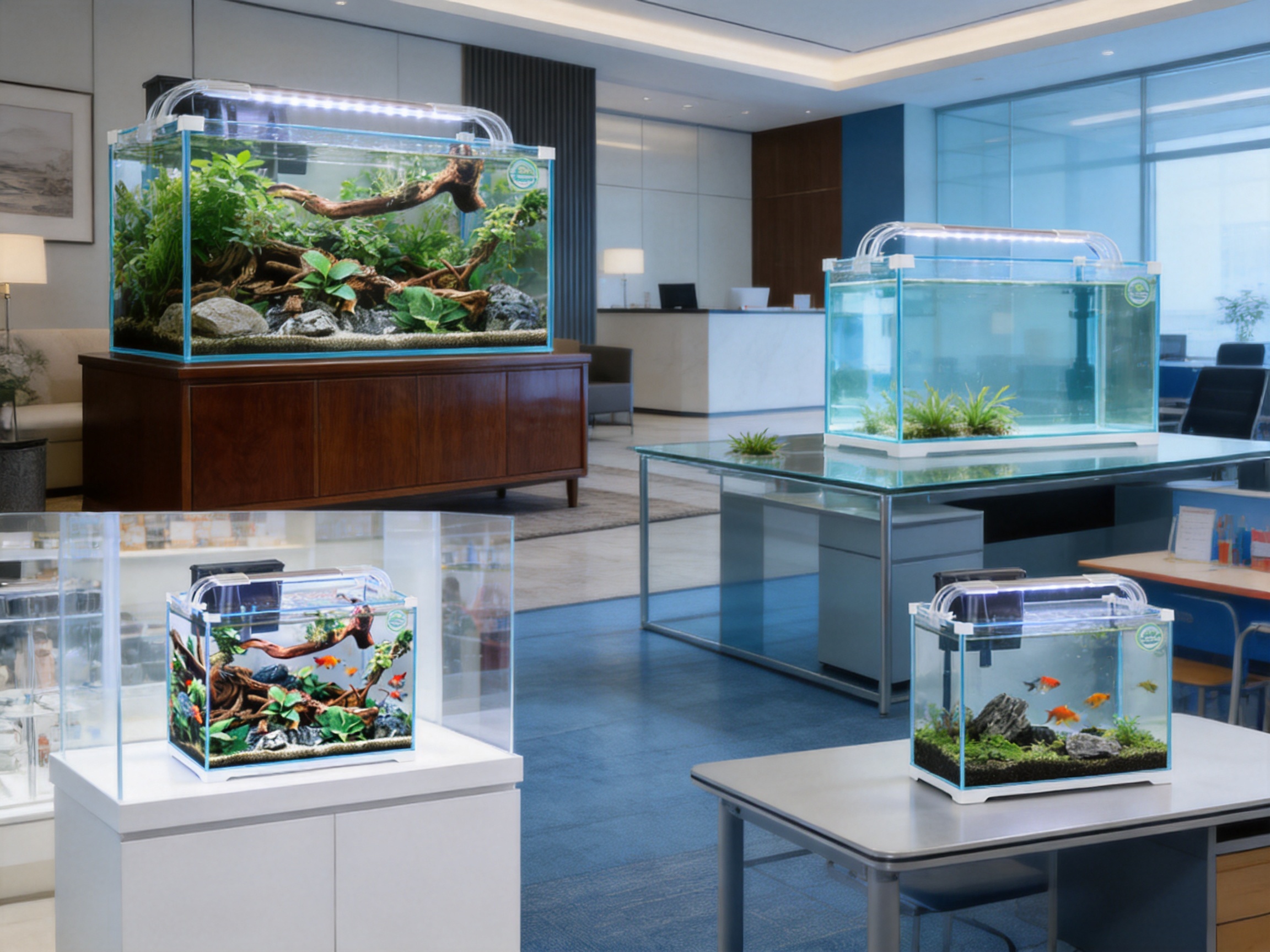
The compact size range makes the series suitable for multiple environments. In homes, a smaller model can be placed on a desk, side table, or dedicated shelf, while a larger version can serve as a living-room feature. The clear viewing structure allows the aquarium to contribute to the interior atmosphere without requiring a large floor area.
In offices, a compact aquarium may be used in a reception area, meeting room, employee lounge, or private workspace. The quiet movement of water and the presence of aquatic plants can add visual interest to an otherwise ordinary environment. Equipment selection should take into account noise, accessibility, and the organization’s maintenance arrangements.
Retail stores and aquarium dealers may use the models as display units. The seven-size range enables a retailer to demonstrate different capacity options and show customers how lighting and filtration can be selected for each model. The consistent series design can also support an organized product presentation.
Educational environments may use a properly managed aquarium to demonstrate aquatic ecosystems, plant growth, animal behavior, water quality, and responsible pet care. In these settings, the removable base and clear viewing surfaces may help students observe the aquarium more closely. Any educational use should still follow appropriate animal welfare and maintenance practices.
Hospitality locations, studios, salons, and other commercial interiors may also benefit from a compact aquatic display. The tank should be installed where it can be serviced easily and protected from accidental contact. A well-maintained aquarium can provide a refined decorative element while occupying less space than many conventional interior features.
Choosing a tank should begin with the needs of the aquatic inhabitants. A small aquarium is not automatically suitable for every small fish, and body size alone does not determine whether a species is appropriate. Swimming behavior, adult size, social requirements, filtration needs, temperature, and water chemistry must all be considered.
The smallest models are generally better suited to carefully planned decorative applications or aquatic life with requirements compatible with very limited water volume. Users should avoid overcrowding and should seek reliable husbandry guidance before purchasing animals. In some cases, aquatic plants or invertebrates may be more appropriate than fish for a very small setup.
The larger models provide more space, but responsible stocking remains essential. Additional volume can improve flexibility, yet it does not compensate for unsuitable species combinations or poor maintenance. A stable aquarium depends on correct cycling, adequate filtration, suitable feeding, and regular observation.
When purchasing equipment separately, users should confirm that the selected pump is suitable for the aquarium’s volume and livestock. Excessive flow may stress some inhabitants, while insufficient circulation may create stagnant areas. Similarly, lighting should be matched to plant requirements rather than selected only for maximum brightness.
Consumers often evaluate an aquarium by looking at its appearance, but the manufacturing background behind the product is also important. A tank is part of a long-term system. It may be filled, moved, cleaned, equipped, and used every day for years. Consistent production and organized quality management can therefore be as important as the initial visual impression.
The manufacturer’s history in aquarium and aquaculture-related industries supports a broader understanding of aquatic applications. Experience with water pumps, filtration products, lighting equipment, and other aquatic machinery can help inform product compatibility and system design.
Its stated commitment to research and innovation is relevant to product development. A compact aquarium must balance appearance, manufacturing efficiency, transport requirements, user convenience, and equipment compatibility. Improving one characteristic without considering the others may create new problems. A structured development process is more likely to evaluate the product as a complete user experience.
The company’s distribution and export capabilities are also significant for business customers. Retailers, wholesalers, and international buyers may require stable product supply, consistent specifications, packaging coordination, and communication across markets. An established import and export operation can support these requirements more effectively than a small, isolated producer.
The company also describes a broad sales network and ongoing efforts to integrate online and offline services. For customers, this type of network may make it easier to access product information, accessories, after-sales communication, and replacement components. Availability will depend on the market and distributor, but the organizational infrastructure is an important strength.
Before installation, select a location that is level, stable, and appropriate for the filled weight of the chosen model. The surface should be clean and free from objects that could place uneven pressure on the aquarium. Larger models should be placed on furniture specifically capable of supporting an aquarium.
Install the removable base correctly before filling the aquarium. Confirm that the tank is stable and that the base is seated evenly. If the model is being paired with an LED bracket light or filter pump, position the equipment in accordance with its separate instructions.
Rinse suitable substrate and decorative materials before placing them into the tank. Avoid using sharp objects that could damage the viewing surfaces. Add water gradually to reduce disturbance to the layout. Once filled, check the aquarium and connections for signs of leakage or instability.
Allow the filter system to operate and establish the aquarium before introducing livestock. The length of preparation depends on the biological method used and the intended inhabitants. Water testing is recommended, particularly during the initial period. Users should introduce animals gradually and monitor their behavior after any change.
Lighting can be installed after confirming that the aquarium and electrical equipment are secure. Keep electrical connections away from splashing water and arrange cables so that water cannot run directly toward outlets or power devices. The lamp’s operating schedule should be set consistently rather than left on continuously.
The series is designed as a compact aquarium for aquatic displays in homes, offices, commercial interiors, and other spaces. It combines a high-transparency viewing structure with a removable base and compatibility with separately purchased lighting and filtration equipment.
There are seven models: HWK-180, HWK-230, HWK-280, HWK-350, HWK-420, HWK-500, and HWK-600. Their approximate capacities range from 3.5 liters to 55 liters.
No. The product information states that the LED bracket light and filter pump are not standard components and must be purchased separately. Suggested equipment models and power ratings are provided for each aquarium size.
The removable base is intended to make cleaning and access more convenient. It can help users clean around the lower part of the aquarium and inspect the support area more easily than a permanently fixed base may allow.
It is intended to provide a clearer and brighter view of the aquarium interior. This can improve the presentation of fish, plants, and decorations, while also making it easier to observe water condition and aquatic life.
The HWK-180, HWK-230, and HWK-280 have the smallest footprints in the range. The final choice should depend on the desk’s load capacity, available space, desired water volume, and the aquatic life being considered.
The HWK-600 is the largest model listed, with dimensions of 606 × 326 × 340 millimeters and an approximate volume of 55 liters.
Yes, the series can be used for suitable aquatic plants when the lighting, substrate, water conditions, and maintenance routine are appropriate. Plant selection should be based on the tank dimensions and the available light.
Users should select a pump that is physically compatible and appropriate for the aquarium’s volume and inhabitants. The listed recommended pumps provide a starting point, but the final selection should also consider flow rate, noise, filtration media, and the needs of the aquatic environment.
The manufacturer has more than 30 years of experience and works across aquarium pets, aquaculture machinery, industrial equipment, and related fields. Its research, quality control, subsidiary production companies, and export operations support the development and supply of coordinated aquatic products.
No aquarium is maintenance-free. A larger water volume may provide more flexibility and may reduce the speed of some water changes, but regular observation, partial water changes, filter care, responsible feeding, and appropriate stocking are still necessary.
Users should check that the surface is level and strong enough, the removable base is installed correctly, the tank is stable, the equipment is safely positioned, and there are no signs of leakage. The aquarium should be biologically prepared before livestock is introduced.
The HWK Series Acrylic View Aquarium combines compact proportions with features intended to improve appearance and usability. Its ultra-white, high-transparency viewing structure supports a clearer presentation, while the removable base is designed to simplify cleaning and access. Seven model sizes provide flexibility for different spaces, water volumes, and display concepts.
The separate-accessory approach gives users more control over lighting and filtration. Suggested pumps and lamps offer guidance without preventing future changes or upgrades. This is a practical alternative to basic aquariums that provide limited equipment flexibility or only one standard size.
The product is also supported by a manufacturer with a long history in aquarium-related products, aquaculture machinery, and industrial equipment. Research functions, quality control organization, subsidiary companies, export capability, and a broad sales network contribute to the company’s ability to develop and distribute products for domestic and international markets.
For buyers seeking a compact aquarium that emphasizes clear viewing, convenient maintenance, model choice, and equipment compatibility, the series offers a balanced solution. As with any aquarium, successful use depends on responsible installation, suitable livestock selection, correct equipment, biological preparation, and regular care. When these practices are followed, the aquarium can become an attractive and manageable aquatic display for both private and commercial environments.
1. Product specification sheet for the HWK Series Acrylic View Aquarium, including model dimensions, volumes, suggested filter pumps, and suggested lamps.
2. Manufacturer-provided product information concerning ultra-white viewing material, high-definition translucency, removable base construction, and optional equipment.
3. Manufacturer-provided company profile describing organizational history, research functions, quality control, subsidiaries, manufacturing scope, and export operations.
4. General aquarium husbandry principles concerning water quality, aquarium cycling, responsible stocking, filtration, lighting, and routine maintenance.
5. General guidance for aquatic plant care, compact aquarium placement, electrical equipment safety, and aquarium support requirements.


 No. 61-79, Baima Street, Maao Town, Dinghai District, Zhoushan City, Zhejiang Province, China.
 0086 580 8082088 / 8081168
 0086 580 8080978
 songhua@sunsun-china.com