

 English
 русский
 España
 Portugal
 عربي
Wang Yu | Aquarium Products After-Sales Engineer
Home / Author / Wang Yu | Aquarium Products After-Sales Engineer / High-Performance Aquarium Air Pumps for Reliable Water Aeration
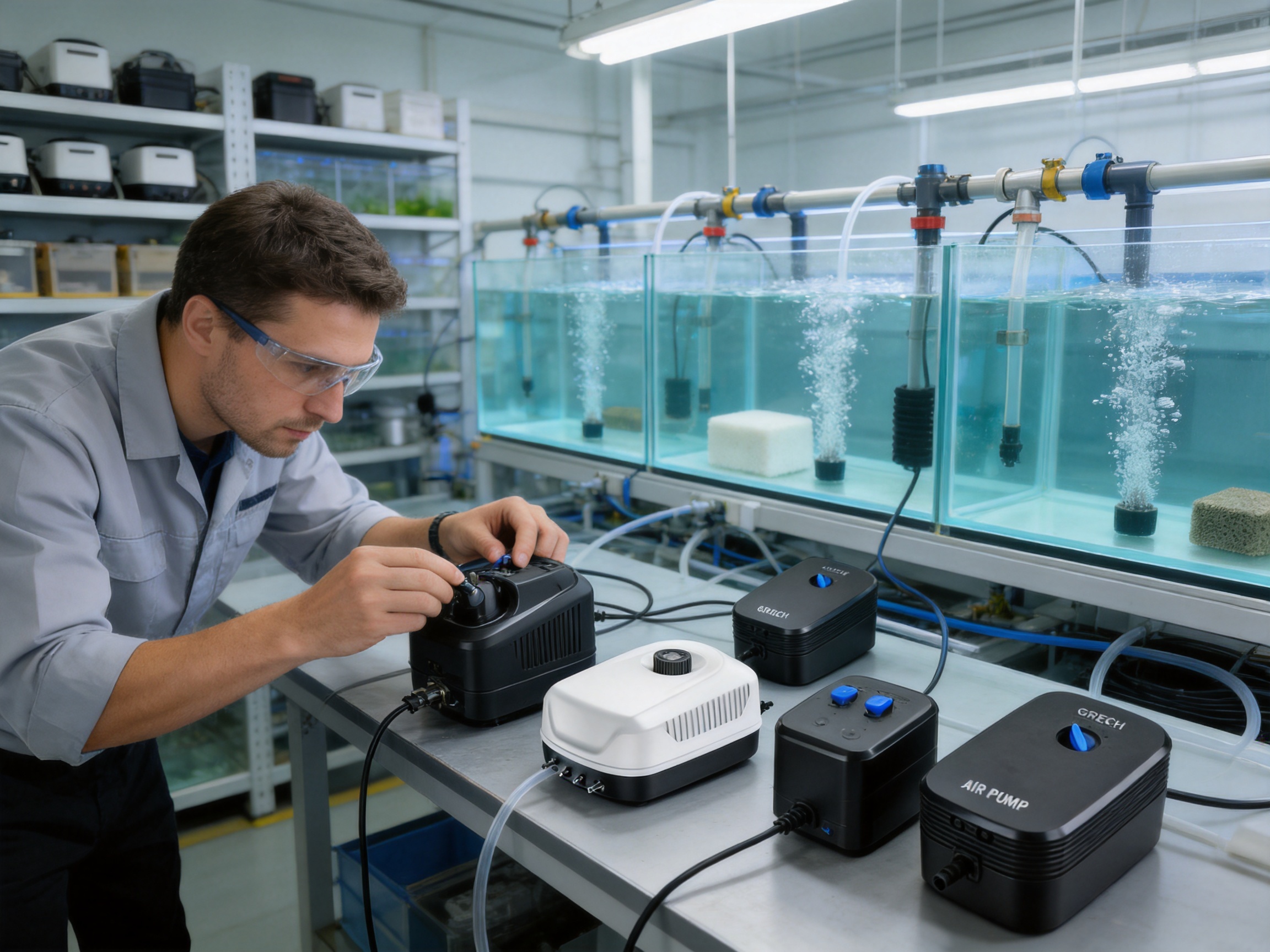
Healthy aquarium water depends on more than filtration and lighting. Fish, beneficial bacteria, aquatic plants, and other organisms all rely on a stable supply of dissolved oxygen. An air pump supports this balance by forcing atmospheric air through an air line and into the aquarium, where an air stone or diffuser breaks the flow into bubbles. Although the operating principle is simple, the quality of the pump determines how consistently the aquarium receives aeration, how much energy is consumed, how easily the equipment can be installed, and how effectively it performs under different operating conditions.
The CQ/CRP Series Air Pump is designed as a versatile range for aquariums requiring different airflow levels, pressure capabilities, and outlet configurations. Six models are available, extending from the compact CQ-100 to the higher-output CQ-3000 and the four-outlet CRP-600. This range enables aquarium owners, retailers, professional installers, and aquatic equipment distributors to select a model according to tank size, diffuser arrangement, and installation requirements rather than relying on one general-purpose pump.
With operating voltages of 220–240V at 50Hz, power consumption from 3.8W to 16W for the CQ models, and a dedicated four-outlet option, the series covers small home aquariums, multi-tank installations, breeding systems, ornamental displays, and a variety of aquatic applications. The pumps combine practical output, compact dimensions, multiple outlet choices, and straightforward installation in one product family.
This article examines the product range in detail, explains how each model can be applied, and considers the manufacturing and organizational strengths behind its development. It also compares the series with common alternatives by focusing on measurable characteristics such as output, maximum pressure, outlet capacity, dimensions, cable length, and power consumption.
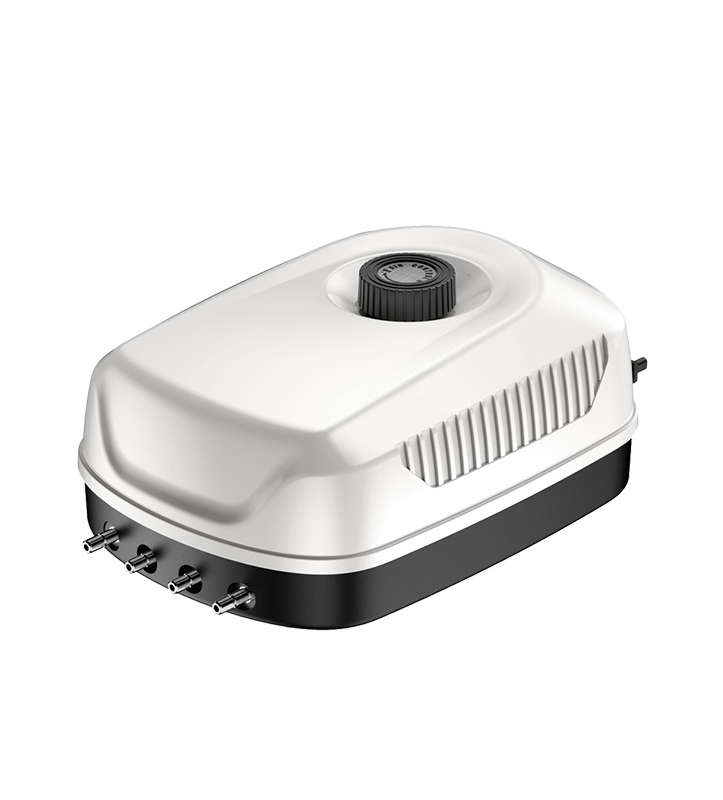
CQ/CRP Series Air Pump
Content
Oxygen is essential for fish respiration and for the biological processes that maintain water quality. In a mature aquarium, nitrifying bacteria convert toxic ammonia into nitrite and then nitrate. These bacteria need oxygen to perform effectively. If oxygen levels fall, biological filtration may become less efficient, and aquatic animals may show signs of stress such as rapid gill movement, gasping near the surface, reduced activity, or unusual crowding around areas of water movement.
Water movement at the surface naturally allows some gas exchange, but surface agitation alone may not be sufficient in every aquarium. Tall tanks, heavily stocked systems, warm water, breeding containers, medication setups, and aquariums with limited circulation may benefit from additional aeration. Air pumps provide a dependable way to introduce air and create circulation without requiring a large water pump or a complicated plumbing arrangement.
A properly selected air pump can serve several functions. It can operate an air stone, power a sponge filter, supply oxygen to a breeding tank, support a decorative bubble feature, or provide circulation in a quarantine aquarium. In multi-tank systems, one pump with several outlets can reduce the number of electrical connections and simplify equipment management.
However, an air pump must be matched to the resistance created by the air stone, tubing length, check valves, and water depth. A pump with a high nominal output may not perform well if its pressure capability is insufficient. Conversely, an unnecessarily large pump can waste energy, generate excessive bubbling, and create turbulence that is unsuitable for delicate fish or fry. The CQ/CRP Series addresses these different requirements through several combinations of output, pressure, outlet count, and physical size.
The product family contains five CQ models and one CRP model. The CQ series is organized around different output levels, while the CRP-600 is configured specifically for multiple outlets. All listed models use a 220–240V/50Hz power supply and are intended for compatible electrical environments.
Model |
Power |
Maximum Pressure |
Output |
Outlets |
Cable Length |
Dimensions |
CQ-100 |
3.8W |
0.018MPa |
1.7L/min |
1 |
2m |
148 × 82 × 75mm |
CQ-200 |
4W |
0.02MPa |
3.3L/min |
2 |
2m |
148 × 82 × 75mm |
CQ-800 |
5W |
0.02MPa |
12L/min |
2 |
1.8m |
156 × 128 × 111mm |
CQ-1000 |
10W |
0.03MPa |
16L/min |
2 |
1.8m |
156 × 128 × 111mm |
CQ-3000 |
16W |
0.03MPa |
30L/min |
1 |
1.8m |
240 × 168 × 111mm |
CRP-600 |
8.5W |
0.012MPa |
4 × 3L/min |
4 |
1.4m |
210 × 146 × 165mm |
The specifications show that the series is not simply a collection of pumps arranged by increasing wattage. Each model offers a different balance. The CQ-100 prioritizes compactness and low power consumption. The CQ-200 adds a second outlet while maintaining the same external dimensions. The CQ-800 and CQ-1000 offer substantially higher output from a similarly sized housing. The CQ-3000 provides the highest stated single-model output. The CRP-600, meanwhile, focuses on distributing air across four outlets rather than producing one large single flow.
The CQ-100 delivers 1.7L/min through one outlet while consuming 3.8W. Its dimensions of 148 × 82 × 75mm make it suitable for installations where cabinet space is limited. It can be paired with a small air stone, a compact sponge filter, or a modest decorative diffuser.
Its low electrical consumption is useful for aquarists who operate equipment continuously. A pump that runs around the clock becomes part of the aquarium’s regular energy load, so a lower-wattage model can be attractive when its output is sufficient for the system. The 2m cable also gives installers practical flexibility when positioning the pump near a tank or inside an aquarium cabinet.
The CQ-100 is best selected when the aquarium has a relatively low aeration demand and the user wants a simple one-line arrangement. It should not be treated as a substitute for a higher-output model in a densely stocked tank or a system with several air-driven devices.
The CQ-200 produces 3.3L/min and has two outlets while retaining the same 148 × 82 × 75mm dimensions as the CQ-100. This configuration is valuable when the user wants to operate two small diffusers, divide aeration between two sections of a tank, or run an air stone and a sponge filter simultaneously.
Compared with using two separate small pumps, a two-outlet design can reduce equipment clutter and simplify power management. One pump also gives the installation a more unified appearance. The 4W rating remains modest for a two-outlet aquarium air pump, making the model appropriate for small and medium applications where independent control of two air lines is not required.
Users should remember that the stated output is the total rated output and not necessarily the flow available from each outlet under every operating condition. Tubing diameter, diffuser resistance, water depth, and the balance between the two lines will affect practical performance.
The CQ-800 increases output to 12L/min at 5W and provides two outlets. It is a strong option for aquariums that need more vigorous aeration without moving immediately to the largest pump in the range. The maximum pressure is stated as 0.02MPa, which provides a useful reference when the pump is connected to air stones or other devices that create resistance.
The housing measures 156 × 128 × 111mm. This is larger than the compact CQ-100 and CQ-200, but it remains practical for aquarium cabinets, service rooms, retail displays, and equipment shelves. The combination of two outlets and high stated flow can support multiple diffusers or a larger air-driven filter arrangement.
The CQ-800 may be especially useful in systems where aeration must be distributed rather than concentrated in one location. For example, two air stones can be positioned at opposite ends of a long aquarium, improving circulation across the entire tank. It can also support a pair of breeding containers or two connected sponge filters, subject to the requirements of the individual setup.
The CQ-1000 offers 16L/min at 10W and a maximum pressure of 0.03MPa. Its pressure rating is higher than that of the smaller CQ models, making it better suited to installations with greater air resistance or deeper water. It maintains the same 156 × 128 × 111mm dimensions as the CQ-800, giving users a higher-performance option without a larger external footprint.
This model can be considered when the CQ-800’s output is insufficient or when a system uses diffusers that require more pressure to produce a consistent bubble pattern. The two-outlet configuration also allows air to be distributed between two devices. For deeper aquariums, long air lines, or systems with multiple valves and check valves, the additional pressure margin may provide more dependable operation.
As with any air pump, maximum pressure should not be interpreted as the normal operating output. It is a performance limit associated with resistance. Actual airflow will vary according to the connected equipment. Careful installation, unobstructed tubing, and clean diffusers remain important for achieving the best results.
The CQ-3000 is the highest-output model in the CQ group, delivering 30L/min at 16W through one outlet. It is intended for applications that require a large volume of air from a centralized source. Possible uses include large aquariums, extensive sponge filtration, display systems, temporary holding tanks, and specialized aquatic installations.
Its 0.03MPa maximum pressure matches the CQ-1000, while the output is substantially higher. This makes the CQ-3000 appropriate where the priority is moving a large quantity of air rather than feeding several low-volume outlets. The 240 × 168 × 111mm housing is the largest in the CQ range, so installation planning should include adequate room for placement, cable routing, air tubing, and ventilation.
A single high-output pump may also simplify maintenance in a large system. Instead of servicing several small pumps, an operator can use one centralized unit with a suitable manifold. However, the manifold should be selected carefully, and the system should be designed so that back pressure does not exceed the pump’s intended operating conditions.
The CRP-600 is distinguished by its four-outlet arrangement. Its stated output is 4 × 3L/min, and its total power consumption is 8.5W. This makes it particularly suitable for supplying four separate air lines, such as four small aquariums, four breeding containers, or several diffusers in one larger system.
The four-outlet structure can offer advantages over a single-outlet pump connected to an external splitter. An integrated multi-outlet design can reduce the number of extra fittings and may provide a cleaner installation. It is also convenient for aquarium shops, laboratories, quarantine areas, and hobbyists who manage several tanks at once.
The CRP-600 has a maximum pressure of 0.012MPa, lower than the CQ-1000 and CQ-3000. Therefore, it should be selected for applications compatible with its pressure rating. Its value lies in controlled distribution across four lines rather than in high-pressure operation. The 210 × 146 × 165mm dimensions provide a stable body for a multi-outlet configuration, while the 1.4m cable supports nearby installation.
Air pumps from different manufacturers can appear similar, but useful comparison requires more than looking at the product name or wattage. The CQ/CRP Series presents several practical advantages when evaluated by the information supplied for each model.
One of the clearest advantages is the breadth of the range. Many basic product lines concentrate on one small pump and one large pump, leaving users to compromise. The CQ/CRP Series provides six options with different airflow levels, pressure capabilities, outlet counts, cable lengths, and dimensions.
This allows a buyer to avoid two common mistakes. The first is under-sizing, which can result in weak bubbling and inadequate circulation. The second is over-sizing, which can create unnecessary turbulence and consume more power than required. A model-based range encourages better matching between the pump and the application.
The listed specifications provide several output-to-power combinations. The CQ-100 uses 3.8W for 1.7L/min, while the CQ-800 provides 12L/min at 5W. The CQ-1000 delivers 16L/min at 10W, and the CQ-3000 produces 30L/min at 16W. These figures allow users to consider not only maximum airflow but also the energy required to obtain it.
Energy efficiency depends on actual operating conditions, and rated values should not be treated as a universal comparison across all brands unless testing methods are identical. Nevertheless, a clearly documented power rating helps buyers estimate operating costs and select a pump appropriate for continuous use.
The range includes one-outlet, two-outlet, and four-outlet arrangements. This is an advantage over products that require an external splitter for every multi-line application. Integrated outlets can reduce the number of accessories, simplify tubing management, and make it easier to distribute aeration intentionally.
The CQ-200, CQ-800, and CQ-1000 each provide two outlets, although their output levels differ considerably. The CRP-600 provides four outlets at 3L/min per line. This variation enables the buyer to select between concentrated airflow and distributed airflow according to the aquarium layout.
Many entry-level air pumps are marketed mainly by airflow, even though the connected diffuser and water depth can significantly affect performance. The CQ/CRP specifications include maximum-pressure figures from 0.012MPa to 0.03MPa. Having this information helps installers consider the resistance created by deep water, fine-pore air stones, valves, and tubing.
A higher pressure rating does not automatically make one pump better for every aquarium. A low-pressure multi-outlet pump may be the better choice for four shallow tanks, while a higher-pressure model may be more appropriate for a deep aquarium with resistant diffusers. The advantage is that the series offers data for making that distinction.
The smallest models measure 148 × 82 × 75mm, while the larger models remain compact relative to their output. The specified cable lengths range from 1.4m to 2m. These details are important in real installations because aquarium cabinets often have limited space, and electrical outlets may not be directly beside the tank.
Compact dimensions can also benefit retailers and wholesalers. More units can be stored and displayed efficiently, while different models can be organized within a clear product family. For end users, the physical measurements provide a basis for checking cabinet clearance before purchase.
The product is associated with Sensen Group Co., Ltd., a manufacturer with a history extending back to November 1985. According to the supplied company information, the group has developed across aquarium pets, aquaculture machinery, industrial equipment, and related fields. This breadth is relevant to air-pump manufacturing because aquarium aeration combines mechanical operation, electrical components, fluid movement, product durability, and application knowledge.
The company reports a substantial internal structure that includes a research institute, business school, quality control department, personnel and administrative information department, financial department, and other functional divisions. A dedicated research institute can support product development and technical improvement, while a quality control department provides an organizational focus for inspection and consistency.
The group also identifies several wholly owned subsidiary corporations and an import and export company. Such a corporate structure can contribute to manufacturing capacity, supply-chain coordination, market coverage, and product distribution. It may also help the company serve different sectors, from domestic aquarium retailers to international distributors and specialized aquatic equipment customers.
The company describes a long-term focus on continuous innovation, industrial technicalization, marketing globalization, and brand internationalization. For a product such as an aquarium air pump, continuous improvement can involve refining airflow stability, reducing energy consumption, improving housing design, strengthening production control, and adapting models to the needs of different markets.
It is important to distinguish organizational capability from specific technical claims that are not included in the supplied specifications. The available information does not state particular certifications, noise measurements, material grades, failure rates, or laboratory test standards. Buyers requiring those details should request the relevant technical documents before placing an order. Still, the company’s long operating history, dedicated departments, production scale, and aquatic-equipment focus provide a meaningful foundation for product development and manufacturing management.

Advanced manufacturing is not limited to the use of automated machinery. It also involves the way a company organizes research, component management, assembly, inspection, documentation, and customer feedback. In an air pump, many small factors can influence final performance: the accuracy of moving parts, the sealing of air pathways, the alignment of internal components, electrical safety, housing fit, vibration behavior, and the consistency of outlet connections.
A structured research function allows product designers to evaluate the needs of different aquarium segments. The six-model range suggests a product-development strategy based on application differences rather than a single undifferentiated design. Low-output compact models, higher-output units, and multi-outlet products address distinct installation scenarios.
Product development can also use performance data to balance power consumption and output. The specifications show graduated choices from 3.8W to 16W for the CQ models. This gives users a clearer path from a small aquarium requirement to a high-volume aeration requirement.
A dedicated quality control department is important for equipment that may run continuously. Consistency in output, pressure, electrical performance, and outlet connection is essential for distributors and end users. A well-managed inspection process can help identify defective components before products reach the market and can support consistent model classification.
For international customers, clear documentation is equally valuable. The supplied product data identifies model numbers, voltage, frequency, power, maximum pressure, output, outlet number, cable length, and dimensions. This level of information supports purchasing decisions, installation planning, inventory management, and product comparison.
The group’s stated network of subsidiaries and trading relationships indicates broad organizational resources. Manufacturing scale can help support stable procurement of components, production scheduling, packaging, distribution, and after-sales coordination. It can also make it easier to offer multiple models within one product family.
For wholesalers and project buyers, supply capability is often as important as individual product performance. A pump may be technically suitable, but the supplier must also be able to support repeat orders, consistent model availability, packaging requirements, and export procedures. An established group structure can be advantageous in these areas, although specific order quantities, lead times, and customization options should be confirmed directly.
A manufacturer focused on aquarium and aquaculture equipment is positioned to understand the practical conditions in which air pumps operate. Aquariums vary in water depth, stocking density, temperature, filtration method, lighting schedule, and maintenance routine. An air pump designed within this sector can be evaluated according to these real use conditions rather than as a generic household blower.
The presence of related aquarium categories, including filters, lighting, controllers, water pumps, accessories, and other equipment, also suggests the ability to consider how aeration interacts with a complete aquatic system. Air pumps are rarely used in isolation. Their performance affects sponge filtration, water movement, oxygenation, and the overall balance of equipment in the aquarium.
Correct installation is necessary to obtain dependable performance from any air pump. Place the pump on a stable, dry surface outside the aquarium. Avoid locations where splashing water can reach the electrical housing. If the pump is installed below the water level, a suitable check valve should be used in the air line to reduce the risk of water flowing backward toward the pump during a power interruption.
Use tubing with a suitable internal diameter and keep unnecessary bends to a minimum. Sharp bends can restrict airflow and increase resistance. When using multiple outlets, balance the air lines so that one unrestricted line does not receive most of the flow while another line is blocked or highly resistant.
Air stones and diffusers should be cleaned or replaced when they become clogged. A blocked diffuser increases back pressure and may reduce output. Sponge filters also require periodic rinsing in removed aquarium water to prevent debris from restricting flow. Maintenance of connected accessories is therefore part of maintaining air-pump performance.
The pump should be located where air circulation around the housing is not obstructed. Do not cover ventilation areas with cloth, packaging, or other materials. Electrical installation should comply with local safety requirements, and the 220–240V/50Hz specification must be compatible with the available power supply.
For equipment that operates continuously, power consumption is a practical purchasing consideration. The CQ-100 uses 3.8W, the CQ-200 uses 4W, the CQ-800 uses 5W, the CQ-1000 uses 10W, the CQ-3000 uses 16W, and the CRP-600 uses 8.5W. These ratings allow a user to compare the expected electrical load of each model.
For example, a lower-output pump may be more economical for a small aquarium if it meets the aeration requirement. A larger pump may provide better value in a multi-tank or high-demand installation if it replaces several smaller units. The most cost-effective choice is not always the pump with the lowest wattage; it is the pump that delivers the required performance without excessive capacity.
Long-term value also includes installation simplicity, outlet configuration, replacement planning, and inventory management. A retailer may prefer a coherent series because customers can move between models as their aquarium needs change. A professional installer may benefit from using several models from the same product family because staff can become familiar with common operating principles and maintenance practices.
An air pump’s reliability depends on both product construction and operating conditions. Continuous use, high humidity, clogged diffusers, unstable electrical supply, and poor ventilation can all affect service life. Selecting the correct model and maintaining the complete aeration system can reduce unnecessary stress on the pump.
Users should avoid exceeding the intended application of the selected model. The CQ-3000, for example, provides the highest stated airflow, but its single-outlet configuration may not be the most convenient choice for four independent tanks. Similarly, the CRP-600 is designed for four 3L/min outlets and should not be chosen solely because its total arrangement appears convenient for a deep, high-resistance system.
Responsible use also means checking the pump regularly. Inspect the cable, plug, tubing, check valves, and housing. Listen for changes in operating sound and observe whether the bubble pattern has weakened. A sudden reduction in airflow may indicate a clogged diffuser, damaged tubing, a valve problem, or an internal issue that requires service.
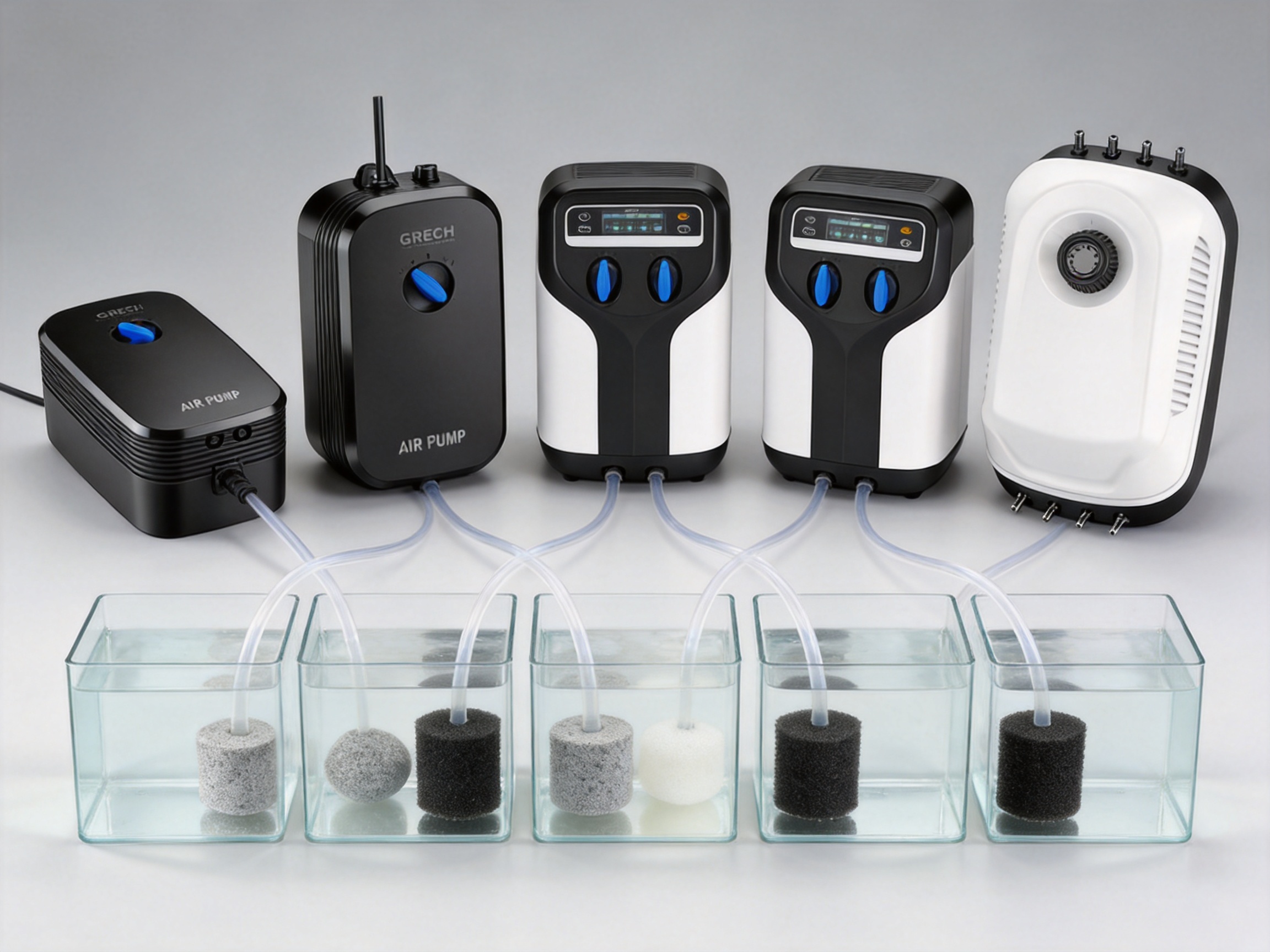
Distributors should evaluate the series as a portfolio rather than as isolated models. The CQ-100 and CQ-200 can serve entry-level and compact aquarium customers. The CQ-800 and CQ-1000 cover higher aeration demand, while the CQ-3000 addresses high-volume applications. The CRP-600 adds a clear multi-outlet solution for customers managing several air lines.
Stocking several models can help a retailer answer common customer questions about aquarium size, air-stone quantity, outlet requirements, and available cabinet space. Product education is easier when the model differences are clear and supported by published specifications.
Project buyers should confirm the expected operating environment, water depth, number of diffusers, tubing distance, and power supply before choosing a model. They should also request any available information about noise, operating temperature, spare parts, packaging, warranty, and compliance requirements relevant to the destination market. These details are not included in the provided specification table and should be verified for each order.
For international distribution, the stated 220–240V/50Hz electrical specification is particularly important. Importers should confirm compatibility with local regulations, plug requirements, labeling rules, and documentation standards. The product’s cable length and dimensions should also be included in installation and packaging plans.
The series supplies air to aquariums and aquatic systems for aeration, surface movement, sponge filtration, breeding setups, quarantine tanks, and decorative bubble devices. Different models provide different airflow levels and outlet configurations.
The CQ-100 and CQ-200 share the smallest listed dimensions: 148 × 82 × 75mm. The CQ-100 has one outlet, while the CQ-200 has two outlets and a higher stated output.
The CQ-3000 has the highest single-model output at 30L/min. It uses one outlet and consumes 16W.
The CRP-600 is the dedicated four-outlet model. Its stated configuration is 4 × 3L/min, with four outlets and total power consumption of 8.5W.
Output describes the volume of air the pump can deliver, while maximum pressure indicates the resistance the pump can overcome under specified conditions. Actual airflow may change when the pump is connected to deep water, fine-pore diffusers, long tubing, or restrictive valves.
No. The correct model depends on the aquarium’s requirements. The CQ-3000 may be excessive for a small tank and has one outlet. A lower-output two-outlet model or the four-outlet CRP-600 may be more suitable for distributed aeration.
It has two outlets and a stated output of 3.3L/min, so it can be considered for two small air lines. The practical result depends on air-stone resistance, water depth, tubing, and how the total flow is divided.
The CQ-1000 and CQ-3000 are both listed with a maximum pressure of 0.03MPa.
All listed models are specified for 220–240V/50Hz operation. Users must confirm that this matches the local electrical supply and installation requirements.
Place it outside the aquarium on a dry, stable surface. Keep it away from splash zones, use suitable check valves where appropriate, and route the cable so that water cannot run along the cable into the electrical connection.
Cleaning frequency depends on aquarium conditions. Inspect the diffuser whenever airflow weakens or bubbles become uneven. A clogged diffuser increases resistance and can reduce pump performance.
No specific noise measurement is provided. Buyers who require a defined sound level should request test data or product samples and evaluate the pump under the intended installation conditions.
Commercial buyers should confirm model availability, order quantity, lead time, packaging, electrical plug requirements, warranty terms, spare parts, compliance documentation, and any customization or private-label requirements. They should also confirm technical details not included in the supplied table.
The CQ/CRP Series Air Pump offers a structured solution for aquarium aeration across a broad range of applications. Its principal strengths are the variety of models, clearly stated performance data, multiple outlet configurations, practical dimensions, moderate power consumption, and compatibility with different installation layouts.
The CQ-100 and CQ-200 serve compact applications, with the CQ-200 adding two-outlet flexibility. The CQ-800 and CQ-1000 provide greater airflow for more demanding systems, while the CQ-3000 supplies the highest stated single-outlet volume. The CRP-600 is designed for four-line distribution and is particularly relevant to multi-tank arrangements.
Compared with a basic one-size-fits-all air-pump offering, the series gives customers more control over the relationship between airflow, pressure, power, space, and outlet count. This can help prevent both underpowered installations and unnecessary oversizing.
The company behind the range brings a long history in aquarium and aquatic equipment, a broad corporate structure, dedicated research and quality-control functions, multiple subsidiaries, and experience serving domestic and international markets. These organizational strengths provide a foundation for continued product development and manufacturing support.
To achieve the best results, users should match the pump to the actual aquarium conditions, maintain diffusers and tubing, protect the electrical housing from water, and verify all technical and compliance requirements before installation. When selected and maintained correctly, the CQ/CRP Series can provide practical, continuous aeration for home aquariums, commercial displays, breeding systems, quarantine facilities, and other aquatic environments.
1. CQ/CRP Series Air Pump Product Specification Table, supplied product materials.
2. Sensen Group Corporate Information, supplied company profile.
3. Aquarium Aeration and Dissolved Oxygen Management, general aquatic-system engineering principles.
4. Aquarium Equipment Installation and Maintenance Practices, general equipment-maintenance guidance.
5. Product Selection Principles for Air Pumps, including airflow, pressure, outlet configuration, and power-consumption considerations.


 No. 61-79, Baima Street, Maao Town, Dinghai District, Zhoushan City, Zhejiang Province, China.
 0086 580 8082088 / 8081168
 0086 580 8080978
 songhua@sunsun-china.com