

 English
 русский
 España
 Portugal
 عربي
Wang Yu | Aquarium Products After-Sales Engineer
Home / Author / Wang Yu | Aquarium Products After-Sales Engineer / How a DC Variable-Frequency Bottom-Suction Pump Improves Fish Pond Cleaning
Maintaining a clean fish pond requires more than removing leaves from the surface. Fine sediment, uneaten food, fish waste, algae particles, and other debris gradually collect on the bottom. If this material is not moved and removed, it can affect water clarity, create unpleasant odors, increase organic loading, and reduce the quality of the aquatic environment. A reliable circulation and drainage solution is therefore essential for pond owners, aquarium professionals, ornamental fish keepers, and aquatic facility operators.
The bottom-suction component of a DC variable-frequency water pump is designed to address this specific challenge. By drawing water and suspended debris from a low point in the pond, the system helps improve bottom cleaning while also supporting circulation, filtration, and water replacement. The SDP series, available in SDP-3500, SDP-6000, and SDP-10000 models, combines DC24V operation, adjustable pump performance, flexible hose connections, and high flow capacity in a compact product family.
This article examines the product’s operating principle, technical advantages, installation possibilities, maintenance requirements, and practical value. It also explains how the manufacturing scale, research structure, quality-control organization, and product-development experience of Sensen Group Co., Ltd. support the performance of this type of aquarium and pond equipment.
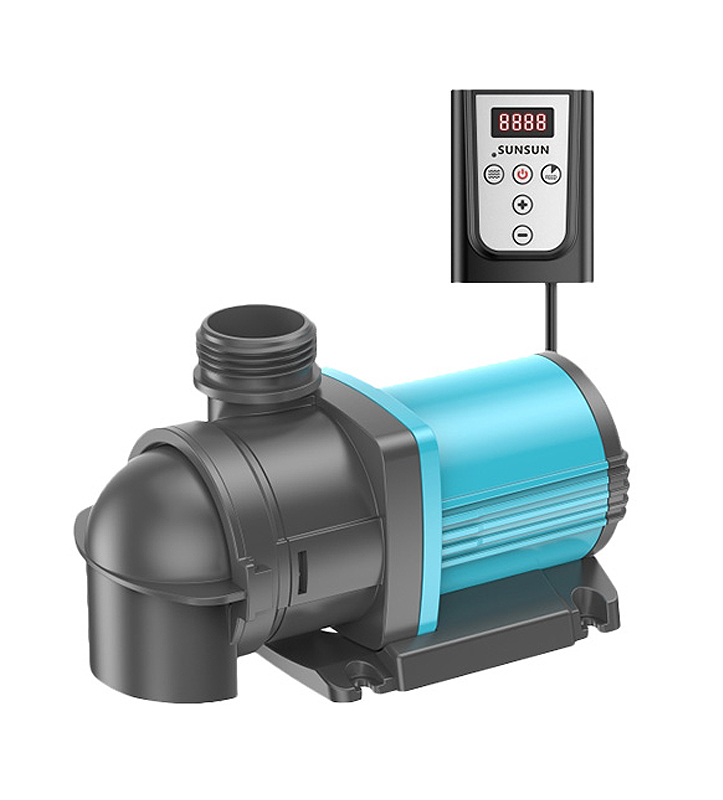
Bottom suction component of DC variable frequency water pump which is better for cleaning the bottom of the fish pond
Content
In a pond without effective bottom circulation, heavier particles tend to settle in low areas. Surface skimmers can collect floating debris, but they do not always reach material that has already sunk. Conventional circulation pumps may move water around the pond while leaving sediment undisturbed on the floor. A bottom-suction arrangement solves this limitation by positioning the intake where waste is most likely to accumulate.
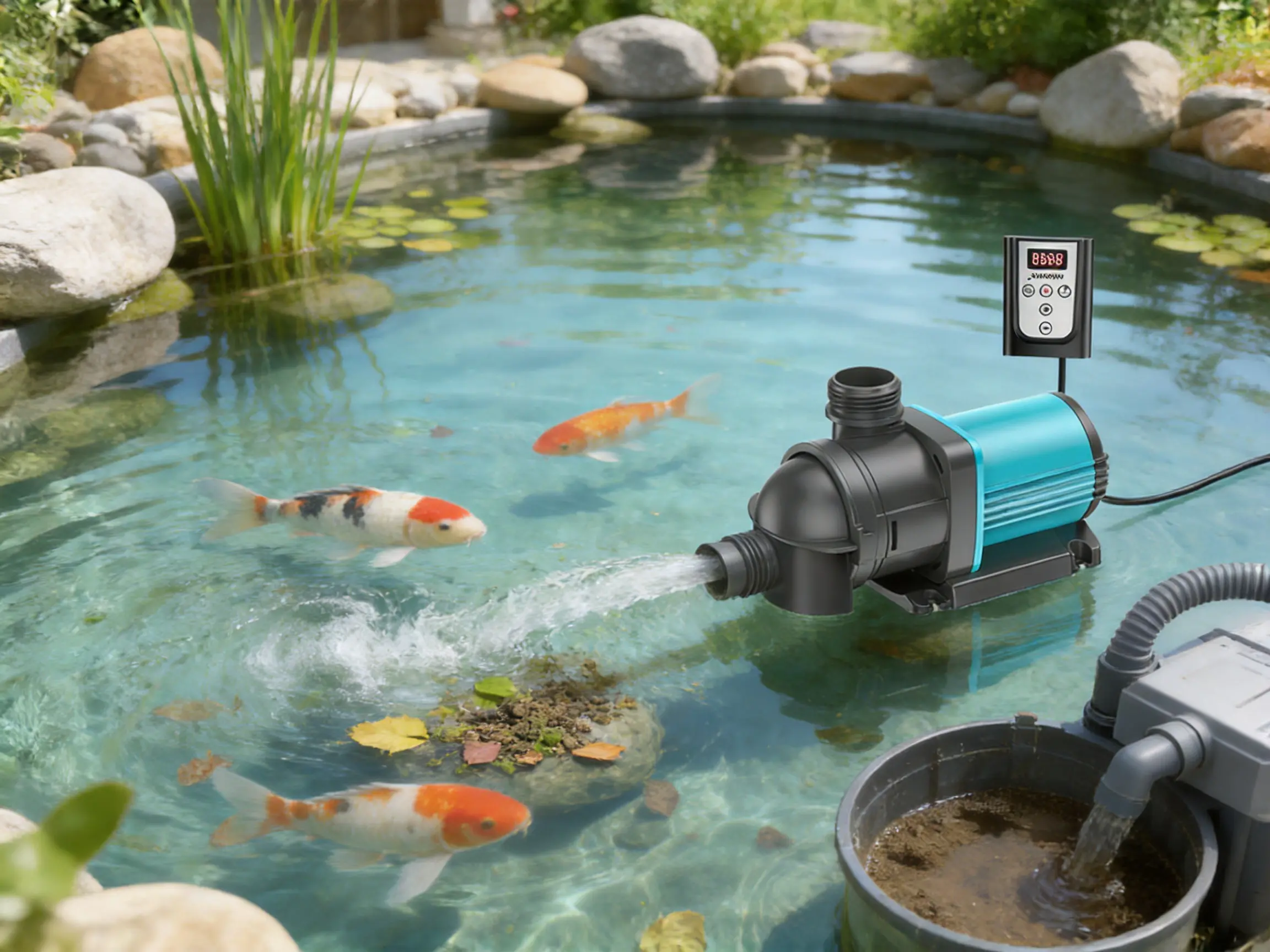
The pump draws water from the lower section of the pond and sends it through a hose toward a filter, drain, treatment unit, waterfall, return line, or other destination. The movement created by this process can lift light debris into the water stream, allowing it to be captured or removed. In a fish pond, this can help reduce the accumulation of organic matter around feeding areas, corners, rockwork, and other places where water movement is weak.
Bottom suction is especially useful when the pond has a large floor area or complex landscaping. Aquatic plants, decorative stones, shelves, and irregular shapes can create dead zones in which waste settles. A properly located suction point, supported by adequate pump capacity, can improve the overall movement pattern and make routine cleaning more efficient.
The system is not intended to replace every form of filtration or manual maintenance. Instead, it functions as an important part of a complete water-management arrangement. Mechanical filters, biological filters, skimmers, ultraviolet equipment, aeration systems, and periodic manual cleaning may all remain necessary depending on pond size, fish load, weather conditions, and water-quality objectives.
The SDP series is a DC variable-frequency water pump range designed for applications that require dependable flow, flexible installation, and efficient control. Its bottom-suction use case makes it suitable for cleaning the bottom of fish ponds, but the same pump family can also be used in aquariums, water features, circulation systems, filtration loops, and other aquatic installations where a controllable water flow is needed.
The pump receives AC100–240V, 50Hz/60Hz input through its power supply system and operates with DC24V at the pump side. This arrangement separates the pump’s low-voltage operating circuit from the main household or commercial supply. The combination supports broad electrical compatibility while providing a practical low-voltage format for aquatic equipment.
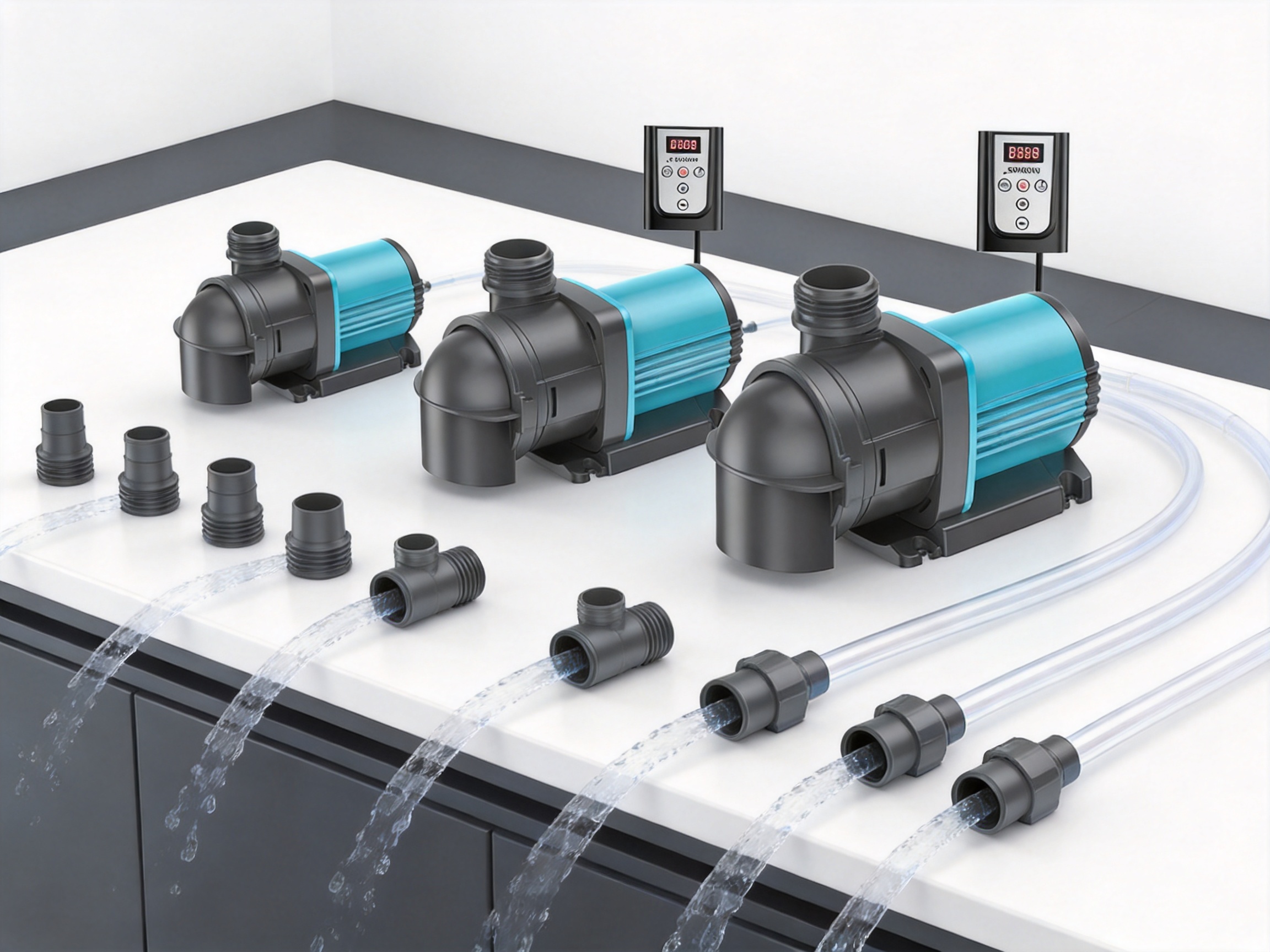
Three models are available. The SDP-3500 provides a rated output of 3,500 liters per hour and a maximum head of 3.5 meters. The SDP-6000 provides 6,000 liters per hour and a maximum head of 5.5 meters. The SDP-10000 provides 10,000 liters per hour and a maximum head of 6 meters. This range allows users to select a pump according to pond size, hose length, vertical lift, filter resistance, and desired cleaning speed.
Model |
Power Supply Input |
Pump Voltage |
Power |
Maximum Output |
Maximum Head |
Hose Adapter Sizes |
Cable Length |
Weight |
Dimensions L × W × H |
SDP-3500 |
AC100–240V, 50Hz/60Hz |
DC24V |
30W |
3,500L/h |
3.5m |
20/25/32mm |
2m |
1.1kg |
147 × 77 × 90mm |
SDP-6000 |
AC100–240V, 50Hz/60Hz |
DC24V |
60W |
6,000L/h |
5.5m |
20/25/32mm |
2.5m |
2.1kg |
170 × 82 × 100mm |
SDP-10000 |
AC100–240V, 50Hz/60Hz |
DC24V |
100W |
10,000L/h |
6m |
20/25/32/38/45mm |
5m |
3.1kg |
202 × 97 × 121mm |
The published specifications identify the largest model’s hose sizes as 20, 25, 32, 38, and 45mm. Hose and adapter measurements should always be confirmed against the supplied components before installation, particularly where the product is being integrated with an existing filtration or drainage system.
One of the most important features of the product concept is variable-frequency DC operation. A fixed-speed pump generally operates at one primary performance level. If the flow is too strong, the user may need to add a valve, bypass line, or additional plumbing to reduce the output. If the flow is too weak, the pump may not deliver sufficient movement through the hose or filtration equipment.
A variable-frequency pump offers a more adaptable approach. The operating speed can be adjusted to match the immediate requirement. Lower output can be used for gentle circulation, delicate fish, shallow water, or energy-conscious operation. Higher output can be selected when bottom debris needs to be moved more quickly or when the pump must overcome greater resistance in the hose and filter system.
This flexibility is valuable because real-world pond conditions change. A pond may require modest circulation during normal operation but stronger movement after feeding, heavy rainfall, seasonal algae growth, or a cleaning session. Adjustable performance helps the same pump serve multiple functions instead of requiring separate fixed-capacity pumps.
Variable-frequency control can also contribute to more efficient operation. Running a pump at the highest available output at all times is not always necessary. By selecting an appropriate working level, users may reduce unnecessary energy consumption and avoid excessive turbulence. The actual energy result depends on the selected operating setting, installation resistance, maintenance condition, and duration of use.
Compared with a basic single-speed pump, the SDP design therefore offers a wider operating range. Compared with an oversized conventional pump, it can provide better control and a more balanced relationship between flow, power consumption, and aquatic conditions. These are meaningful advantages for users who need both bottom-cleaning capability and day-to-day circulation.
Flow capacity is normally expressed in liters per hour and indicates how much water the pump can move under defined test conditions. The SDP-3500, SDP-6000, and SDP-10000 models provide progressively higher rated outputs. However, the actual flow at the pond will vary according to hose diameter, hose length, bends, filter media, elevation, valves, intake conditions, and other resistance factors.
The maximum head specification is equally important. Head describes the vertical lifting capability of the pump. The SDP-3500 has a maximum head of 3.5 meters, while the SDP-6000 reaches 5.5 meters and the SDP-10000 reaches 6 meters. A pond system with a raised waterfall, elevated filter, or long return line should be evaluated using the required head as well as the desired flow rate.
Users should avoid selecting a pump solely by looking at the highest liters-per-hour number. A high nominal output may not provide the desired flow if the installation includes a significant elevation change or narrow tubing. Conversely, a pump with a lower maximum output may be entirely suitable for a short, low-resistance bottom-cleaning line.
The SDP range helps simplify selection by offering three clear capacity levels. Smaller ponds, compact water features, and low-resistance circulation loops may be well matched to the SDP-3500. Medium-sized systems or installations requiring additional head can consider the SDP-6000. Larger ponds, long hoses, wider plumbing, and demanding cleaning operations may benefit from the SDP-10000.
Proper sizing improves reliability. An under-sized pump may need to operate continuously at a high setting without achieving adequate movement. An excessively large pump may create unnecessary turbulence, disturb fish, overload downstream filters, or waste energy when throttled back. Matching the pump to the actual installation is therefore more important than simply choosing the largest available model.
Hose compatibility is a practical advantage of the SDP product family. The SDP-3500 and SDP-6000 support 20mm, 25mm, and 32mm hose adapter sizes. The SDP-10000 expands the available range to include 38mm and 45mm connections. This gives installers more flexibility when working with different pond layouts and existing plumbing systems.
Wider hose connections can reduce flow resistance, particularly in high-output applications. They may be useful when the system includes a long hose, multiple bends, a large filter, or a considerable vertical lift. Smaller connection sizes can be appropriate for compact installations where space is limited and the required flow is lower.
Good installation practice includes keeping the suction line as short and direct as practical. Excessive bends can reduce performance and increase resistance. The hose should be supported so that its weight does not place stress on the pump connection. Connections should be secure, correctly sized, and checked for leaks before continuous operation begins.
The pump should be positioned according to the installation instructions and protected from conditions that could damage the motor or electrical components. The intake must remain unobstructed, and any pre-filter or protective screen should be cleaned regularly. If the pump is being used to move water containing substantial solids, a suitable pre-filtration arrangement is especially important.
The cable lengths provide additional installation convenience. The SDP-3500 has a 2-meter cable, the SDP-6000 has a 2.5-meter cable, and the SDP-10000 has a 5-meter cable. Cable routing should keep electrical connections away from standing water and should avoid sharp edges, heat sources, and areas where the cable could be pinched or damaged.
Product comparisons should always be based on actual specifications, installation conditions, and total operating requirements. Nevertheless, the SDP series has several characteristics that can distinguish it from simpler fixed-speed or narrowly configured pumps.
The variable-frequency operating concept provides greater control than a basic single-speed pump. Users can adapt flow to different cleaning stages, fish requirements, and filtration conditions. This can reduce the need for additional bypass plumbing or mechanical throttling.
The AC100–240V, 50Hz/60Hz input specification supports use across a broad range of electrical environments. This is particularly helpful for international distribution and for replacement applications where local supply conditions differ. The DC24V pump-side operation also provides a practical low-voltage format for aquatic equipment.
Three output levels allow customers to choose a model rather than forcing every installation to use one generalized pump. The range covers compact systems through higher-flow pond applications, making it easier for distributors, installers, and end users to select a suitable capacity.
The available adapter sizes accommodate different plumbing arrangements. The larger SDP-10000 model supports hoses up to the listed 45mm size, which can be useful for high-flow applications where smaller tubing would create excessive resistance.
Despite its performance range, the pump dimensions remain relatively compact. The SDP-3500 measures 147 × 77 × 90mm, the SDP-6000 measures 170 × 82 × 100mm, and the SDP-10000 measures 202 × 97 × 121mm. Compact dimensions simplify placement in equipment compartments, filter chambers, pond cabinets, and service areas.
The listed weights range from 1.1kg to 3.1kg. Lower weight can make installation, inspection, cleaning, and replacement easier. It also reduces the structural demands placed on mounting surfaces and supports, although the pump and hose should always be secured properly.
A pump designed for bottom suction can also support general circulation, filtration, drainage, and water-feature operation. This multipurpose capability can reduce equipment duplication and provide greater value for pond owners who need one adaptable pump for several seasonal tasks.
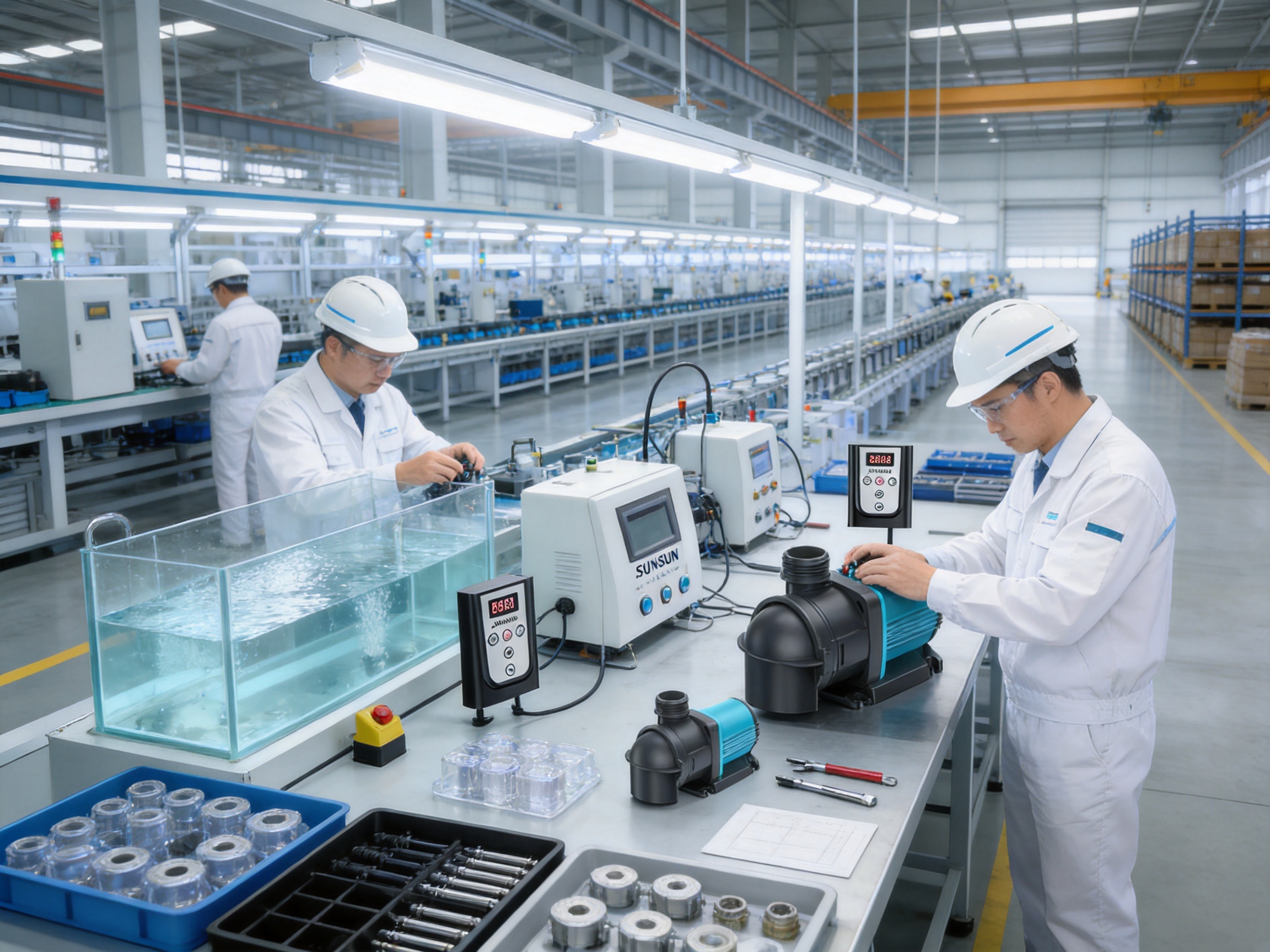
Performance in the field depends not only on the visible product design but also on the organization behind it. Sensen Group Co., Ltd. was established in November 1985 and has developed a broad business presence in aquarium pets, aquaculture machinery, industrial equipment, and related areas. More than three decades of activity provide an extensive foundation for understanding aquatic equipment requirements.
The company’s headquarters includes several functional departments, including the Sensen Research Institute, Sensen Business School, Quality Control Department, Personnel and Administrative Information Department, and Financial Department. A dedicated research function supports product development and technical improvement, while a quality-control function provides organizational focus for inspection and production consistency.
This departmental structure is important for equipment such as variable-frequency pumps because reliable performance requires cooperation across multiple stages. Product research must consider hydraulic output, motor operation, electrical design, durability, installation compatibility, and user requirements. Production planning must translate those design requirements into repeatable manufacturing procedures. Quality control must then verify that incoming materials, assembly work, and finished products meet the expected specifications.
Sensen Group also operates wholly owned subsidiaries, including Zhoushan Grech, Zhejiang Jialu, Jiangsu Sensen, Chongqing Sensen, Zhongshan Sensen, Tianjin Sensen, Roll-Tail Pet Company, and Marine Organism, together with an import and export company. The group additionally holds interests in several trading companies. This wider industrial and commercial structure supports production, logistics, market access, and service coordination.
The company describes its development direction through industrial technicalization, marketing globalization, and brand internationalization. For an aquatic pump manufacturer, industrial technicalization means that products are developed with increasing attention to engineering, process control, and application performance rather than being treated as simple commodity items.
A large-scale manufacturing organization can also support broader product testing and improvement. Feedback from domestic and overseas markets may help identify common installation problems, preferred hose sizes, required flow ranges, and maintenance concerns. This information can be fed back into future product versions and supporting accessories.
The company’s nationwide network of aquarium stores and its integration of online and offline services also create opportunities to observe how products are used in actual consumer environments. Retail and service channels can provide practical information about installation, product selection, replacement demand, and customer expectations.
Although every pump should be assessed according to its verified specifications, the combination of long operating history, research resources, quality-control organization, manufacturing subsidiaries, and international business infrastructure gives Sensen Group a substantial platform for producing and distributing aquatic equipment.
In ornamental fish ponds, the pump can be installed as part of a bottom-drain or low-level circulation arrangement. It can help move water toward mechanical filtration while reducing the amount of debris remaining on the pond floor. Adjustable performance is useful because ornamental fish may require stable, moderate circulation during normal operation and stronger flow during cleaning.
Koi ponds and other systems containing valuable fish require careful attention to water quality. A bottom-suction pump can support the removal of suspended waste and help keep water moving through filtration equipment. The operator should select the flow setting carefully to avoid excessive turbulence or stress, especially in smaller ponds.
Large aquariums, public displays, breeding facilities, and commercial aquatic installations may need compact pumps that can fit inside equipment compartments. The SDP series offers several capacity levels and relatively compact dimensions, allowing designers to consider the pump where space is restricted.
Fountains, streams, waterfalls, and decorative water features require a dependable flow source. The maximum-head ratings of the SDP series can be considered when water must be lifted to an upper return point. The final result will depend on the height, hose arrangement, outlet design, and desired visual effect.
Some pond owners may use the pump during periodic cleaning rather than as a permanent circulation unit. In this case, the pump can help transfer dirty water or direct bottom water through a temporary filter. The equipment should be inspected before and after each use, and solid debris should not be allowed to enter the pump without suitable protection.
The first selection factor is required flow. Estimate the pond volume, the desired turnover rate, and the flow required by any connected filtration equipment. A higher nominal pump output does not automatically mean better water quality. The objective is to provide sufficient movement without creating excessive turbulence or overwhelming the filter.
The second factor is total head. Measure the vertical distance from the pump outlet to the highest point of discharge. Then consider the additional resistance caused by hose length, bends, valves, connectors, filters, and outlet fittings. The model should be selected with enough capacity to maintain useful flow under these real conditions.
The third factor is hose size. Use the largest practical hose that matches the pump, system layout, and flow requirement. Narrow hoses can reduce performance and increase workload. However, oversizing every part of a small installation may increase cost and make routing more difficult.
The fourth factor is installation space. Compare the pump dimensions with the available equipment chamber or pond-side cabinet. Allow enough room for cable routing, hose connections, inspection, cleaning, and future replacement.
The fifth factor is operating purpose. A pump used mainly for gentle circulation may not need the same capacity as one used for bottom cleaning, long-distance transfer, or a raised waterfall. Variable-frequency operation provides flexibility, but correct model selection remains important.
Application Consideration |
Recommended Evaluation |
Why It Matters |
Small pond or compact aquarium |
Consider the SDP-3500 when flow and head requirements are modest |
Compact size and lower power can suit limited installations |
Medium pond or moderate lift |
Consider the SDP-6000 for higher flow and increased head capability |
Provides a balance between capacity, size, and power |
Large pond or high-flow cleaning |
Consider the SDP-10000 where the plumbing supports larger hose sizes |
Offers the highest listed output and head in the series |
Long hose or restrictive filter |
Calculate system resistance rather than relying only on nominal output |
Actual flow decreases as resistance increases |
Delicate fish or low-turbulence system |
Use variable-frequency adjustment to select a gentler setting |
Helps adapt circulation to livestock and water conditions |
Before installation, inspect the pump, cable, hose adapters, and connection points. Confirm that the selected hose size matches the required adapter. Make sure the pump is installed in a location where it will remain properly supported and where routine service can be performed without draining more water than necessary.
The intake should be protected from large leaves, stones, fish food containers, plant fragments, and other objects that could block the impeller or reduce flow. A suitable intake screen or pre-filter is recommended for ponds with substantial debris. The protective device must also be cleaned because a clogged screen can create the same symptoms as a weak pump.
Fill the system with water as required before starting the pump. Operating a water pump without adequate water can cause damage, overheating, or premature wear. Never assume that water will automatically reach the pump simply because the hose is connected.
After starting, check every connection for leakage. Observe the water movement at the outlet and listen for unusual vibration, grinding, or rattling. If the pump produces abnormal noise or if the flow is lower than expected, switch it off and investigate the intake, hose, filter, and power connections.
Do not place electrical connectors where they can sit in water. Follow appropriate electrical safety practices, including the use of suitable protective devices and professional installation where required by local regulations. The supplied voltage specification should be observed precisely, and modifications to the power system should not be attempted without qualified technical knowledge.
During operation, avoid running the pump against a completely closed outlet. Restricted discharge can reduce circulation and place unnecessary stress on the system. If flow adjustment is required, use the intended control method or a correctly designed bypass arrangement rather than abruptly blocking the outlet.
Regular maintenance helps preserve flow and extends service life. The most common causes of reduced performance are blocked intake screens, dirty filters, kinked hoses, trapped air, excessive hose resistance, and accumulated debris around the pump housing.
Inspect the intake area at regular intervals. The required frequency depends on pond conditions. A heavily planted pond, a pond with many fish, and an outdoor installation exposed to leaves may require more frequent inspection than a small indoor aquarium.
Clean the intake protection and filter media according to their design. Avoid using harsh chemicals that could damage components or leave residues harmful to fish. If the pump is removed for cleaning, disconnect the power first and allow the equipment to stop completely.
Check the impeller area for gravel, plant fibers, hair-like algae, and other material. Do not force objects into the housing or use tools that could damage the impeller. If a component appears worn, cracked, or deformed, replace it with a compatible part rather than continuing to operate the pump in an unsafe condition.
Inspect the cable and external housing for cuts, swelling, cracks, or other damage. A damaged cable should not be repaired with an improvised connection. Electrical safety is especially important because the pump is used near water.
Seasonal storage also requires preparation. If the pump will not be used for an extended period, clean it, remove deposits, allow appropriate components to dry, and store it in a protected environment according to the product instructions. Avoid exposing the unit to freezing conditions unless it is specifically designed for them.
No pump can remove every form of pond contamination by itself. Heavy sludge, large stones, dense algae mats, and oversized debris may require manual removal or specialized pond-vacuum equipment. The bottom-suction component is best viewed as part of an integrated water-management system.
Maximum output is a reference value, not a guaranteed flow under every installation condition. Pump performance changes with lift, hose size, hose length, filter resistance, and operating setting. Customers should use performance information responsibly and consult technical support when designing a complex system.
Water quality also depends on biological balance. A pump can improve circulation and help transport waste, but it does not replace beneficial bacteria, appropriate stocking density, regular water testing, or proper feeding practices. Good pond management combines mechanical movement with biological filtration and sensible husbandry.
Users should also recognize that variable-frequency operation does not mean unlimited adjustment under all conditions. The pump must remain within its intended operating range, and the installation must provide adequate water supply and heat dissipation. Controls, adapters, and power components should be compatible with the pump system.
For distributors, a three-model product range is easier to present and stock than a collection of unrelated pump specifications. Each model has a clearly defined output, head, power rating, weight, size, cable length, and adapter range. This supports more organized product selection for retail and project customers.
The broad AC100–240V input specification is also helpful for international sales. Distributors serving different markets do not necessarily need completely different pump versions for each electrical region, although local regulations and power-supply requirements must always be reviewed.
Professional installers can benefit from the range of hose adapters and the compact construction. A pump that can fit into a restricted equipment space may reduce redesign work during renovation projects. The adjustable operating concept also gives installers more flexibility when final system resistance differs from the initial estimate.
For service teams, the clear model structure and published dimensions simplify replacement planning. A technician can compare the existing installation with the dimensions and hose requirements of a replacement model before visiting the site. This can reduce downtime and help ensure that the selected pump is appropriate.
Sensen Group Co., Ltd. has built a broad organizational structure around aquatic products and related equipment. Its activities include aquarium pets, aquaculture machinery, industrial equipment, production, domestic distribution, international trade, and retail-network development. Such breadth can support customers who require more than a single standalone product.
The company’s import and export activity provides a foundation for serving overseas markets. Its network of subsidiaries and trading-company relationships can support production coordination, commercial distribution, and market coverage. This is particularly relevant for buyers seeking stable supply across different regions.
The company’s research institute and quality-control department are central strengths for technical product development. Pumps are engineering products in which small differences in assembly, sealing, electrical connection, impeller balance, and material quality can affect practical performance. A structured organization helps assign responsibility for these areas and supports continuous improvement.
The company also emphasizes professional knowledge through its business-school structure and industry-focused development. Training and information exchange can help align product design, manufacturing, sales, and after-sales service. This is useful when products are installed in different climates, water systems, and market environments.
Its long history since 1985 suggests experience with changing customer expectations and evolving aquatic technology. The company’s stated approach of continuous innovation is consistent with the development of products that combine electronic control, compact form, flexible installation, and higher-performance water movement.
The main purpose is to draw water from the lower area of a fish pond or aquatic system so that settled debris can be transported toward a filter, drain, treatment unit, or return line. It can also support general circulation and water-feature operation.
No. The pump moves water, while the filter removes particles or provides biological treatment. The pump and filter normally work together as parts of a complete water-management system.
It allows the operating performance to be adjusted instead of forcing the pump to run at only one fixed level. This helps users match flow to cleaning, circulation, fish, filtration, and energy requirements.
The SDP-10000 has the highest listed output at 10,000 liters per hour and a maximum head of 6 meters.
The SDP-3500 is the smallest model in the listed range. It measures 147 × 77 × 90mm, weighs 1.1kg, uses 30W, and provides a listed output of 3,500 liters per hour.
The product information lists AC100–240V, 50Hz/60Hz input and DC24V pump operation. Users should follow the supplied electrical instructions and should not modify the power arrangement without qualified assistance.
It can be used with a hose system, but longer hoses create greater resistance and reduce actual flow. The installer should account for hose length, diameter, bends, elevation, filters, and fittings when selecting the model.
The larger connection options support higher-flow installations. Wider hoses can reduce resistance compared with narrow hoses, especially when water must travel a long distance or pass through a demanding system.
It may be suitable for a waterfall if the required lift and flow are within the model’s capabilities. The actual waterfall performance depends on elevation, hose resistance, outlet design, and the selected operating setting.
Use suitable intake protection, keep the pump away from large debris, inspect the suction area regularly, and clean the intake screen or pre-filter. Outdoor ponds with leaves and plant material may require frequent maintenance.
No. The best model is the one that matches the pond size, system resistance, desired flow, hose arrangement, and filtration capacity. An unnecessarily large pump may create turbulence and consume more energy than needed.
Sensen Group Co., Ltd. has operated since 1985 and maintains research, quality-control, production, subsidiary, import-export, and market-distribution resources. These capabilities support product development, manufacturing coordination, quality management, and international supply.
The DC variable-frequency bottom-suction water pump provides a practical way to improve pond-bottom cleaning and aquatic circulation. Its primary advantages include adjustable operation, three output levels, DC24V pump-side operation, broad AC input compatibility, multiple hose-adapter options, compact dimensions, and useful maximum-head ratings.
The SDP-3500, SDP-6000, and SDP-10000 models give users a structured choice for different pond sizes and installation demands. The smaller model suits compact systems, the middle model provides increased flow and lift, and the largest model is designed for higher-capacity applications with wider hose connections.
Compared with a basic fixed-speed pump, the variable-frequency design offers greater adaptability. Compared with a single-size product range, the three-model structure provides better selection flexibility. When correctly installed with suitable filtration and intake protection, the pump can help move settled debris, support water treatment, and improve the overall circulation pattern.
The product is also supported by the broader capabilities of Sensen Group Co., Ltd., including long-term industry experience, research resources, a dedicated quality-control function, multiple subsidiaries, international trade infrastructure, and a wide aquatic-product network. These organizational strengths provide a foundation for continued product development and reliable market service.
For the best result, users should size the pump according to actual flow and head requirements, select suitable hose dimensions, protect the intake, maintain the system regularly, and treat the pump as one part of a complete pond-management solution. With these practices, a bottom-suction DC variable-frequency pump can become an effective tool for keeping fish ponds cleaner, better circulated, and easier to manage.
1. Sensen Group Co., Ltd. Product specification data for the SDP-3500, SDP-6000, and SDP-10000 DC variable-frequency water pump series.
2. Sensen Group Co., Ltd. Corporate information concerning company history, research organization, quality-control structure, subsidiaries, and international operations.
3. General principles of pump selection, including flow rate, maximum head, hose resistance, and installation sizing.
4. General aquarium and ornamental pond maintenance practices concerning bottom debris, mechanical filtration, circulation, intake protection, and routine cleaning.
5. General low-voltage aquatic-equipment installation and electrical-safety principles.


 No. 61-79, Baima Street, Maao Town, Dinghai District, Zhoushan City, Zhejiang Province, China.
 0086 580 8082088 / 8081168
 0086 580 8080978
 songhua@sunsun-china.com