

 English
 русский
 España
 Portugal
 عربي
Zhang Lina | Overseas Aquarium Filters Sales Rep
Home / Author / Zhang Lina | Overseas Aquarium Filters Sales Rep / Dream White Series Special Lamps for Aquatic Plants: A Practical Guide to Purpose-Built Aquarium Lighting
Aquatic plants are living components of an aquarium, and their performance depends on more than water quality and substrate alone. Light influences plant growth, visual presentation, daily rhythm, and the overall balance of a planted aquarium. For this reason, choosing a suitable aquarium lamp is an important decision for aquascapers, aquarium retailers, public displays, and professional aquatic-plant installations.
The Dream White Series is a dedicated lamp range designed for planted aquariums. It provides several length and power options for aquariums from approximately 800 millimeters to 2,000 millimeters and above. Instead of treating lighting as a universal accessory, this series organizes its products around aquarium length, making it easier to select a lamp that corresponds to the physical dimensions of the tank.
The range includes six principal models: ADO-600W-F, ADO-760W-F, ADO-980W-F, ADO-1300W-F, ADO-1500W-F, and ADO-1700W-F. Their power ratings range from 9 watts to 30 watts. The model numbering also communicates the approximate lamp length, allowing buyers, installers, and distributors to identify the intended size quickly.
For planted aquarium owners, this practical structure offers an advantage over poorly matched lighting systems. A lamp that is too short may leave areas of the aquarium visually uneven, while an unnecessarily powerful or oversized lamp may increase energy use and complicate installation. The Dream White Series provides a clear selection framework based on aquarium size and intended application.
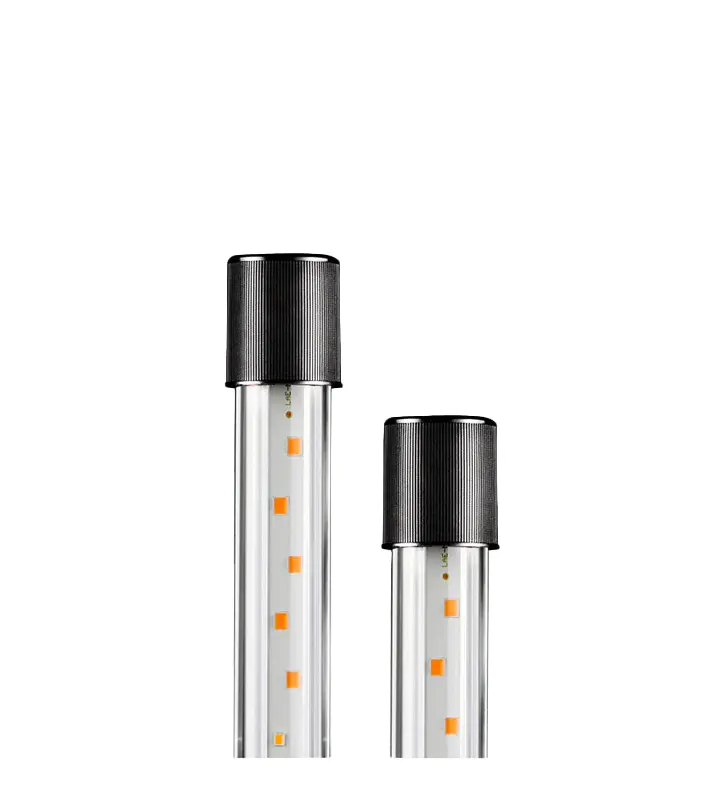
Dream White Series (Special Lamp for Aquatic Plants)
Content
Aquatic plants require consistent illumination as part of their growing environment. In an aquarium, light must pass through the water surface and reach plants distributed across the tank. The shape and length of the aquarium therefore matter when selecting a lighting fixture. A narrow lamp may illuminate only the central section, while a lamp designed for a longer aquarium can provide broader coverage across the planted layout.
The Dream White Series is described as a special lamp for aquatic plants rather than a general-purpose aquarium light. This application-specific positioning is one of its principal strengths. It gives the product a clear purpose: supporting the illumination needs of planted aquarium arrangements while also contributing to the appearance of the display.
The series is suitable for different tank scales. A smaller planted aquarium may use the ADO-600W-F, while a long display aquarium may require the ADO-1700W-F. Between these two sizes, four additional models provide intermediate choices. This graduated product architecture helps reduce the compromise often encountered when only one or two standard lamp lengths are available.
Lighting selection should always consider the aquarium’s depth, plant species, planting density, water clarity, hardscape arrangement, and installation height. The information supplied for the Dream White Series primarily identifies the recommended aquarium length and electrical power. Buyers should therefore treat the listed fit as a starting point and confirm the final installation according to their specific aquarium design.
The following table presents the available models, their rated power, and the aquarium size indicated for each product.
| Model | Power | Recommended Aquarium Size |
|---|---|---|
| ADO-600W-F | 9W | 800 millimeters and above |
| ADO-760W-F | 13W | 1,000 millimeters and above |
| ADO-980W-F | 20W | 1,200 millimeters and above |
| ADO-1300W-F | 22W | 1,500 millimeters and above |
| ADO-1500W-F | 24W | 1,800 millimeters and above |
| ADO-1700W-F | 30W | 2,000 millimeters and above |
The numerical portion of each model represents the approximate lamp length. This naming method is particularly useful in wholesale, retail, and service environments because the model itself communicates an important physical characteristic. A purchaser can compare the aquarium length with the model number before reviewing additional technical details.
The power progression is also organized according to product size. The smallest listed model uses 9 watts, while the longest uses 30 watts. The range does not follow a simple linear increase, which allows the product family to offer different power levels for different lamp lengths. Users should select the lamp according to the manufacturer’s intended aquarium-size range instead of judging suitability by wattage alone.
The ADO-600W-F is rated at 9 watts and is intended for aquariums measuring 800 millimeters and above. It is the entry model in the series and may be appropriate for compact planted displays, smaller retail aquariums, or installations where a relatively short lamp is required.
Its lower power rating can be helpful for users who want to establish a simple planted aquarium without selecting a larger fixture than necessary. It may also be suitable for display systems where plant density, tank depth, and visual style call for moderate illumination. The final result will depend on the aquarium’s biological and structural conditions.
The ADO-760W-F provides 13 watts of power and is intended for aquariums measuring 1,000 millimeters and above. It fills the space between the shorter entry model and the larger fixtures in the range.
This intermediate option can simplify product selection for aquariums that are longer than compact tanks but do not require the dimensions of a large commercial display. It may also help retailers maintain a more complete range of planted-aquarium lighting options without relying on one universal model.
The ADO-980W-F is rated at 20 watts and is intended for aquariums measuring 1,200 millimeters and above. It is designed for a longer planted display and provides a higher power level than the two smaller models.
For aquariums with a broader planting area, the ADO-980W-F offers a practical midpoint in the range. Its size and power combination may be considered for community aquariums, planted layouts, and display tanks where a larger illuminated area is required.
The ADO-1300W-F uses 22 watts and is intended for aquariums measuring 1,500 millimeters and above. This model is suited to long aquariums where a compact lamp would not provide the same length coverage.
Long aquariums can be difficult to illuminate evenly when the available fixture is too short. A lamp selected from the appropriate length category can help create a more coherent visual presentation across the entire display. The ADO-1300W-F addresses this requirement within the medium-to-large section of the series.
The ADO-1500W-F is rated at 24 watts and is intended for aquariums measuring 1,800 millimeters and above. It is designed for substantial display systems, including large home aquariums, showroom installations, and commercial aquarium arrangements.
Its extended length can help reduce the visual imbalance that may occur when a short light is centered over a long tank. For large aquascapes, the lamp should be evaluated together with the aquarium’s depth, plant arrangement, mounting position, and surrounding ambient light.
The ADO-1700W-F is the longest and highest-rated model in the listed range. It uses 30 watts and is intended for aquariums measuring 2,000 millimeters and above.
This model provides a solution for large planted aquariums that require a longer dedicated fixture. It can be considered for professional displays, retail installations, institutional aquariums, and large residential systems. Because large tanks often have greater water depth and more complex planting zones, installation planning remains important even when the lamp length is appropriate.

One of the strongest advantages of the Dream White Series is the availability of six coordinated models. Many aquarium lighting selections become difficult when a supplier offers only one standard size. A single fixture may be too short for long aquariums or unnecessarily large for compact tanks. A structured product family provides a more practical alternative.
The six-model range supports a broader group of customers. Aquarium hobbyists can select a product closer to their tank length. Retailers can stock several models for different customer needs. Aquarium installers can specify a fixture according to project dimensions. Importers and distributors can promote a complete series instead of presenting an isolated product with limited application coverage.
Another advantage is simplified product communication. The model number includes a length reference, while the product table identifies the power and recommended aquarium size. This can reduce confusion during purchasing and make quotations easier to prepare. In business-to-business sales, clear model differentiation is valuable because it helps purchasing teams compare products and reduce ordering errors.
The series also allows a more consistent appearance across multiple aquariums. A retailer operating several display tanks can select different models while maintaining a related product style. A public or commercial installation can use the same product family across tanks of different lengths, creating a more unified maintenance and procurement process.
Generic lighting products may be marketed for many uses, including household illumination, decorative displays, or general aquarium visibility. While such products may provide brightness, they are not always organized around the dimensions and needs of planted aquariums. A dedicated aquatic-plant series begins with a more specific application.
The first advantage is purpose. The Dream White Series is positioned specifically for aquatic plants, which makes it easier for users to distinguish it from ordinary decorative lights. This does not remove the need to evaluate plant requirements, but it gives the buyer a product category aligned with the intended aquarium environment.
The second advantage is sizing. Generic lights are often selected according to availability rather than aquarium length. The Dream White Series provides a clear progression from a model for aquariums of 800 millimeters and above to a model for aquariums of 2,000 millimeters and above. This encourages more deliberate fixture selection.
The third advantage is product continuity. When an aquarium owner expands from a smaller tank to a larger one, the same range provides a familiar selection path. Retailers and service companies can also train staff around one consistent model structure instead of explaining unrelated products from different categories.
The fourth advantage is application-focused purchasing. A buyer can begin with three basic questions: How long is the aquarium? Which model corresponds to that length? What installation arrangement is required? This is more straightforward than comparing unrelated lamps based only on appearance or advertised brightness.
These advantages should not be interpreted as a guarantee that one lamp is appropriate for every aquatic plant or every aquarium condition. Plant species differ in their requirements, and aquarium depth affects light delivery. The value of the series lies in its clear, purpose-oriented design and its range of size options.
Aquarium retailers often need to balance product variety with inventory control. Too few models limit customer choice, while too many unrelated products increase stock complexity. A coordinated six-model series can help retailers build a logical lighting section.
The models can be organized by aquarium length, giving sales staff a simple consultation process. A customer can provide the tank length, and the retailer can identify the corresponding model before discussing installation and aquarium conditions. This approach may improve the clarity of product recommendations and reduce the risk of selling an obviously mismatched fixture.
For distributors, the product family offers opportunities for tiered catalog presentation. The smaller models can serve compact and medium aquariums, while the larger models address long residential, commercial, and professional displays. A distributor can therefore present the series to different market segments without changing to an unrelated product line.
The model structure also supports replacement planning. If a customer needs to replace a lamp after extended use, the model designation provides a useful reference. When several aquariums use products from the same family, staff can record the model number and aquarium length in maintenance documents, making future purchasing more organized.
In export and wholesale markets, standardized naming is especially useful. Product names, technical tables, packaging, quotations, and after-sales records can all use the same model references. This is beneficial for companies that supply aquarium equipment to multiple regions and need consistent documentation.
The Dream White Series is supplied by a group with a long operating history in aquarium-related products and equipment. The company information states that the group was established in November 1985 and has developed through more than 30 years of continuous effort. This background is relevant when evaluating a specialized aquarium lighting product because experience in the aquarium sector can support a better understanding of tank environments, equipment integration, distribution requirements, and customer expectations.
The company describes a broad industrial structure covering aquarium pets, aquaculture machinery, industrial equipment, and related fields. This wider scope can contribute to product development by connecting lighting design with other aquarium systems, including water pumps, air pumps, filtration equipment, controllers, accessories, and complete aquarium installations.
The company has established several functional departments, including a research institute, business school, quality control department, personnel and administrative information department, and financial department. From a manufacturing and product-management perspective, this indicates an organizational framework that extends beyond basic assembly. Research, quality control, training, administration, and finance each support different stages of product development and delivery.
A dedicated research function can assist with product improvement, design evaluation, and adaptation to market requirements. A quality control department can support inspection and process management. Training resources can help staff and distributors understand products more consistently. These functions are important for a specialized lighting range because reliable product communication is almost as important as the physical fixture itself.
The company also reports several wholly owned subsidiary corporations and an import and export company, together with holdings in multiple trading companies. Such an organizational network may provide advantages in sourcing, production coordination, distribution, and market access. For international buyers, the existence of an established export structure can be helpful when discussing product specifications, packaging, delivery, and commercial documentation.
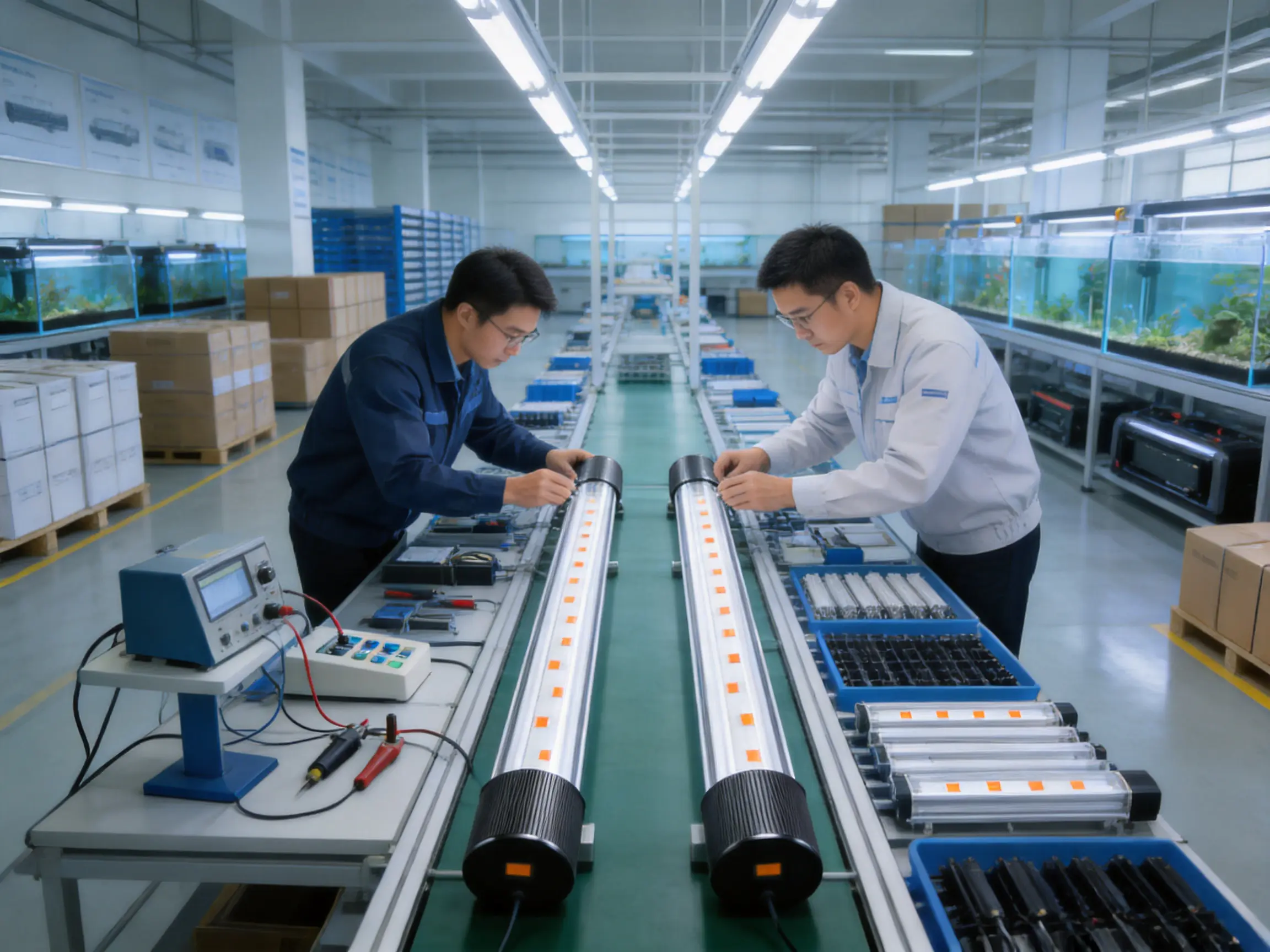
Aquarium lighting requires coordination between mechanical design, electrical components, production assembly, inspection, packaging, and after-sales support. A product cannot be evaluated only by its external appearance. Consistent dimensions, stable electrical performance, suitable assembly, and clear model identification are all important to the final user.
The company’s stated quality control function provides an organizational basis for managing these requirements. Although detailed process specifications are not provided in the supplied materials, a formal quality control department can support the inspection of incoming materials, production stages, finished products, and packaging. These activities are essential for maintaining consistency across a multi-model series.
Different lamp lengths require accurate product differentiation. The ADO-600W-F and ADO-1700W-F serve very different aquarium sizes, and confusing their specifications could lead to poor application results. Manufacturing and warehouse procedures therefore need reliable model identification, labeling, and order management. A coordinated production system can help preserve the distinction between each model.
Product development also benefits from internal communication between research, production, quality control, and commercial departments. The research team can identify market requirements, production teams can evaluate manufacturability, quality personnel can establish inspection points, and sales teams can communicate customer feedback. This cycle supports continuous improvement rather than one-time product creation.
The company’s long operating history and broad product portfolio may also support manufacturing learning across related equipment categories. Aquarium lighting is used alongside pumps, filters, controllers, and other equipment. Experience with these systems can help the manufacturer understand the practical conditions in which a lamp will be installed and maintained.
For buyers, the main value of manufacturing strength is not a single marketing statement. It is the ability to deliver consistent products over time, maintain a recognizable model structure, support different market sizes, and provide a stable supply channel. These factors can be especially important for retailers and professional installers that need repeat orders.
Before installing a Dream White Series lamp, users should measure the aquarium length and compare it with the recommended size shown in the product table. The lamp model should be selected according to the stated fit rather than by visual preference alone.
The aquarium should also be assessed for depth. A deeper tank may require a different lighting arrangement from a shallow tank, even when both aquariums have the same length. Plant type, water clarity, hardscape height, floating plants, and the position of the lamp can all affect the amount of light reaching the leaves.
The fixture should be positioned securely and kept clear of unnecessary obstructions. Cables should be arranged so that they do not interfere with maintenance or create avoidable tension. The installation must also follow the product instructions and local electrical safety requirements.
Because the series is intended for aquarium use, users should take reasonable precautions against water exposure. The lamp, power connection, and control equipment should be installed according to the manufacturer’s instructions. Water splashing, condensation, and maintenance activities should be considered during installation planning.
Newly installed aquarium lighting should be introduced with attention to the aquarium’s biological condition. A sudden increase in light duration or intensity can contribute to algae problems in an immature aquarium. A gradual schedule, regular observation, and balanced maintenance can help the user evaluate the result more effectively.
Lighting should be considered together with filtration, carbon dioxide management where applicable, fertilization, water changes, and plant selection. A dedicated lamp supports the lighting part of the system, but healthy aquatic-plant growth depends on the interaction of several environmental factors.
Home aquariums vary greatly in length and design. Some users prefer compact planted tanks, while others build long aquascapes that become a central feature of a living room, office, or reception area. The six-model structure makes it possible to select a lamp according to the physical dimensions of the aquarium.
The range can support simple layouts as well as more elaborate displays. Users may choose a model based on aquarium length and then refine the installation according to the plant species, aquascape height, and desired appearance. The white-series concept may also complement a clean, bright presentation in a domestic environment.
Aquarium shops often use display tanks to demonstrate fish, aquatic plants, hardscape materials, and equipment. A reliable and clearly organized lighting range can help the store maintain consistent presentation across multiple tanks.
Retailers may use smaller models for compact demonstration aquariums and longer models for large planted displays. Because the model numbers correspond to approximate lamp lengths, staff can record the products used on each display and repeat the arrangement when building new tanks.
Restaurants, hotels, offices, schools, and public reception areas may use planted aquariums as decorative or educational features. These installations often require a professional appearance and a lighting solution that corresponds to the size of the display.
The longer models can be considered for large aquariums where visual uniformity is important. Commercial users should also plan maintenance access, operating schedules, electrical safety, and replacement procedures before installation.
Aquascaping projects depend on composition, contrast, plant arrangement, and visual depth. Lighting is part of the presentation strategy, not merely a technical accessory. A lamp selected to match the aquarium length can help the layout appear more balanced from end to end.
Designers should still evaluate the specific plant collection and the physical depth of the aquarium. The Dream White Series provides the fixture range, while the aquascaper remains responsible for adapting the complete environment to the selected plants.
Routine maintenance helps preserve the performance and appearance of aquarium lighting. Dust, salt deposits, water marks, and algae can accumulate around aquarium equipment. The lamp should be inspected and cleaned according to the manufacturer’s instructions, with power disconnected when appropriate.
Users should avoid using unsuitable cleaning chemicals or abrasive materials that may damage the fixture. Any cleaning process should prevent water from entering electrical connections. If the product shows physical damage, unusual heat, flickering, or other abnormal behavior, it should be switched off and inspected by a qualified person or the supplier.
Aquarium lighting is commonly operated on a schedule. A consistent daily period can support a predictable aquarium routine, while excessive operating time may encourage algae growth. The best schedule depends on the aquarium’s maturity, plant species, ambient light, and maintenance program.
When a lamp is installed over a planted aquarium, the condition of the plants should be observed over time. New growth, leaf color, algae development, and overall plant posture can provide practical information. Adjustments should be made gradually rather than changing several environmental factors at once.
For commercial installations, maintenance records should include the model number, installation date, operating schedule, cleaning history, and any observed issue. The model-based structure of the series makes these records easier to organize across aquariums of different lengths.
International aquarium-equipment markets require products that can be identified and discussed accurately across different sales channels. A clear model system helps manufacturers, importers, retailers, installers, and end users refer to the same product.
The Dream White Series uses an identifiable prefix and a numerical length reference. This format is useful in quotations, packing lists, inventory systems, online catalogs, installation records, and replacement orders. It also helps separate one model from another when several lamps are purchased together.
For a distributor, model clarity can reduce training time. Sales staff can learn the relationship between each model, its power rating, and its recommended aquarium size. For an installer, the model can be matched to a project specification. For an end user, the model can be retained as a reference for future service or replacement.
The manufacturer’s reported export and trading structure further supports the potential for international distribution. A company with dedicated commercial and export resources may be better positioned to coordinate regional orders and serve professional buyers than a small supplier offering only one local product channel.
When purchasing a Dream White Series lamp, the first step is to measure the aquarium accurately. The buyer should compare the measurement with the recommended size listed for each model and avoid selecting a lamp solely because its wattage appears higher.
The second step is to review the aquarium’s depth and plant arrangement. A long but very deep aquarium may require additional planning. Likewise, a shallow aquarium with demanding plants may need different operating considerations from a low-maintenance display.
The third step is to confirm the installation environment. The buyer should understand how the lamp will be supported, where the power connection will be placed, and how maintenance will be performed. Retailers and installers should provide the customer with clear instructions rather than treating the lamp as a simple decorative item.
The fourth step is to confirm product documentation, packaging, available accessories, and after-sales procedures with the supplier. Requirements can differ by market, and the exact installation arrangement should be verified before purchase.
For wholesale buyers, it is useful to request a complete model list, carton information, product photographs, technical specifications, and sample availability. A consistent documentation package helps distributors build accurate catalogs and prevents misunderstandings between the supplier and downstream customers.
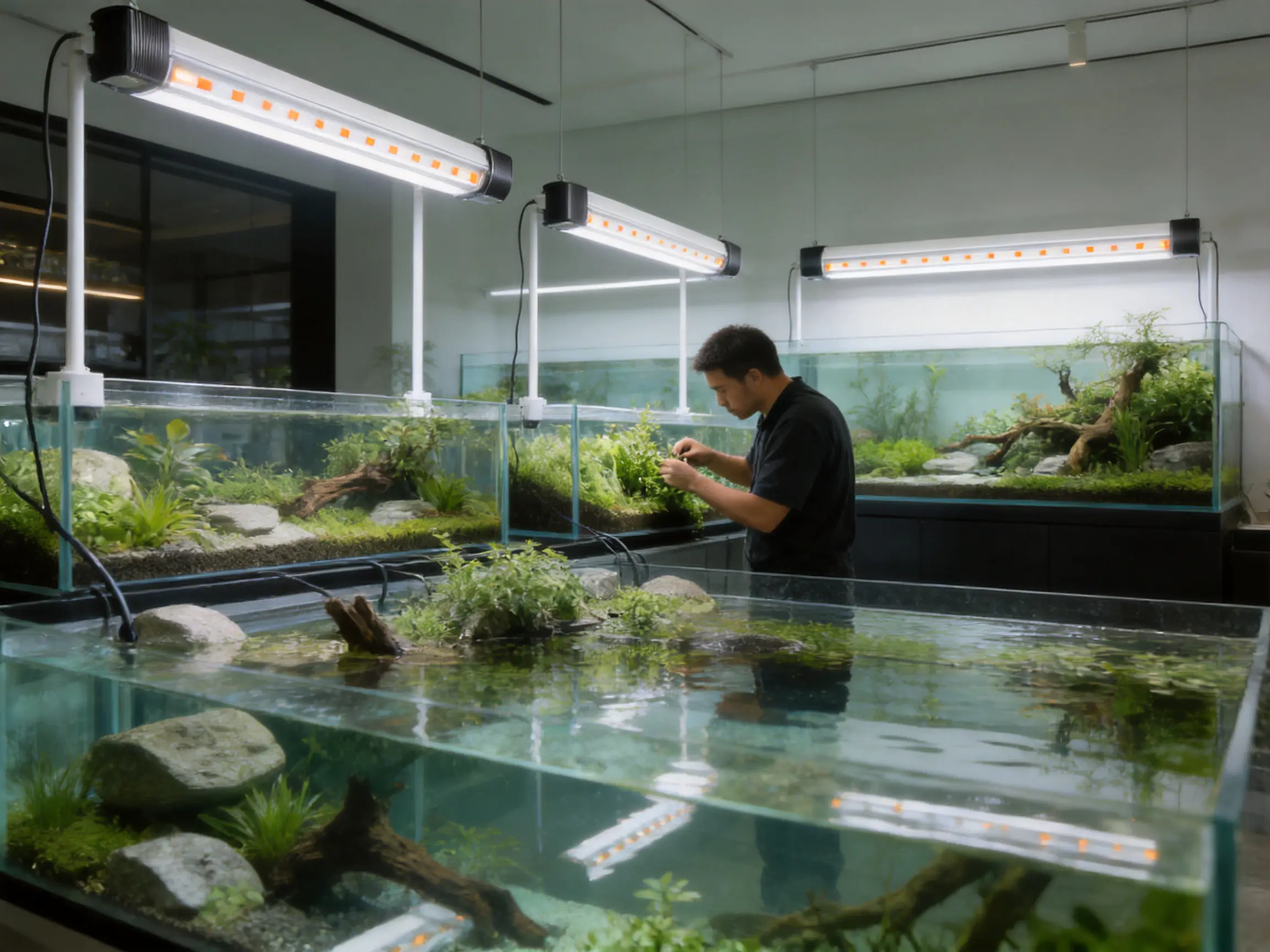
It is a series of lamps designed specifically for aquatic plants in planted aquariums. The range includes six models with different lengths and power ratings.
There are six listed models: ADO-600W-F, ADO-760W-F, ADO-980W-F, ADO-1300W-F, ADO-1500W-F, and ADO-1700W-F.
The number represents the approximate length of the lamp. It helps users connect the product model with the intended aquarium size.
The ADO-600W-F is listed for aquariums measuring 800 millimeters and above, with a rated power of 9 watts.
The ADO-760W-F is listed for aquariums measuring 1,000 millimeters and above, with a rated power of 13 watts.
The ADO-1700W-F has the highest listed power at 30 watts. It is intended for aquariums measuring 2,000 millimeters and above.
The series is designed for aquatic-plant applications, but plant requirements vary. Users should consider plant species, tank depth, water clarity, planting density, and operating schedule before finalizing an installation.
The published recommendations identify a minimum aquarium size for each model. Buyers should follow those recommendations and confirm the final application with the supplier, especially when the aquarium has unusual depth or layout conditions.
The range gives users more choices based on aquarium length. It can reduce the need to use one oversized or undersized lamp for every aquarium.
No. Aquarium length, depth, plant selection, lamp position, water conditions, and operating schedule should all be considered. Wattage alone does not describe the complete lighting environment.
Home aquarists, aquarium retailers, aquascaping professionals, commercial display operators, distributors, and institutional aquarium managers can all evaluate the range according to their application requirements.
The supplied company information describes a history extending back to 1985, a research institute, a quality control department, several functional departments, wholly owned subsidiaries, an import and export company, and a broad product focus covering aquarium and industrial equipment.
Users should follow the product instructions, keep the fixture clean, prevent water from entering electrical connections, and disconnect power when appropriate during maintenance. Damaged or abnormal equipment should be inspected before continued use.
Aquarium lighting should be introduced carefully, especially in a new aquarium. A gradual schedule and regular observation can help reduce the risk of excessive algae and allow the user to evaluate plant response.
The Dream White Series provides a clear and practical approach to planted-aquarium lighting. Its principal advantage is the combination of dedicated aquatic-plant positioning, six coordinated size options, and a model-number system that communicates lamp length. From the 9-watt ADO-600W-F for aquariums of 800 millimeters and above to the 30-watt ADO-1700W-F for aquariums of 2,000 millimeters and above, the series covers a broad range of aquarium formats.
Compared with generic lighting products, the series gives buyers a more structured way to match a lamp with aquarium length. This is valuable for hobbyists, retailers, installers, and distributors who need repeatable product selection and consistent product documentation.
The supplier’s reported history, research resources, quality control function, subsidiary structure, and export capabilities provide an additional foundation for professional procurement. These organizational strengths can support product continuity, manufacturing coordination, quality management, and international supply.
As with all aquarium equipment, the lamp should be selected and installed as part of a complete aquarium plan. Tank depth, plant requirements, water conditions, maintenance, and operating time must be considered together. When these factors are properly evaluated, the Dream White Series can serve as a practical lighting solution for planted aquariums ranging from medium-sized home displays to large commercial and professional installations.
1. Product specification sheet for the Dream White Series, including model numbers, power ratings, and recommended aquarium sizes.
2. Manufacturer-provided company profile describing organizational history, research resources, quality control functions, subsidiaries, and export operations.
3. General aquarium-maintenance principles concerning planted-tank lighting schedules, algae management, equipment cleaning, and safe installation.
4. General aquascaping practice concerning aquarium dimensions, plant placement, light distribution, water depth, and display composition.
5. Product installation and maintenance information supplied for the Dream White Series.


 No. 61-79, Baima Street, Maao Town, Dinghai District, Zhoushan City, Zhejiang Province, China.
 0086 580 8082088 / 8081168
 0086 580 8080978
 songhua@sunsun-china.com