

 English
 русский
 España
 Portugal
 عربي
Zhang Lina | Overseas Aquarium Filters Sales Rep
Home / Author / Zhang Lina | Overseas Aquarium Filters Sales Rep / How to Choose a High-Performance Pond Water Pump for Reliable Water Circulation
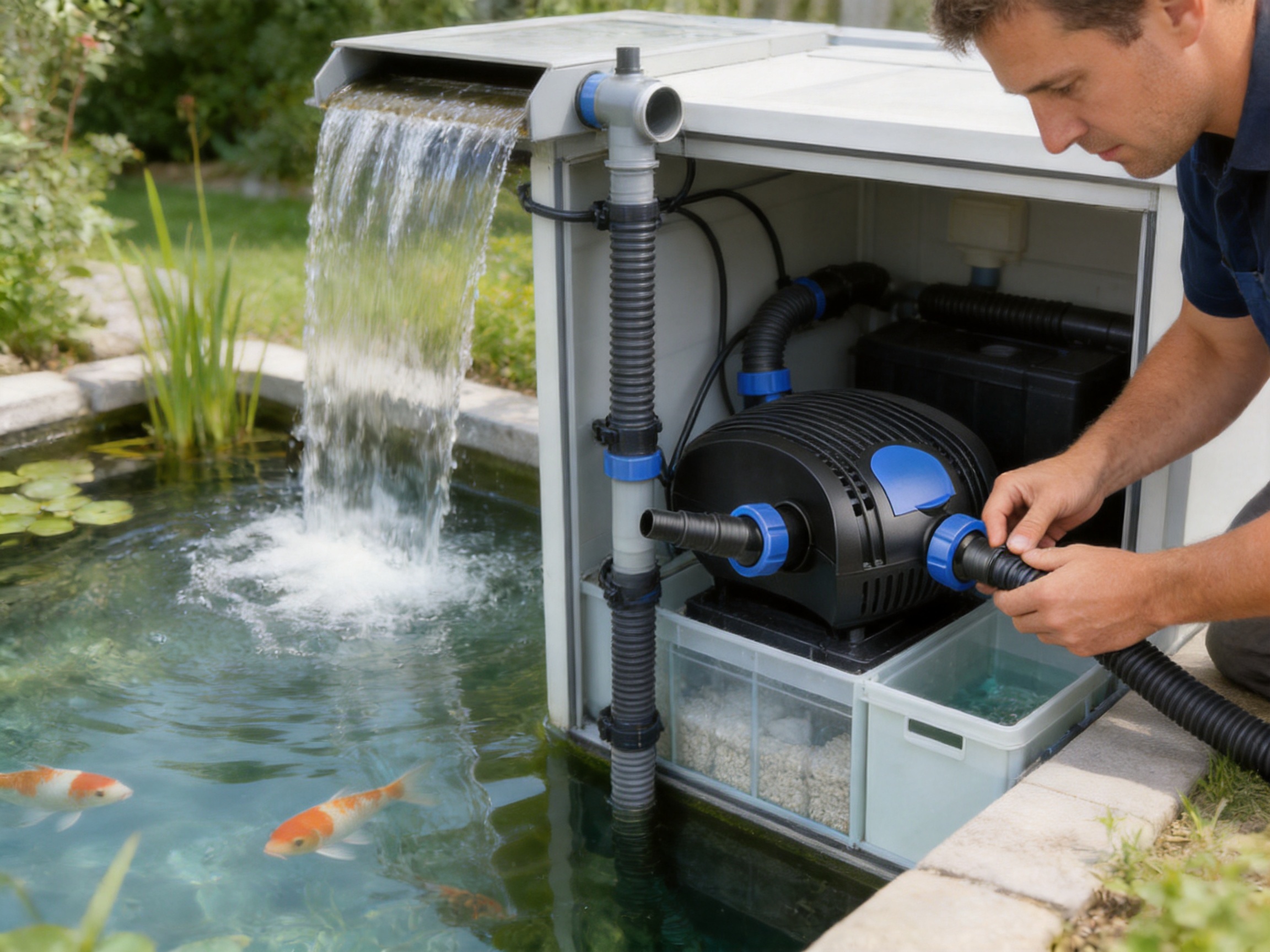
A dependable pond water pump is one of the most important components in a garden pond, ornamental water feature, aquatic display, or large filtration system. The pump determines how efficiently water moves through filters, waterfalls, streams, biological treatment chambers, and circulation outlets. It also affects operating cost, installation flexibility, maintenance requirements, and the long-term health of the aquatic environment.
The CFP Series Frequency Variation Pump is designed for users who need a broad selection of flow rates, practical installation options, and stable performance across different pond and water-feature applications. The series includes models ranging from 900 liters per hour to 18,000 liters per hour, allowing one product family to serve compact water features as well as substantial ponds and circulation systems.
Its model range combines relatively low power consumption with useful maximum head heights, multiple hose adapters, long power cables on larger models, and a design suitable for continuous water movement. These characteristics make the series appropriate for pond circulation, waterfall supply, filtration systems, aquatic landscaping, aquaculture support, and other water-management applications.
The product is manufactured by Sensen Group Co., Ltd., a company with a long history in aquarium equipment, aquaculture machinery, pet products, and related industrial technologies. Through decades of development, manufacturing expansion, quality management, research activity, and international sales experience, the company has built the capabilities required to produce equipment for both household and professional water applications.
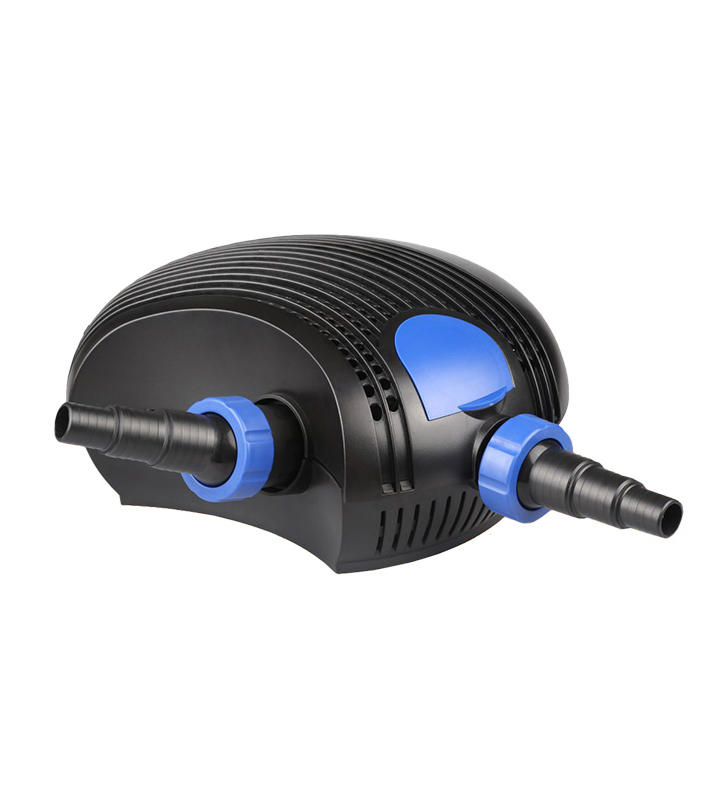
CFP Series Frequency Variation Pump
Content
Water circulation is essential for maintaining a functional pond environment. Still water can develop uneven temperatures, stagnant areas, sediment accumulation, unpleasant odors, and reduced oxygen distribution. In ponds containing fish or aquatic plants, poor circulation can also place additional stress on the biological balance of the system.
A pump supports circulation by drawing water from a pond or reservoir and directing it toward a filter, waterfall, fountain, stream, return outlet, or other treatment point. The correct pump must provide enough flow at the actual installation height, not merely at the outlet when no hose or vertical lift is present.
For this reason, maximum head height is a key specification. A pump with a high nominal flow rate may deliver substantially less water when the water must travel upward, pass through a long hose, or move through bends and filtration equipment. The CFP Series offers maximum head heights from 1.5 meters on the CFP-900 to 6.2 meters on the CFP-18000/A. This range allows users to select a model according to the vertical lift and circulation requirements of the installation.
Hose diameter is equally important. A narrow hose can restrict flow, increase resistance, and reduce the practical output of a pump. The CFP Series includes hose adapters covering several common outlet sizes. Smaller models support compact hose connections, while larger models provide connections up to 50 millimeters. This flexibility makes it easier to match the pump with existing pipework or to design a new system around the appropriate outlet size.
Power consumption must also be considered. The listed models use between 20 watts and 315 watts, depending on capacity. A smaller pump may be sufficient for a decorative pond or compact filter, while a larger installation may require more power to deliver higher flow and greater head performance. Selecting the correct capacity prevents both underperformance and unnecessary energy use.
The CFP Series is a family of pond water pumps intended for water circulation and transfer. The range includes twelve listed models: CFP-900, CFP-1500, CFP-2000, CFP-2500, CFP-3000, CFP-8000, CFP-9000, CFP-10000, CFP-13000/A, CFP-15000/A, and CFP-18000/A. Each model operates at 220V–240V and 50Hz according to the supplied specifications.
The series is structured to provide a gradual increase in capacity. Users can select from compact 900-liter-per-hour equipment, medium-capacity models from 1,500 to 3,000 liters per hour, and high-output models from 8,000 to 18,000 liters per hour. This broad range is one of the product’s major practical strengths because it reduces the need to combine unrelated pump families for different projects.
The pumps are suitable for pond filtration circulation, water-wall systems, garden streams, ornamental waterfalls, reservoir transfer, and aquatic display applications. Depending on the model and installation, they can support either compact systems with short pipe runs or larger installations with extended cables and larger-diameter hoses.
The smaller CFP-900 and CFP-1500 models have compact dimensions and low weights, making them suitable for applications where installation space is limited. The CFP-2000 through CFP-3000 models provide higher flow rates while remaining relatively compact. The CFP-8000 through CFP-10000 models increase output substantially, while the CFP-13000/A through CFP-18000/A models are intended for high-volume circulation and larger water features.
| Model | Power | Maximum Head | Output | Hose Adapter | Cable Length | Weight | Dimensions L×W×H |
|---|---|---|---|---|---|---|---|
| CFP-900 | 20W | 1.5m | 900L/h | 13/16mm | 1.5m | 0.45kg | 106×64×95mm |
| CFP-1500 | 25W | 1.8m | 1500L/h | 16/16/20mm | 1.5m | 0.6kg | 106×69×95mm |
| CFP-2000 | 35W | 2.0m | 2000L/h | 20/25/32mm | 5m | 1.0kg | 203×214×103mm |
| CFP-2500 | 45W | 2.7m | 2500L/h | 20/25/32mm | 5m | 1.1kg | 203×214×103mm |
| CFP-3000 | 55W | 3.0m | 3000L/h | 20/25/32mm | 5m | 1.6kg | 203×214×103mm |
| CFP-8000 | 70W | 3.2m | 8000L/h | 25/32/38mm | 10m | 3.5kg | 310×300×150mm |
| CFP-9000 | 95W | 3.6m | 9000L/h | 25/32/38mm | 10m | 3.7kg | 310×300×150mm |
| CFP-10000 | 155W | 5.0m | 10000L/h | 25/32/38mm | 10m | 4.0kg | 310×300×150mm |
| CFP-13000/A | 180W | 5.2m | 13000L/h | 25/32/38/50mm | 10m | 5.5kg | 353×315×170mm |
| CFP-15000/A | 215W | 5.8m | 15000L/h | 25/32/38/50mm | 10m | 5.5kg | 353×315×170mm |
| CFP-18000/A | 315W | 6.2m | 18000L/h | 25/32/38/50mm | 10m | 5.5kg | 353×315×170mm |
One of the clearest advantages of the CFP Series is its broad output range. Some competing product lines focus only on small aquarium pumps or only on high-volume pond equipment. By offering models from 900L/h to 18,000L/h, this series gives distributors, installers, pond builders, and end users a more consistent product platform.
The smaller models are appropriate for compact ponds, tabletop water features, small streams, and limited filtration units. The mid-range models can serve garden ponds, moderate waterfalls, and multi-stage filter systems. The larger models provide the volume required for substantial ponds, high-flow biological filters, long watercourses, and larger decorative installations.
This range also simplifies product planning for suppliers. Retailers can stock a coordinated family of pumps rather than sourcing separate products from multiple manufacturers. Customers can upgrade or replace an existing pump with a model from the same series while maintaining familiar specifications and installation principles.
Maximum head ratings increase across the series, from 1.5 meters on the CFP-900 to 6.2 meters on the CFP-18000/A. This is important for installations where the pump must supply a raised waterfall, elevated return line, or filtration unit positioned above the pond level.
The higher-head models are particularly useful when the system includes vertical lifting, longer hose runs, or several changes in direction. A pump that can produce a greater head height gives designers more flexibility when positioning filters, reservoirs, and water outlets. However, the actual flow should always be checked against the complete system resistance, because real-world output is affected by hose length, internal diameter, fittings, valves, elevation, and filter media.
Hose compatibility is another practical advantage. The CFP-900 supports 13mm and 16mm connections, while the CFP-1500 includes 16mm and 20mm options. Models from CFP-2000 to CFP-3000 support 20mm, 25mm, and 32mm connections. The CFP-8000 to CFP-10000 models support 25mm, 32mm, and 38mm connections, and the largest models extend the selection to 50mm.
Multiple adapters allow a user to choose an outlet size suited to the desired system. A smaller connection can be practical for compact installations, while a larger connection generally helps reduce restriction in a high-volume system. This is more flexible than a single fixed outlet that may require additional reducers or custom fittings.
The CFP-900 and CFP-1500 are listed with 1.5-meter cables, while the CFP-2000 through CFP-3000 include 5-meter cables. The high-output models from CFP-8000 to CFP-18000/A include 10-meter cables. Longer cables can simplify installation when the pump is positioned away from the nearest suitable electrical connection.
Long cable lengths can also help keep electrical connections away from splash zones, provided that installation is performed according to applicable electrical safety requirements. Users should never place plugs, connectors, or extension arrangements where they can be submerged or exposed to uncontrolled water ingress.
The listed specifications show that several models deliver significant water volume for their rated power. For example, the CFP-900 provides 900L/h at 20W, the CFP-1500 provides 1500L/h at 25W, and the CFP-8000 provides 8000L/h at 70W. These figures can be attractive for users who are evaluating operating costs in systems that run for long periods.
Actual energy efficiency depends on operating conditions. Flow decreases as head height and system resistance increase, so comparisons should be made using equivalent working conditions rather than nominal free-flow ratings alone. Nevertheless, the combination of flow, power, and head specifications provides a useful basis for selecting an appropriately sized pump.

Garden ponds require circulation to move water through filters and distribute oxygen and temperature more evenly. The CFP Series offers options for small decorative ponds and larger landscaped ponds. A low-capacity model may be enough for a compact pond with a short return line, while a higher-capacity model can supply a waterfall, skimmer, and filtration system.
When choosing a model, pond volume is only one factor. The user should also consider the desired turnover rate, the height of the waterfall, the length of the pipe, the quantity of bends, and the resistance created by filters or ultraviolet equipment. The selected pump should be evaluated at the expected working head rather than its free-flow output.
A waterfall requires enough flow to create a visible and consistent sheet or stream of water. The required output depends on the width of the spillway, the desired appearance, and the height between the pond surface and the discharge point. The higher-output CFP models can serve wider spillways and longer streams, while smaller models are suitable for narrow decorative cascades.
Large-diameter hose adapters on the high-capacity models can be valuable in waterfall systems because they provide more flexibility when designing the supply route. Using an appropriately sized hose can reduce friction and help preserve useful flow at the outlet.
Pond filters depend on a consistent supply of water. If the pump is undersized, the filter may not receive sufficient flow to operate effectively. If the pump is excessively large, it may create unnecessary turbulence, overflow risk, or excessive loading on the filter.
The CFP Series supports different filtration arrangements through its range of capacities and hose connections. Smaller pumps can supply compact mechanical or biological filters, while larger models can support multi-stage filtration systems used in sizeable ponds or commercial aquatic installations.
Vertical water walls and plant-wall features often require water to be lifted from a lower reservoir to a distribution channel at the top. These installations benefit from a pump with an appropriate head rating and a cable long enough to simplify positioning.
The CFP-2000 through CFP-3000 models provide 2.0 to 3.0 meters of maximum head, while the larger models reach from 3.2 to 6.2 meters. The appropriate choice depends on the height of the installation and the flow required across the wall. A distribution manifold may also be used to spread the flow across several outlets.
Aquaculture systems depend on reliable water movement for filtration, oxygenation support, temperature distribution, and water exchange. The required configuration varies greatly according to species, tank volume, stocking density, and filtration technology.
The CFP Series can be considered for water-transfer and circulation duties in aquaculture-related equipment where its electrical specifications, flow rate, head performance, and installation conditions are appropriate. Professional users should verify compatibility with the specific water chemistry, operating schedule, safety system, and regulatory requirements of the facility.
The performance of a pump depends not only on its published specifications but also on the consistency of its manufacturing process. A pump is a combination of electrical, mechanical, hydraulic, and sealing components. Variation in any of these areas can influence noise, flow, service life, efficiency, and reliability.
Sensen Group Co., Ltd. has developed its business across aquarium pets, aquaculture machinery, industrial equipment, and related product categories. The company’s stated organizational structure includes a research institute, business school, quality control department, personnel and administrative information department, financial department, and other functional departments. This indicates an operating model that combines product development, manufacturing management, quality oversight, training, and commercial coordination.
The company was established in November 1985 and has accumulated more than three decades of experience in relevant industries. Long-term participation in aquarium and water-equipment markets can provide valuable knowledge of product design, consumer requirements, distribution conditions, packaging, installation practices, and after-sales expectations.
Its manufacturing and commercial structure includes wholly owned subsidiary corporations and an import and export company. The organization also maintains holdings in several trading companies. Such a structure can support production coordination, supply-chain management, regional sales, and international distribution. For overseas customers, this broader organization may be useful when evaluating the supplier’s ability to support recurring orders and different market requirements.
Water pumps must be developed around real hydraulic requirements rather than motor power alone. The impeller, motor, housing, water path, cable structure, and connection design must work together. A research-oriented organization can evaluate these elements as a complete system and adapt products for different applications.
The CFP Series reflects a systematic approach to product grouping. The models are arranged by output, power, head, connection size, cable length, and physical dimensions. This structured specification system helps customers compare products and identify a model that matches their installation.
Ongoing product development is particularly important because pond and aquarium users increasingly expect lower energy consumption, easier installation, quieter operation, more flexible control, and improved reliability. A manufacturer with experience in several aquatic equipment categories can apply knowledge from one product area to another.
Quality control is essential for electrical water equipment. A pump must be checked for mechanical assembly, electrical insulation, cable integrity, water resistance, dimensional accuracy, and operating performance. Consistent inspection helps reduce variations between production batches and supports dependable field operation.
The company identifies a dedicated Quality Control Department as part of its organizational structure. While individual inspection procedures and certification details should be confirmed for a specific order, the presence of a specialized quality function demonstrates that quality management is treated as an organizational responsibility rather than only a final assembly task.
Effective manufacturing quality also depends on process control. Components need to be received and inspected, assembly steps need to follow defined procedures, and finished units need to undergo appropriate testing. For a pump series with multiple sizes, standardized processes are especially important because several models may share design principles while using different motor, impeller, housing, and cable configurations.
The company’s subsidiaries, production activities, and trading network provide a foundation for serving domestic and overseas markets. Manufacturing scale can help support stable component sourcing, production planning, packaging, inventory management, and order fulfillment.
For distributors and project suppliers, production capability matters because a pump may be required in multiple quantities or as part of a broader aquatic equipment package. A supplier capable of offering pumps alongside aquarium equipment, filtration products, air pumps, water pumps, and related products may simplify procurement and product coordination.
The company operates across aquarium pets, aquaculture machinery, industrial equipment, and other related fields. This market experience is relevant because water circulation requirements vary between household aquariums, ornamental ponds, professional aquatic systems, and industrial applications.
Application knowledge helps a manufacturer understand that a pump’s usefulness is determined by the entire system. Flow rate, head, pipe diameter, cable length, installation position, maintenance access, and operating environment all influence the final result. A product range that includes different sizes and connection options can therefore address more practical conditions than a narrow, one-capacity solution.
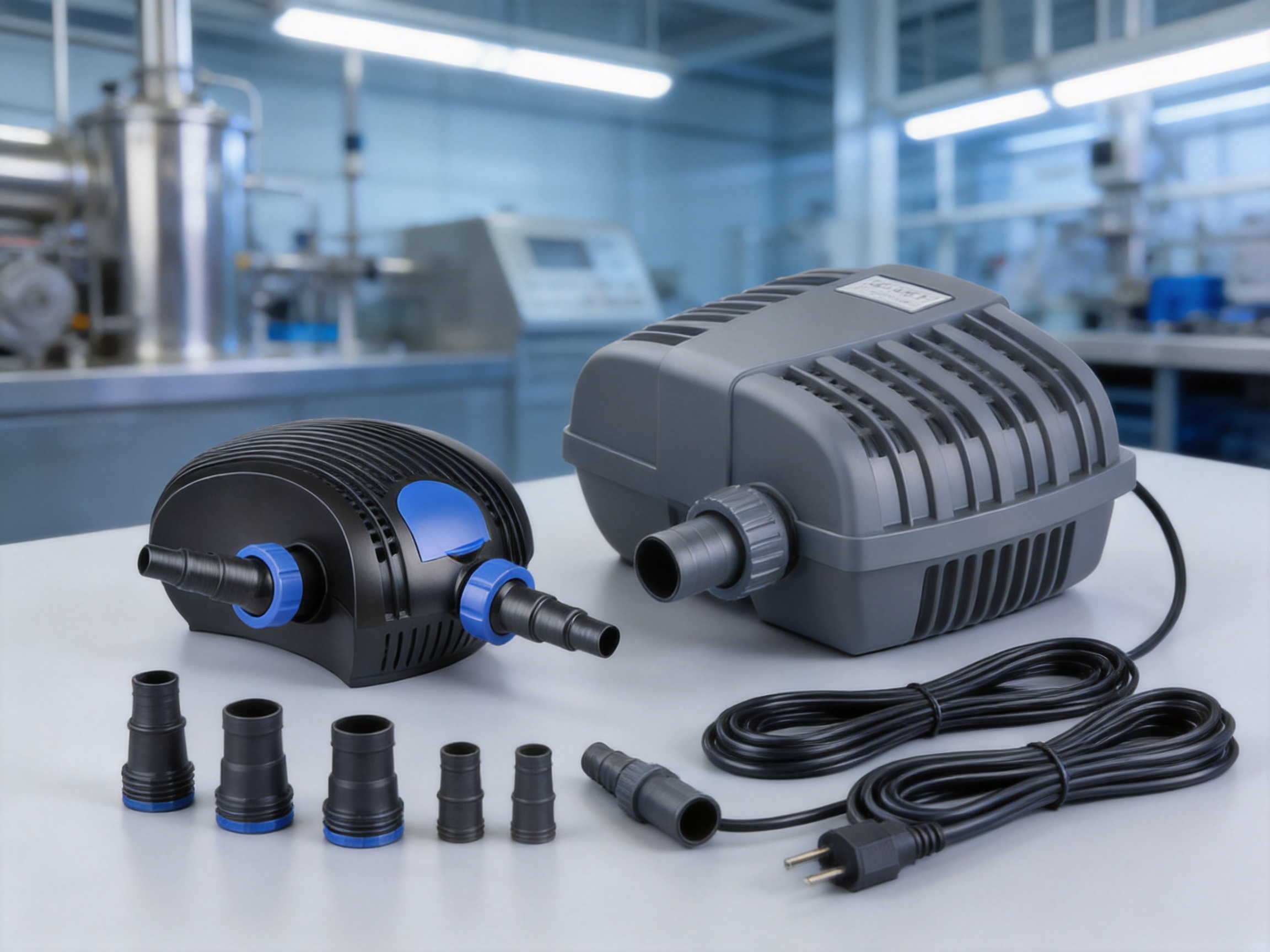
Direct performance comparisons with another manufacturer require equivalent test conditions and verified competitor data. However, the CFP Series has several design and specification advantages when compared with product ranges that offer only a limited number of models or fixed connection formats.
A narrow pump range may force users to choose a model that is either too small or unnecessarily large. The CFP Series reduces that problem by providing multiple steps between 900L/h and 18,000L/h. This allows a more precise match between pump output and system demand.
Some pumps are sold with one outlet size, requiring reducers, adapters, or additional fittings. The CFP Series includes several hose adapter sizes across most models. This makes the product more adaptable to existing pond plumbing and gives installers more freedom when designing the system.
With cable lengths increasing from 1.5 meters to 10 meters across the range, the series accommodates different installation layouts. This is especially useful for larger ponds and water features in which the pump may be located well away from the electrical source or control location.
Some basic pump listings emphasize only free-flow output. The CFP Series provides both output and maximum head information for each model. Presenting these two specifications together makes it easier for engineers, installers, and customers to evaluate whether a product is appropriate for a vertical lift or more demanding pipe arrangement.
A coordinated product family can reduce training requirements for distributors and installation teams. Once a technician understands the general installation principles of one model, those principles can be applied to other models in the same series, subject to the individual specifications. This can simplify product selection, maintenance planning, and replacement decisions.
Before installation, confirm the electrical supply, water conditions, hose sizes, required head height, and intended flow rate. The listed models are specified for 220V–240V and 50Hz operation. Users must verify that the local electrical system matches these requirements and that all electrical work complies with local regulations.
Place the pump on a stable, suitable surface or in the intended submerged position, depending on the final product instructions and application design. The pump should not be allowed to rest in loose sediment, where debris can enter the water path or restrict the intake. An appropriate pre-filter or protective screen may be needed in ponds containing leaves, gravel, algae, or other particles.
Use hose and pipe sizes that correspond to the pump’s adapters and the desired flow. Avoid unnecessary reductions in diameter, sharp bends, and excessively long runs. These restrictions increase resistance and may reduce the flow delivered to the outlet.
Measure the vertical distance from the pump water level to the highest discharge point. Then account for additional losses caused by filters, valves, elbows, manifolds, and outlet fittings. The maximum head value provides a reference point, but it should not be interpreted as the expected flow at every height.
Keep electrical connections protected from water. Use properly rated outlets, residual-current protection where required, and safe cable routing. Do not handle the pump, plug, or electrical connection with wet hands. Disconnect the electrical supply before moving the pump, opening a housing, cleaning components, or performing maintenance.
After installation, inspect all hose connections for leaks. Confirm that water is flowing correctly through the intended route and that the pump is not operating without sufficient water. Any unusual noise, overheating, vibration, or reduction in flow should be investigated promptly.
Regular maintenance helps preserve pump performance. The frequency depends on water quality, debris levels, algae growth, operating hours, and the presence of fish or plants. A pump in a clean filtration chamber may require less frequent cleaning than one located directly in a natural pond.
Disconnect the power before maintenance. Remove leaves, plant fragments, sludge, and other debris from the intake area. Inspect the hose and adapters for blockage, kinks, or damage. A blocked intake can restrict water flow and place additional stress on the pump.
If the product design permits access to internal components, inspect the impeller and water passage for deposits or foreign objects. Mineral buildup and organic debris can reduce performance. Clean components carefully and avoid using tools or chemicals that could damage seals, plastic parts, or electrical components.
Inspect the cable and plug periodically. Any sign of cracking, exposed conductors, water ingress, or mechanical damage should be treated seriously. Electrical repairs should be performed by qualified personnel using suitable replacement parts.
Seasonal conditions should also be considered. In climates where water can freeze, the pump should be protected according to the manufacturer’s instructions. Running a pump in freezing conditions may damage the housing or water path. In hot climates, ensure that the pump has adequate water coverage and that the installation does not expose it to excessive heat.
The CFP-900 is suitable for users who need a compact 900L/h pump, a 1.5-meter maximum head, and low rated power consumption of 20W. Its compact dimensions and 0.45-kilogram weight make it convenient for smaller water features.
The CFP-1500 increases output to 1,500L/h and maximum head to 1.8 meters while using 25W. It is a logical choice for a somewhat larger pond, small waterfall, or compact filtration system that needs additional circulation capacity.
The CFP-2000, CFP-2500, and CFP-3000 offer a mid-range progression. Their outputs are 2,000L/h, 2,500L/h, and 3,000L/h, while maximum heads are 2.0, 2.7, and 3.0 meters respectively. These models include 5-meter cables and 20/25/32mm hose adapter options, making them useful for a wider range of garden pond and filtration layouts.
The CFP-8000, CFP-9000, and CFP-10000 are designed for substantially higher flow. They provide 8,000L/h, 9,000L/h, and 10,000L/h, with maximum heads of 3.2, 3.6, and 5.0 meters. Their 10-meter cables and 25/32/38mm adapter options support larger installations.
The CFP-13000/A, CFP-15000/A, and CFP-18000/A are the high-capacity models in the supplied range. Their outputs extend from 13,000L/h to 18,000L/h, and their maximum heads range from 5.2 to 6.2 meters. They offer 25/32/38/50mm hose adapters and 10-meter cables, making them suitable for larger ponds, wide waterfalls, substantial filter systems, and high-volume circulation duties.
| Application Requirement | Recommended Selection Approach |
|---|---|
| Small decorative feature | Consider the CFP-900 or CFP-1500, subject to actual head and pipe resistance. |
| Medium pond or compact waterfall | Compare the CFP-2000, CFP-2500, and CFP-3000 according to required lift and flow. |
| Large garden pond | Evaluate the CFP-8000, CFP-9000, or CFP-10000 based on filter resistance and waterfall height. |
| High-volume pond circulation | Consider the CFP-13000/A, CFP-15000/A, or CFP-18000/A for demanding flow requirements. |
| Long-distance installation | Review the models with 5-meter or 10-meter cables and confirm safe electrical routing. |
| Large-diameter plumbing | Select a model with an adapter size compatible with 38mm or 50mm hose requirements. |
The CFP Series can provide commercial value beyond the performance of an individual pump. For distributors, a complete capacity range makes it possible to serve several customer segments using one coordinated product family. Small retailers can offer an entry-level pump, while pond specialists can stock higher-capacity models for professional installations.
Product-family consistency can also simplify catalog management. The key specifications are presented in a common format: model, voltage, frequency, power, maximum head, output, hose adapter, cable length, weight, and dimensions. This makes it easier to prepare quotations, compare models, create product listings, and advise customers.
For project suppliers, the range supports different phases of a water-feature design. A small circulation pump may be used for a demonstration system, while a larger model may be required for the final pond or commercial installation. Having access to a broad range can reduce the need to redesign the system around a completely different product family.
The company’s experience in aquarium products, aquatic machinery, industrial equipment, and international business also provides a foundation for serving OEM, wholesale, and project-based customers. Specific customization, packaging, certifications, documentation, and order quantities should be confirmed directly for each project.
Sensen Group Co., Ltd. operates from No. 61–79, Baima Street, Maao Town, Dinghai District, Zhoushan City, Zhejiang Province, China. The company states that it has continued innovating in aquarium pets, aquaculture machinery, industrial equipment, and related industries since its establishment in 1985.
The organization includes the Sensen Research Institute, Sensen Business School, Quality Control Department, personnel and administrative information functions, and financial operations. This combination suggests that product development, employee training, quality management, administration, and commercial planning are integrated into the company’s wider operating structure.
The company also reports wholly owned subsidiaries including ZHOUSHAN GRECH, ZHEJIANG JIALU, JIANGSU SENSEN, CHONGQING SENSEN, ZHONGSHAN SENSEN, TIANJIN SENSEN, ROLL-TAIL PET COMPANY, and MARINE ORIGANISM. It also maintains an import and export company and holdings in several trading companies. This network can support broader manufacturing and distribution activity.
A company’s ability to remain active over several decades is especially relevant in equipment categories that require manufacturing knowledge and market support. Water pumps are not disposable accessories in many pond systems; they are operating components expected to function over extended periods. Supplier continuity, technical documentation, replacement planning, and communication can therefore influence the total value of the product.
The company’s stated development direction includes industrial technicalization, marketing globalization, and brand internationalization. These objectives align with the needs of international buyers who require standardized specifications, export coordination, consistent quality, and product availability across different markets.
No pump should be selected solely from its nominal output. The values listed for the CFP Series should be matched to the real operating conditions. A professional installer should calculate or estimate system resistance, including vertical lift, pipe length, bends, valves, filters, and discharge fittings.
The supplied specifications list the electrical operating range as 220V–240V and 50Hz. Customers in regions using different electrical standards should confirm compatibility before ordering. Any required electrical certification, plug configuration, control method, or frequency compatibility should also be verified for the destination market.
The product title identifies the range as a frequency variation pump, but the supplied specification table lists 50Hz operation for each model. Buyers requiring adjustable operating frequency or external speed control should request detailed technical confirmation before integrating the pump with a controller.
Environmental suitability should also be confirmed. Water temperature, water chemistry, salt content, suspended solids, continuous-duty requirements, and installation depth can affect pump suitability. The product should be used within the conditions stated in its technical documentation and applicable safety instructions.
The CFP Series is designed for pond water circulation and transfer. Depending on the model, it can support garden ponds, waterfalls, streams, filtration systems, water walls, reservoirs, aquatic displays, and other water-management applications.
The smallest listed model is the CFP-900. It has a rated output of 900L/h, a maximum head of 1.5 meters, rated power of 20W, a 1.5-meter cable, and dimensions of 106×64×95mm.
The CFP-18000/A is the largest listed model. It provides 18,000L/h output, a maximum head of 6.2 meters, rated power of 315W, a 10-meter cable, and 25/32/38/50mm hose adapter options.
The CFP-8000, CFP-9000, CFP-10000, CFP-13000/A, CFP-15000/A, and CFP-18000/A are listed with 10-meter cables.
The CFP-13000/A, CFP-15000/A, and CFP-18000/A are listed with 25/32/38/50mm hose adapter options.
The listed output and maximum head are separate reference specifications. Actual flow at a given height depends on the pump curve and the resistance of the complete system. Customers should request the relevant performance curve or technical confirmation for a precise design.
The supplied table lists all models as 220V–240V and 50Hz, but their power ratings differ from 20W to 315W. Buyers should verify the exact electrical requirements, plug arrangement, protection requirements, and destination-market documentation for the selected model.
First determine the vertical height, waterfall width, desired visual flow, pipe length, and fittings. Then select a model with adequate maximum head and output after accounting for system resistance. A larger hose diameter may help reduce friction in a high-flow installation.
Yes, the range is suitable for consideration in pond filtration and water-circulation systems, provided the selected model matches the filter’s required flow, head, connection size, and operating conditions.
Yes. The series extends from 900L/h to 18,000L/h, giving users and distributors several upgrade or replacement options within one product family. Any replacement should still be checked for electrical, hydraulic, and physical compatibility.
The main advantages are its broad capacity coverage, multiple hose adapter sizes, increasing head performance, longer cables on larger models, and consistent specification structure. These features give users more flexibility when planning different pond and water-feature installations.
The CFP Series is manufactured by Sensen Group Co., Ltd., a Chinese company with stated experience in aquarium products, aquaculture machinery, industrial equipment, and related industries.
Buyers should contact the manufacturer or authorized supplier for performance curves, installation instructions, certifications, packaging details, replacement parts, controller compatibility, and destination-market requirements.
The CFP Series Frequency Variation Pump provides a broad and practical solution for pond circulation, filtration, waterfalls, streams, water walls, aquaculture support, and related water-equipment applications. Its most significant advantage is the range itself: users can choose from compact 900L/h models to high-volume 18,000L/h equipment, with progressively higher maximum head ratings and connection options suited to different installations.
Additional strengths include multiple hose adapter sizes, cable lengths of up to 10 meters on larger models, a structured specification system, and a selection of power ratings intended for different water-moving requirements. Compared with narrower pump ranges, this product family can simplify product selection, distribution, system design, and replacement planning.
The company behind the product contributes further value through long-term industry experience, research and development activity, dedicated quality-control functions, a broad subsidiary structure, and international market capabilities. These organizational strengths support the production and distribution of equipment for aquarium, pond, aquaculture, garden, and industrial applications.
For the best result, users should select a model according to actual head height, desired flow, hose diameter, filter resistance, cable-routing requirements, water conditions, and electrical standards. With these factors properly evaluated, the CFP Series can provide a flexible foundation for efficient and dependable pond water circulation.
Sensen Group Co., Ltd. Product specification sheet for the CFP Series Frequency Variation Pump.
Sensen Group Co., Ltd. Corporate information and company development overview.
CFP Series model data covering voltage, frequency, power, maximum head, output, hose adapters, cable length, weight, and dimensions.
General principles of pond hydraulic design, pump selection, pipe-resistance evaluation, and water-feature circulation planning.
General electrical safety practices for water pumps, pond equipment, outdoor installations, and aquatic filtration systems.


 No. 61-79, Baima Street, Maao Town, Dinghai District, Zhoushan City, Zhejiang Province, China.
 0086 580 8082088 / 8081168
 0086 580 8080978
 songhua@sunsun-china.com